|
| China |
| New rules to reduce emotional dependency on AI | |
|
|
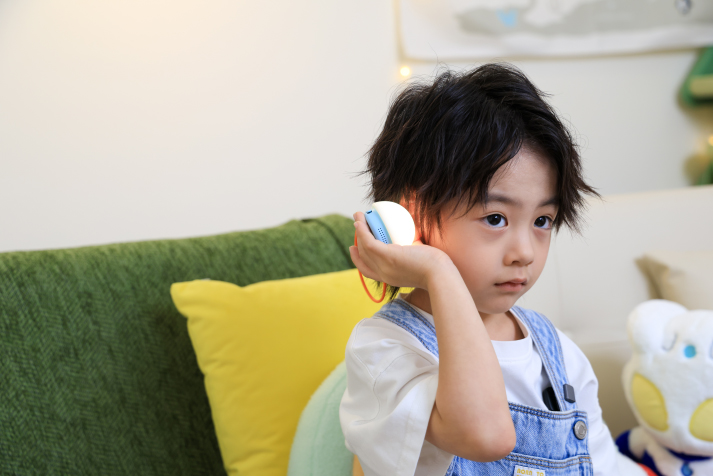 A child plays with an AI toy at a hi-tech company in Shenzhen, Guangdong Province, on October 31, 2025 (XINHUA) On a quiet July morning this year, Chen Xiulan, a 78-year-old retired teacher living in Changchun, Jilin Province, spoke gently to her smart speaker, just as she had done every day for the past two years. "What's the weather like today? What should I wear?" she asked. Within seconds, a warm, synthesized voice responded. The old woman nodded and murmured "Thank you." It had become a habit natural to her. Her daughter Wu Min gave her the speaker as a birthday gift. At first, Chen found it odd. She had never chatted with machines. But little by little, she got used to having it around. Later, her daughter walked her through using the AI assistant on her phone. Wu jotted down the steps in large, clear print on a sticky note: "Hold down this round button, talk, then let go" and stuck the note to the back of the phone case so that she would not forget. Chen has made many queries: Can I have sweet potatoes for breakfast with diabetes? Is it safe to take my blood pressure medication with cold medicine? Why are my clivia's leaves turning yellow?... And the AI always came back with thoughtful, well-organized answers.
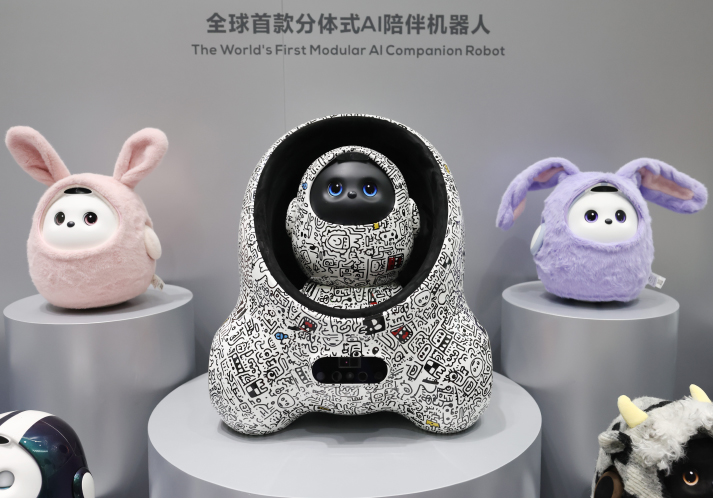
AI companion robots on display at the China International Supply Chain Expo in Beijing on June 23 (XINHUA) A patient companion To Chen, the AI is more than just a gadget; it's a companion that doesn't get impatient when she asks the same thing over and over because of her poor memory, and that never hurries her along when she fumbles for words. "My children have their own lives and can't always be by my side. But with this little AI speaker around, I feel much more at ease," she told Beijing Review. Chen's experience reflects a growing trend among seniors who find comfort in AI companionship, yet they are by no means the only age group seeking such connection. From children to professionals, people across generations are increasingly turning to AI for conversation, reassurance, or simply a non-judgmental ear. According to big data intelligence service provider QuestMobile's 2025 China Mobile Internet Annual Report, by the end of 2025, monthly active users of mobile AI apps in China had hit 722 million. A closer look at user behavior is offered by a 2025 report conducted by Just So Soul, the research institute of Chinese social networking platform Soul App. The report revealed more than 50 percent of young adults turn to AI for help with studying, work and content creation, while close to 40 percent depend on AI for emotional connection on a daily basis. Regulation in place While AI companion services, which have been used in areas ranging from customer service and mental health support to childcare and elderly care, have gained popularity by simulating human personalities and conversation, concerns over emotional dependence and other risks have emerged. Researchers warn that AI's tireless, unconditional responses may make real-world relationships feel harder to navigate, though effects vary by individual. In 2025, the China Youth and Children Research Center surveyed more than 8,500 minors across the country. The results showed that over 60 percent of the respondents had used AI, and that more than 20 percent of the respondents said they "only want to chat with AI and do not want to talk with real people." Children and older adults are more prone to developing emotional attachments to it because AI is always available, endlessly patient and unfailingly compliant, Wang Zhechen, an associate research fellow at the Department of Psychology, School of Social Development and Public Policy at Fudan University in Shanghai, told Xinhua News Agency. Moreover, a two-year Finnish study of nearly 2,000 AI chatbot users revealed in April that while AI companions can ease loneliness, long-term use is linked to increased anxiety, depression and other negative emotions. Such risks have fueled calls for tighter regulation. On July 15, China rolled out a set of regulations aimed at curbing emotional dependence on AI-powered companion bots, as part of efforts to regulate this rapidly growing sector. The rules, China's first of its kind, were jointly formulated by the Cyberspace Administration of China and four other government bodies. The rules require platforms to detect emotional distress, intervene in crisis situations, limit excessive use, give users full control over their personal data and prevent the misuse of user information. The rules define AI companion services as those offering "sustained emotional interaction" through text, images, audio or video, while excluding task-oriented AI applications such as customer service, work assistance, education and scientific research. They explicitly make it clear that service providers offering anthropomorphic AI interactions are required to clearly mark AI-generated content and proactively remind users that they are engaging with an AI, not a human being. When users exhibit signs of excessive dependence or addictive behavior, providers must give a noticeable alert—for example, through a pop-up—stating that the content is generated by AI. Furthermore, whenever a user has been continuously interacting with the service for more than two hours, the provider should send a reminder about the usage time, either through a chat message or a pop-up notification. When a user requests to discontinue the service, the service must stop immediately. Providers are not allowed to obstruct users from leaving by continuing to engage them in interaction, the rules stipulate. The rules will encourage companies to shift their focus from maximizing user immersion and engagement to developing healthier and more responsible human-AI interaction models, thereby helping channel resources toward socially valuable applications and supporting the industry's orderly development, according to Chen Liang, Dean of the School of AI and Law at the Southwest University of Political Science and Law in Chongqing Municipality. Companies have already taken action. China's major AI content-generation platforms, including Doubao, Qwen and Yuanbao, have recently announced the suspension of their AI agent features, such as customized virtual romantic companions, AI recreations of the deceased and chatbots built around any specific character profile. These AI agents were fully customizable—users could tailor their personalities, rules and abilities as they saw fit. They could set everything from identity and tone to professional domain and communication style. Each agent had its own independent conversation history, meaning users could switch between different agents without any crossover or confusion in context. "When users begin to confuse virtual emotional connections with real-world relationships, systems should provide appropriate reminders: 'This is a machine, not a real person,'" Liu Xiaochun, an associate professor at the University of Chinese Academy of Social Sciences in Beijing, told Xinhua. She said she believes these users should be encouraged to spend more time interacting with people in the real world and talking with their friends and family. "Human communication involves emotional resonance; and it can bring frustration, challenges and pressure. But when you talk to AI, it is always there to satisfy you instantly, without any real emotional exchange," Shanghai-based psychologist Wu Sihui told Beijing Review. "If we rely too heavily on AI companionship over time, we risk losing our ability to perceive others' emotions, which can ultimately impair our social functioning." (Print Edition Title: The Digital Confidant) Copyedited by G.P. Wilson Comments to luyan@cicgamericas.com |
|
||||||||||||||||||||||||||||
|