
|
| China |
| China's coffee capital | |
|
|
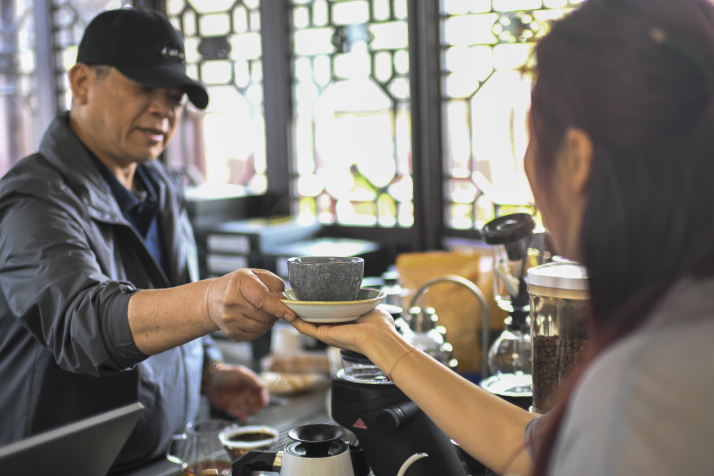 A customer buys coffee at a café renovated from an old factory building in Kunshan on April 1 (VCG)
Without a single coffee tree in sight, Kunshan, a city in Jiangsu Province, has built a 100-billion-yuan ($14 billion) coffee industry entirely from scratch, a remarkable feat for a city with no history of coffee cultivation. Situated in the heart of the Yangtze River Economic Belt, just a 20-minute high-speed rail ride from Shanghai, Kunshan was long globally renowned as an electronics manufacturing powerhouse: At its peak, one out of every three laptops worldwide was manufactured there. Today, it has a new title: China's International Coffee Industry Hub. The city now processes and roasts 60 percent of the nation's coffee beans, yielding enough for 10 billion cups a year. In effect, the majority of coffee consumed across China comes from the storage and roasting facilities in Kunshan. Kunshan is home to more than 600 cafés, a striking figure for a county-level city. Coffee has interwoven itself with the local heritage, fostering a distinct coffee culture uniquely native to Kunshan. 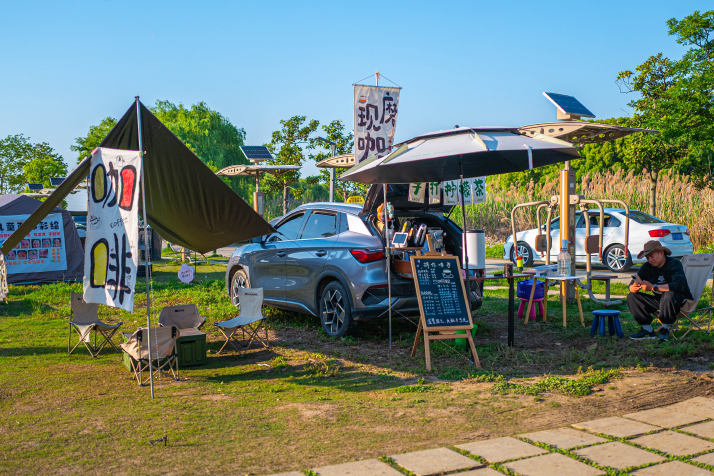 A coffee stall set up inside a scenic resort area in Kunshan, Jiangsu Province, on May 4 (VCG)
Building a coffee chain Now 48, Yu Congjie stands as both a witness to and a catalyst for the meteoric rise of Kunshan's coffee industry. Eleven years ago, he traded the security of a career in the civil service for the precarious path of an entrepreneur, opening his own café in Kunshan. He spent a full year systematically studying the craft before taking the leap. In 2015, Yu became one of the first certified coffee trainers in China, and by that October, his café opened its doors. But market realities proved unforgiving. "Back then, big coffee chains dominated public awareness; specialty coffee and independent cafés were alien concepts to the average consumer," Yu told Suzhou Daily newspaper. That year, the national survival rate for independent cafés hovered at a stark 4 percent, and many Kunshan locals struggled to distinguish pour-over brew from instant coffee. Undeterred, Yu launched low-cost pour-over workshops, patiently educating the public and building a devoted following from the ground up. To carve out a distinct identity and root his business deeply in Kunshan's cultural fabric, Yu began infusing his offerings with local heritage. He incorporated regional dialects and Kunqu opera—one of China's oldest surviving performing arts, originating in Kunshan—into his packaging design. This includes a dialect-themed gift set featuring 10 drip-coffee bags, each printed with a local idiom alongside pinyin (the official Romanization system for standard Chinese) and English phonetic transcriptions, as well as a separate Kunqu opera series showcasing 10 distinct character illustrations that match specific opera pieces with tailored coffee processing methods. On the back of each bag, a QR code allows drinkers to scan and listen to a traditional aria while enjoying their brew. As Kunshan's coffee supply chain matures, Yu has leveraged the city's trade infrastructure to source high-quality beans from across the globe. As cafés have proliferated across the city, his role has expanded alongside the industry. Now serving as vice president of the Kunshan Coffee Association, Yu plays a pivotal role in refining the local ecosystem. In 2024, he spearheaded an effort to relocate the national finals of the ABrC Pour-over Coffee Competition from a major metropolis in the Pearl River Delta to Jijiadun, a village in Kunshan's Jinxi Town. It was the first time a national coffee championship was hosted in rural China. Yu's personal evolution from a lonely pioneer introducing pour-overs to a leader championing rural coffee culture mirrors the extraordinary trajectory of Kunshan itself—its rise from a specialty-coffee desert to a powerhouse controlling a significant share of China's coffee trade. "Kunshan's approach to cultivating its coffee industry directly mirrors the blueprint that built its electronics empire in the 1990s," Shao Zhiqiang, Deputy Director of the Kunshan Comprehensive Bonded Zone Management Bureau, told International Business Daily newspaper. He recalled how municipal technicians back then would strip down a laptop component by component. They cataloged thousands of parts to pinpoint exactly what wasn't being made locally, turning those supply chain gaps into targeted investment goals. That surgical "chain-filling" strategy eventually built a comprehensive IT ecosystem, and the city applied the same precision to coffee. Following a systematic audit of the coffee value chain, Kunshan chose to anchor its strategy at the absolute foundation: storage of raw coffee beans. "In the past, without specialized facilities to manage the strict humidity levels green beans require, most imported coffee arrived as semi-finished or finished products," Shao said. To solve this, Kunshan broke ground on a dedicated coffee bean storage and distribution center in 2022, opening China's first standardized, professional green-coffee warehouse the following year. From that anchor, the city rapidly expanded into roasting, platform trading and brand retail. The move paid off: Starbucks chose the hub as the site for its primary roasting facility in China, and industry giants like Luckin Coffee quickly followed suit, making Kunshan one of the major bases for their roasting operations. The entire supporting supply chain functions with synergy. Kunshan Customs has tailored bespoke clearance protocols specifically for imported coffee, allowing 90 percent of green beans entering the zone to be released upon declaration and dramatically slashing wait times. Once cleared, the beans move straight into state-of-the-art, climate-controlled storage facilities. As soon as a roasting order lands, they leave the distribution center and arrive at any local roasting plant within a 30-minute drive, quickly entering the production line. Brewing more than coffee For Ma Junxia, running a café in the burgeoning "Coffee Capital" is about far more than just serving drinks. A Kunshan native whose journey began with a modest coffee studio driven by personal passion in 2019, Ma now sees his space as a bridge between coffee culture and everyday life. His goal is to foster an inclusive hub where local enthusiasts can gather, while offering tailored, professional training for those looking to master the craft. "I grew up in the old town, so I have a deep bond with this neighborhood," Ma told Suzhou Daily. That personal connection explains why all three of his cafés are rooted in Kunshan's historic core. In recent years, the area has seen a surge of new coffee shops, each bringing its own distinct blend of community warmth and creative flair. What started as a small team with just a few people has now grown to over 60 employees with its own roastery. Today, his brand serves as a roasted bean supplier and technical consultant for over 100 local shops in Kunshan and more than 1,000 independent cafés across China. The business has also trained over 100 students, many of whom have launched their own ventures or built careers in the industry. In many ways, Ma's business mirrors Kunshan's broader industrial rise. From green bean roasting and barista training to retail management, he has quietly built a self-sustaining "mini-ecosystem" in which every supply-chain link reinforces the next. Copyedited by G.P. Wilson Comments to yuanyuan@cicgamericas.com |
|
||||||||||||||||||||||||||||
|








