
|
| China |
| Following the red star | |
|
|
 Iain Inglis takes photos at the Guluhai Flower Sea Park in Luding County, Sichuan Province, on July 5 (WEI YAO)
This July, I was invited to take part in a tour commemorating the 90th anniversary of the conclusion of the Long March across west Sichuan Province, organized by China International Communications Group. The event turned history into real-life experience, leaving me with plenty of questions about human courage, belief and endurance. From textbook to terrain Having lived in China for 22 years, I have picked up a solid working knowledge of the country's modern revolutionary history. For decades, this history existed for me only in books, exhibition displays and documentaries. I understood the timeline, key battles and broad historical importance of the Long March, but I had never fully grasped its human cost. Our journey began in the urban calm of Chengdu, a prosperous modern city that feels far removed from the rugged frontier landscapes of west Sichuan. Within hours, flat plains had given way to winding mountain roads, steep ridges and fast-flowing glacial rivers, changing the mood of the trip entirely. My clearest shift in perspective came at Luding Bridge, one of the most famous landmarks of the Long March. I had read about the 1935 Battle of Luding Bridge before, but standing on the iron chain structure and staring down at the churning Dadu River below stripped away all my hitherto detached, "textbook" understanding. The visitor center's virtual reality exhibits recreated the fierce assault on the bridge, conveying the sheer boldness of the Red Army's advance. Thirteen bare iron chains, no protective planks, enemy fire sweeping the gorge and exhausted soldiers pushing forward regardless. The raw desperation for survival was what struck me most. Edgar Snow, an American journalist known for his books and articles introducing the Chinese communist revolution in the 1930s, captures the audacity of this make-or-break offensive in Red Star Over China: "The crossing of the Dadu River was the most critical single incident of the Long March. Had the Red Army failed here, quite possibly it would have been exterminated." Standing there, I saw that these soldiers were not fighting for praise or status, but because inaction would have meant certain defeat. What lingers most is how ordinary they were. History frames them as "revolutionaries" and "heroes," but they were young, worn-out people making impossible choices under unbearable pressure. It was here that I began to wonder what inner drive pushed "everyday" people to keep going, when logic or instinct would otherwise have caused them to stop. Mountains, marshes and solidarity Moving westward toward Xiaojin County and the high-altitude passes of the Jiajin Mountain, the nature of the tour moved my focus from military strategy to human resilience. Most historical accounts prioritize victories and breakthroughs, yet the Long March's most staggering feature is its sustained suffering. Altitude sickness affected our group despite modern transport, warm clothing and plentiful supplies, not the least of which were canisters of oxygen on demand. Even with every modern convenience, the thin air and winding mountain roads left some of us fatigued. It forced a sobering comparison: The Red Army crossed these same passes on foot, in ragged uniforms, with minimal food, no shelter and no certainty of safe passage. Thousands perished from exposure, exhaustion and altitude-related illness, their names unrecorded, their stories uncelebrated. Snow's firsthand observations on the Red Army's youthful character help to explain their unusual resilience, a detail often overlooked in standard historical summaries: "Though tragedy had touched the lives of nearly all of them, they were perhaps too young for it to have depressed them much. They seemed to me fairly happy, and perhaps the first consciously happy group of Chinese proletarians I had seen." This youthful optimism goes a long way toward explaining why so few deserted. These recruits were not professional soldiers. They were farmers, laborers and students who joined a movement that offered dignity and fairness after lifetimes of exploitation. They fought for a better future the likes of which they had never seen. To abandon the march would have meant letting go of the only hope they had. In Xiaojin, local heritage sites anchor abstract strategic history in tangible, everyday terrain. Our visit to the Lianghekou Meeting site offered clarity on the human uncertainty behind the Long March's major turning points. In June 1935, after the first and fourth front armies of the Red Army met in this remote highland valley, senior commanders gathered here to resolve a critical strategic divide, settling on a unified northward advance to build new base areas and continue the revolutionary struggle. Standing in that mountain setting, it was easy to grasp why such decisions carried such weight: This isolated, rugged landscape offered little room for hesitation or error. Nearby, at the Baxi Meeting site, a local historian walked our group through the finer details of the pivotal conference in September 1935 that reshaped the Red Army's strategic direction, explaining how local villagers sheltered exhausted soldiers, shared scarce food supplies and guided lost troops through unmarked mountain paths. These minor acts of community support helped me to understand how the Red Army sustained momentum through stretches of profound strategic and geographical uncertainty. These local stories also helped me to answer a question I had long held: Why the Red Army earned such strong support from rural communities, while the Kuomintang troops did not. Snow documented this key behavioral and ideological divide in his field notes: "What discipline they had seemed almost entirely self-imposed… [W]hen we passed private orchards, nobody touched the fruit in them, and the grain and vegetables we ate in the villages were paid for in full." This was the core difference between the two forces. The Kuomintang troops often treated villagers as resources to exploit. The Red Army built strength through respect and reciprocity. Their considerate approach built a community solidarity strong enough that locals risked harm to shelter and support the marching troops, even when victory looked unlikely. The most affecting segment of the tour came when we reached the vast Zoige Marshland. It stretches endlessly to the horizon: flat, waterlogged and deceptively barren. Many troops perished here not from battle wounds, but from starvation, hypothermia and drowning in hidden swamp bogs. They did not die in dramatic combat, but slowly, silently, swallowed by the unforgiving landscape. Snow's unflinching original account of the grassland crossing remains the definitive portrayal of this brutal, overlooked ordeal: "In the Grasslands there was no human habitation for ten days. Almost perpetual rain falls over this swampland… There was no firewood; they were obliged to eat their wheat green and vegetables raw. There were no trees for shelter, and the lightly equipped Reds carried no tents. At night they huddled under bushes tied together, which gave but scant protection against the rain." I began to understand why survivors often describe the grasslands as the hardest segment of the Long March. Battles offered a chance to fight back; the grasslands offered no opposition, no aid, no reprieve, only unrelenting hardship. Standing there, my questions about persistence felt most urgent. What stopped exhausted, starving soldiers from giving up entirely? Talking with Luo Jianguo, I found an unspoken answer. Luo's father was a Long March veteran, and he has dedicated his entire adult life to tending the graves of unknown soldiers who died crossing the grasslands. He does not do this for recognition or reward. He does it out of simple remembrance, a promise to preserve the names and sacrifice of soldiers who have never returned home. His devotion revealed the invisible bond that sustained the Red Army: collective responsibility. Soldiers kept marching not only for their own survival, but for their comrades, for the villagers who sheltered them, and for the unseen future that they hoped their suffering would build. Desertion meant breaking that fragile, sacred trust. 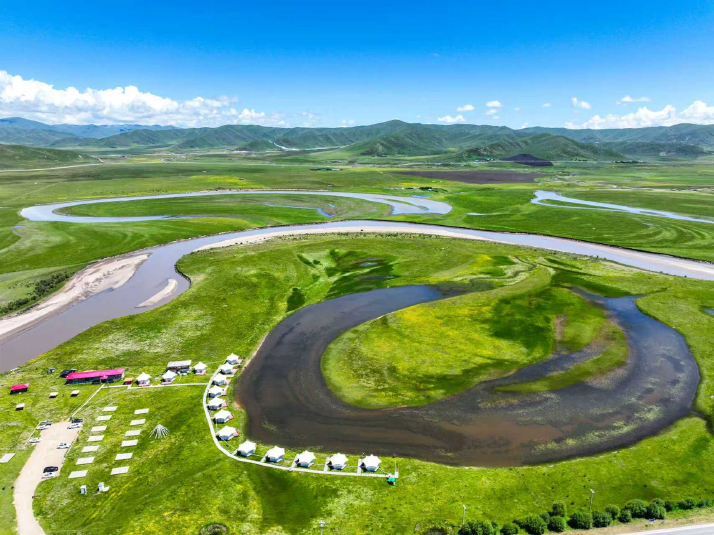 The winding rivers and marshland in Zoige County, Aba Tibetan and Qiang Autonomous Prefecture, Sichuan Province, on July 8. In August 1935, the Red Army traversed this perilous marshland, often referred to as the "death trap," during the Long March (WEI YAO)
The march continues One of the most surprising parts of the trip was seeing revitalization of rural areas along the Long March route. Villages like Xiahalama and Chuni weave revolutionary heritage into sustainable local development, running homestays, selling regional produce and welcoming tourists. Young residents are not stuck dwelling on the past. They are building stable, modern livelihoods rooted in their local history and landscape. Sitting in a village homestay, drinking a cup of coffee while gazing at grasslands once crossed by starving soldiers, I felt a faint sense of resolution. The Long March generation's sacrifices were never meant to preserve suffering. They were meant to build a world where ordinary people could live stable and dignified lives. Returning to Chengdu at the end of the tour, I revisited the questions that had stayed with me throughout the journey. I still have no clear, final answers for why ordinary people endured such extreme hardship, why they refused to desert, and what sustained them through unthinkable conditions. Even so, I have gained a deeper, more empathetic understanding of the Long March as a human story, rather than simply as a political or military event. Snow's work ultimately shows that revolutionary history is shaped by ordinary people choosing to persist through extraordinary difficulty. After walking these Sichuan routes, that observation feels all the more palpable. The Long March's legacy lives beyond monuments and textbooks. It endures in the community spirit of west Sichuan's villages, the quiet dedication of local heritage guardians and the stable, prosperous lives modern residents enjoy. Ninety years on, the march continues, not as a desperate retreat, but as steady forward progress built on the courage of generations past. BR The author is a British linguist and bilingual presenter based in Hainan Province Copyedited by Elsbeth van Paridon Comments to taozihui@cicgamericas.com |
|
||||||||||||||||||||||||||||
|