
|
| China |
| Seeds of success | |
|
|
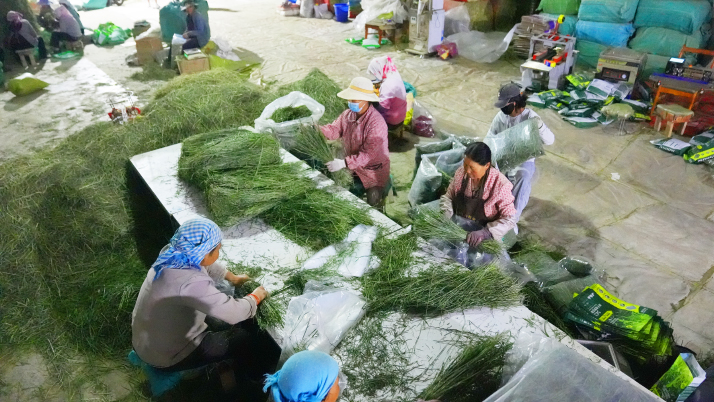 Villagers pack dried timothy grass inside the warehouse of the Minxian Green Grass Growing Farmers' Cooperative in Minxian County, Gansu Province, on July 16 (COURTESY PHOTO)
The scent of dried timothy grass fills the warehouses of Minxian County in Gansu Province—a fragrant testament to a remarkable agricultural transformation. Once a secondary feed for racehorses, this humble grass has become a lucrative driver of China's booming pet economy, with Minxian positioned as the undisputed champion of the national market. Minxian holds great significance in the history of the Long March (1934-36). When the Red Army's second and fourth front armies arrived there in August 1936, locals demonstrated extraordinary generosity, donating over 2 million kg of grain and substantial military supplies. The Red Army rested in Minxian for 57 days, from August 8 to October 4. This vital period led to significant physical recovery and the replenishment of their ranks, with over 3,000 new soldiers joining, laying a critical foundation for their northward advance. It is for these indelible contributions that Minxian earned its moniker: the "Long March's Refueling Station." It was within this land of historical resonance that a "modern-day Long March" has unfolded over the past two decades. During a recent visit to the county as part of the Together on the Long March international outreach initiative organized by China International Communications Group, a delegation of Chinese and foreign experts and media professionals toured the Minxian Green Grass Growing Farmers' Cooperative. Their immersion into the local timothy grass industry offered insight into rural revitalization. 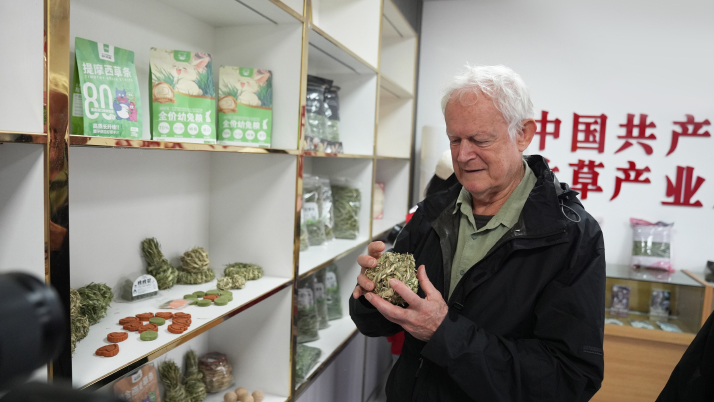 A participant in the Together on the Long March: 90th Anniversary of an Epic Journey international communication project organized by China International Communications Group visits the Minxian Green Grass Growing Farmers' Cooperative on July 16 (COURTESY PHOTO)
From crisis to e-commerce Timothy grass, originally introduced from the U.S. in the 1940s as fodder for military horses, has undergone a metamorphosis. Fueled by the pet economy's explosive growth, its high fiber and nutritional properties have transformed it into premium feed for a rapidly expanding population of exotic pets like chinchillas and hamsters. Today, 80 percent of China's timothy grass originates from Minxian, and its products are exported globally. Lilin Village was among the first in Minxian to embrace large-scale timothy grass cultivation. Wang Wenjuan, a native of the village, recounted the extreme poverty of her childhood. "The land yielded meager harvests of potatoes and wheat. Survival was a daily struggle," she told China Report magazine. The turning point arrived in 2005 when Lilin decided to develop a timothy grass industry. In 2006, under the leadership of Wang Caizhong, then the village branch secretary of the Communist Party of China, villagers embarked on a trial planting, yielding promising results in the first year. Timothy grass, a perennial plant, can produce harvests for at least six years after a single planting. Its ease of management and suitability for rotation with medicinal herbs made it an ideal crop. Wang Caizhong established the Minxian Green Grass Growing Farmers' Cooperative in 2013, offering a safety net by guaranteeing the purchase of timothy grass at market prices. However, the primary bottleneck remained in sales. For a prolonged period, farmers were dependent on downstream merchants, with virtually no say in pricing. The situation reached a crisis point between 2016 and 2018, when an oversupply led to a substantial portion of the cooperative's timothy grass remaining unsold. It was amid this crisis that Wang Wenjuan, then a university graduate teaching in Xi'an, Shaanxi Province, began to ponder deeply how she could help her hometown. She made the resolute decision to return. Upon her arrival, the cooperative's inventory obstructed the warehouse entrance. Adding to the woes, continuous rain threatened the grass. Freshly harvested timothy grass requires immediate processing; if not dried the day after harvesting, it will turn yellow by the third day. Facing immense pressure, she and her family took out a substantial loan to purchase natural gas drying equipment, an investment intended to help the entire village with processing. But the ultimate challenge persisted: How to sell the grass. Wang Wenjuan turned to e-commerce. With no one in the village understanding it, she began learning from scratch, studying online until the early hours. The village also lacked a courier service; her family would pack goods until midnight, then rely on villagers for rides to the county town to ship the products. She later learned to drive a variety of vehicles to handle the shipping. Over the next two years, her efforts bore fruit. She sold all the village farmers' unsold timothy grass. With sales channels expanded, the dividends of development began to ripple back into the countryside. Gansu Jiazhiyuan Agricultural Development Co. Ltd., founded by Wang Wenjuan in 2021, now regularly employs 50 people, expanding to over 200 during harvest season. The company also provides jobs for villagers with disabilities and those around 70 years old. Youthful ambitions bloom The burgeoning success of the timothy grass industry has also reshaped the career aspirations of the region's youth. He Hongbin, another Lilin resident, exemplifies this new generation. In 2023, during his first year of university, he began exploring the creation of online stores, moving his parents' wholesale business online. Later, he realized that simply selling raw timothy grass offered limited added value. He understood that transitioning into the mid-to-high-end market was essential for greater profit growth. Observing the pet market, he noted the steady expansion of the exotic pet market segment in China. In 2025, He registered a new brand targeting the mid-to-high-end rabbit food market. Leveraging his e-commerce experience, he achieved an impressive annual sales revenue of 2 million yuan ($299,440) for his rabbit food products within just one year. Meanwhile, with government support, Wang Wenjuan has since spearheaded school-enterprise collaborations with universities including Lanzhou University and Gansu Agricultural University. These partnerships combine the company's resources with universities' technical expertise, promoting the rapid transformation of scientific research into practical applications. Wang Wenjuan has also been exploring overseas markets. She successfully registered Minxian's first cross-border e-commerce store on Amazon. In September 2023, she received the first timothy grass order from North America. At the 2024 Beijing International Pet Expo, she also received an order from Southeast Asia. William N. Brown, a professor of management at Xiamen University, said at a symposium on the Long March spirit on July 18 that from the battle against poverty to the drive for rural revitalization, Gansu's development has been forged by countless ordinary people, step by step. The Long March spirit has never faded; it resides within every person who lives with dedication and moves forward with steadfast resolve, he added. The author is a reporter with China Report magazine Copyedited by G.P. Wilson Comments to jijing@cicgamericas.com |
|
||||||||||||||||||||||||||||
|