
|
| China |
| Walking the Red Route | |
|
|
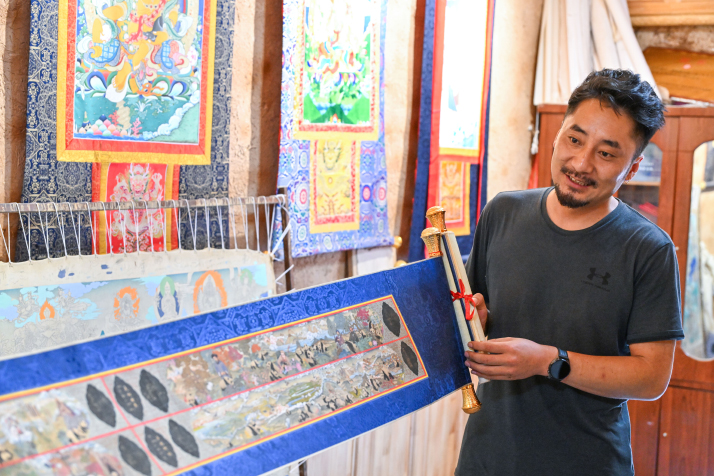 Sanlang Luoerwu, head of a provincial-level intangible cultural heritage Thangka training base, displays a Red Army-themed Thangka artwork at the base in Barkam, Aba, on July 7 (WEI YAO)
The smell hit first. Matsutake mushrooms, milk tea, dried yak meat and bundles of mountain herbs—Jiujiu's small shop in Xiaojin County, Sichuan Province, smells of the Qinghai-Xizang Plateau. Across a narrow mountain road sits the site of the Lianghekou Conference, where in June 1935 the Chinese Workers' and Peasants' Red Army led by the Communist Party of China (CPC), maneuvering across a fractured country, stopped long enough to decide how it might survive. Jiujiu, a young Tibetan woman who runs the shop, smiled when she talked about the tourists flowing through her door. "They come to find the road the Red Army walked," she told Beijing Review, "and they leave with something from my shop." On a busy summer weekend, her matsutake stock was half gone by noon. Ninety years after an army marched through the mud out front, a local young woman is building the kind of life those soldiers could not have imagined: ordinary, steady and her own. She is not the only one. In the summer of 2026, in honor of the 90th anniversary of the conclusion of the Long March (1934-36) this October, our reporting team from the Center for the Americas under China International Communications Group (CICG), publisher of Beijing Review, traced the Sichuan leg of the Long March to meet the people who now live along it. What we found were not just monuments, but places where younger generations today are writing new chapters. 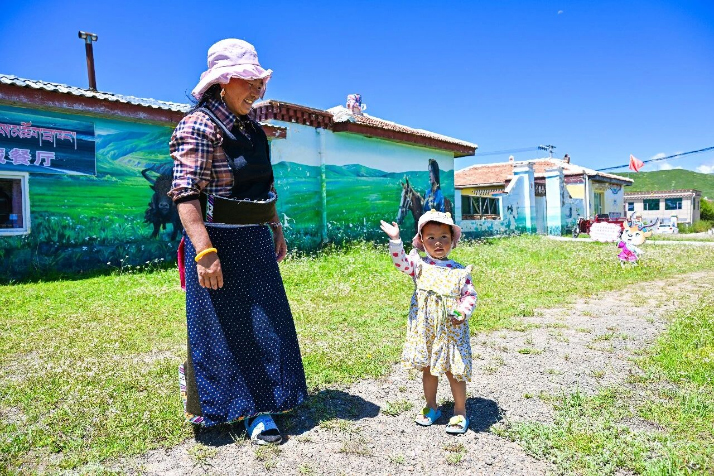 A Tibetan woman and a little girl in Zoige County, Aba Tibetan and Qiang Autonomous Prefecture, Sichuan Province, on July 8 (WEI YAO)
A life worth wanting A few hundred kilometers northwest of Jiujiu's shop, the land tells a historic story. The wetlands of Riganqiao, now inside Hongyuan County, were once called a "sea of death"—more than 100,000 hectares of peat bog that swallowed anyone who literally put a foot wrong. In 1935, as the Red Army's main columns crossed these marshes, more than 10,000 troops died here, not from bullets but from cold, hunger and the black mire. On the bank of Banyou River in Zoige County, a monument stands, where 700 exhausted soldiers sat back to back to rest and never woke. There is no cemetery. The bog is their grave. It is also the setting of The Golden Fishhook, a story every Chinese child reads, about an old army squad leader who gave his last food to three injured soldiers and quietly starved, somewhere along the last 10 km before the marsh ended. Today the mire is a national wetland park with its black peat hidden under alpine buttercups. And on its edge, a young woman who trained in Scotland has come home to pour coffee. Luo Lan could have stayed in Britain. Instead she came back to open a café, called Eat the Clouds, at a glamping-style tented camp on the grassland. One summer afternoon, she was making a cup of espresso, as British writer David Ferguson, who was on the CICG trip, sat by the window watching the tents and the grass rolling toward the horizon. "People think the Long March is something that happened a long, long time ago," Luo told Beijing Review. "But all the suffering the Red Army endured—it was so that we, younger generations, could choose how to live our lives. I put the cafe here not just because the view is beautiful, but so the world can see that Hongyuan (literally "the red plain") today has a past that breaks your heart and a present worth wanting." New chapters In the Dadu River valley in Luding County, Luding Bridge—where soldiers covered about 120 km in a single day in May 1935 to reach it and eventually take it—has become a draw. In 2025, Luding County drew 5.74 million visitors and earned 6.31 billion yuan ($870 million) in tourism. In the nearby mountains lies Haizi Village, which was among the county's poorest. After a 6.8-magnitude earthquake in September 2022, most of its Yi ethnic group families moved downhill. Qiu Gang, born in 1993, stayed. His life took a turn in 2023, when Tian Honggang, an entrepreneur from Inner Mongolia Autonomous Region, arrived by chance, saw snow-covered Gongga Mountain and decided to build a "flower-sea" park. Tian put in 17 million yuan ($2.4 million). The park now boasts about seven hectares of planted flower beds, a campground and upscale lodges, and on peak days pulls in more than 2,000 visitors. Qiu, who had farmed his whole life, now helps run the park. "I never thought a farmer like me could become a company executive," he said. The park hands the village a fixed 20 percent of ticket sales, employs 23 locals full time, and spends over 1.4 million yuan ($200,000) a year on seasonal staff. Qiu is now coaching the seven households still living in Haizi to open their own guesthouses; four already have. The paved road into the village is currently being widened and paved. "I want to stay," he said, "and help more villagers do well for themselves." In Xisuo Village of Barkam, the stone houses of Xisuo Village, a Gyalrong Tibetan settlement in Aba Tibetan and Qiang Autonomous Prefecture, have also become guesthouses. Across the river, at the Choktse Tusi Manor, the Red Army rested for a week in July 1935. CPC leader Mao Zedong, short of reading on the march, slept in the manor's study and borrowed a thread-bound set of the Chinese classic Romance of the Three Kingdoms—leaving a written receipt, which is still on display there today. Today, young artists are pursuing their dreams in the village. In one of the stone houses, Sanlang Luoerwu, a master of Thangka art, Tibetan Buddhist scroll painting, runs a provincial intangible-heritage workshop where he trains the next generation of Thangka masters and paints the Long March itself: Red Army-related themes rendered in the fine, mineral-pigment hand of the Gyalrong tradition. "People eat better, dress better, most families have more than one car now," he told us. "I paint this era so the memory stays alive." Not far from Xisuo Village, a woman has written history in her own way. At the foot of Jiajinshan—the first snow-capped mountain the Red Army crossed, in June 1935, Chen Wanghui has spent more than a decade turning thorny rose bushes into a living for 3,300 households across 13 townships. Her brand began with a farmer's hunch: Wild boars will not cross a hedge of thorns. So she began to plant roses rather than crops. The roses and their byproducts, including essential oils that are exported to European countries including Bulgaria and France, now bring in 44.1 million yuan ($6.3 million) a year. The old road there has since been rebuilt to match modern life: The Jiajinshan Tunnel now drives straight through the mountain's worst stretch, turning an hours-long, deadly crossing into a few minutes of smooth, safe road. Winter no longer seals the county off from the world. Standing on any of these ridges, we can feel the layers of time press close. In 1935, barefoot teenagers in thin clothes walked through snow and bog to save a country. In 2026, a Gyalrong Tibetan shopkeeper, a returnee with an espresso machine, an Yi farmer turned manager, a Thangka master and a woman with dirt under her nails are after something quieter: a good life, on their own terms, in the place they come from. The Long March, people here will tell you, never really ended. It just changed names—and handed the next stage to the younger generations. (Reporting from Sichuan Province) Copyedited by Elsbeth van Paridon Comments to taozihui@cicgamericas.com |
|
||||||||||||||||||||||||||||||
|