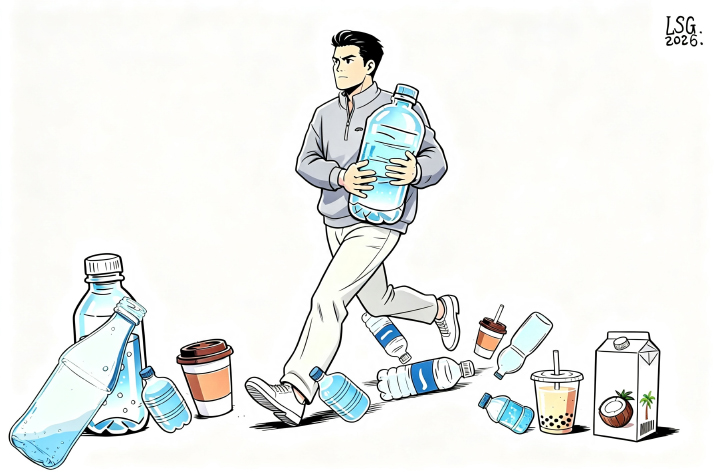
(CARTOON BY LI SHIGONG)
A "big-water theory" has recently gone viral among young Chinese on social media: Ditch the sugary drinks and carry a 1.5-liter bottle of plain water with you instead. Its proponents claim that "all mental exhaustion stems from not drinking enough water." Some embrace this "big-water theory" as a rejection of consumerism, a stance against spending heavily on widely touted, expensive beverages. Critics call it "repackaged common sense"—like drinking more water, sleeping well and eating high-quality protein—and warn that the trend smacks of misconceptions and may even lead to water intoxication.
Ren Guanqing (China Youth Daily): Hitting your "water KPI" without worrying about what others think or, for example, preferring some muscle definition over a bulky physique, young people are shifting their focus from external evaluation to self-perception.
Consider beverage consumption. In recent years, brands have competed with a stream of new concepts and gimmicks: High-end sparkling water that deliberately differentiates on taste and hints at social status, coffee and milk tea mashups, health-branded coconut water or weakly alkaline water rich in trace elements. It's a market that keeps reinventing itself until consumers are dazzled. These products may indeed improve taste or add health benefits, but when a big bottle of water carries excessive praise and is even endowed with social, aesthetic and identity-expressing meanings, the hype clearly outweighs the substance. In this sense, the popularity of the "big-water theory" is a return to simplicity: It is direct and straightforward, refusing to pay excessive product premiums and restoring the plainest truth that adequate hydration benefits health.
Given that concepts like drinking plain water, training to build lean muscle and sleeping well are growing increasingly popular among the younger generations, this also reflects their search for a sense of control amid uncertainty. Counselors often note that when people feel powerless over major life domains, they turn to controllable substitute behaviors to rebuild control. Compared with schooling, employment and career development, daily hydration, regular sleep and health management have lower thresholds and yield direct self-rewards.
Tang Min (Xinmin Evening News): Stripped of its "influencer" label, the "big-water theory" is little more than the old "eight-glasses-a-day" rule recycled for the digital age. The fixation traces back to a 1945 United States Food and Nutrition Board recommendation—yet the public overlooks its pivotal second half: Most water is already contained in daily food, including fruit and vegetables. As early as 2002, professor Heinz Valtin of Dartmouth Medical School debunked the "force down eight glasses" claim in the American Journal of Physiology, finding no scientific support. Yale University's Steven Novella likewise noted that the myth's popularity owes much to the bottled water industry.
Debunking the myth does not mean neglecting hydration, but finding one's own dynamic balance based on individual and environmental factors. Drinking too much too quickly can cause water intoxication. Practical details matter: Avoid gulping when extremely thirsty, and drink small amounts frequently and evenly. After intense exercise or heavy sweating, plain water alone may trigger low sodium, so sports drinks or lightly salted water help restore electrolytes. Plain tea and black coffee count toward daily fluid intake; the water they provide outweigh their mild diuretic effect. People with reduced kidney function, heart failure or cirrhosis must follow medical advice strictly, as excess water can worsen edema and shortness of breath.
Copyedited by Elsbeth van Paridon
Comments to yanwei@cicgamericas.com