
|
| Lifestyle |
| The relevance of Confucianism | |
|
|
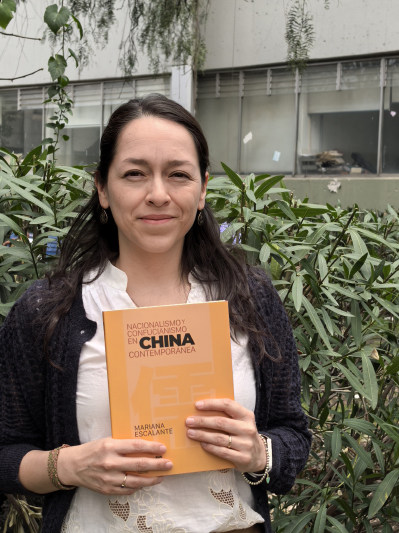 Mariana Escalante, a professor at the Faculty of Political and Social Sciences, National Autonomous University of Mexico (COURTESY PHOTO)
What do Spanish speakers really know about Confucius? Most people surveyed on the street would likely call him "an ancient philosopher," if they didn't just say, "I don't know." Confucius was a revered Chinese philosopher in the Spring and Autumn Period (770-476 B.C.) and the founder of a school of thought known as Confucianism. Although it emerged many centuries ago, this philosophy has deeply influenced Chinese society and continues to do so today. It remains a field of study not only for Chinese scholars, but also for researchers around the world. One such researcher is Mariana Escalante, the Mexican author of the book Nationalism and Confucianism in Contemporary China. Holding a bachelor's degree in international relations from the National Autonomous University of Mexico (UNAM), a master's in international relations from Peking University and a Ph.D. in political science and government from UNAM, Escalante developed an interest in Confucianism during her time in China. "I studied international relations at the Faculty of Political and Social Sciences at UNAM. In the sixth semester, there's a required course called Asia and the Pacific, and that's when I became fascinated by China. I started learning Chinese at the National School of Languages, Linguistics and Translation, and my interest in the country just kept growing," she told Beijing Review. A way of life Once in China, Escalante first focused on studying the language before pursuing her master's degree in international relations. During that time, she immersed herself in Chinese culture through everyday interactions with people from all walks of life. "When I first arrived in China in 2008, I was struck by how people behaved—the importance of rituals, values, hierarchies and respect for elders. It all seemed deeply ingrained in everyday life," she recalled. Confucianism, however, was not the first thing that came to her mind when observing Chinese society, as people rarely mentioned it in daily conversation. Initially, she was more interested in studying nationalism in China. "What caught my attention was nationalism as a sense of pride. I wanted to understand what shapes China's national pride. When I talked with Chinese classmates, they often mentioned the term aiguo zhuyi, meaning 'love for the country' or 'patriotism,' rather than minzu zhuyi, meaning 'nationalism.' I've always been interested in cultural studies, so I asked myself what cultural factors nourish this nationalism in China. That's how I came across Confucianism. At that point, the concepts clicked for me. Some might say nationalism and Confucianism conflict, but to explain the cultural foundation of Chinese nationalism, Confucianism is essential," she said. 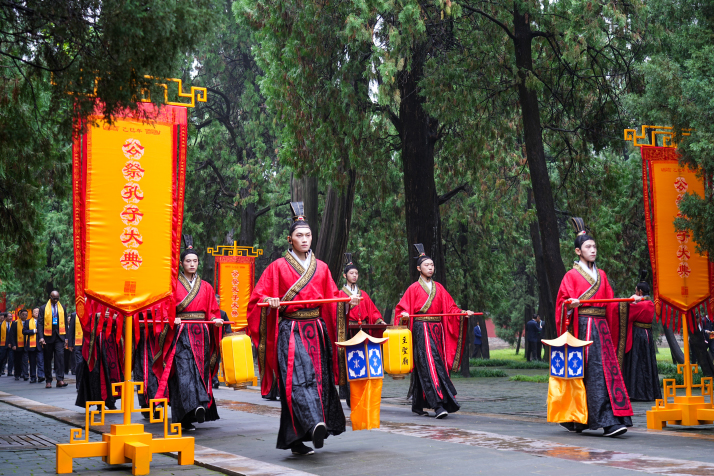 A ceremony in Qufu, Shandong Province, Confucius’ hometown, on September 28, 2025, marks the 2576th anniversary of the philosopher’s birth (XINHUA)
Key concepts According to Escalante, the Western notion of "nationalism" doesn't fully capture what minzu zhuyi and aiguo zhuyi represent in China. "The Chinese sense of belonging is ancient—thousands of years older than the Western concept of a nation or nationalism. It dates back to the Western Zhou Dynasty (1046-771 B.C.). There has always been this idea of unity and cultural coherence in China, which remains very important," she explained. This is how Escalante links nationalism and Confucianism—and it raises the question of how Confucianism has managed to remain relevant today. Drawing on key Confucian ideas such as ren (benevolence), yi (righteousness), li (ritual propriety), zhi (wisdom), xin (integrity), xiao (filial piety), de (virtue) and junzi (the superior person), Escalante analyzed various speeches by President Xi Jinping, collected in the series Xi Jinping: The Governance of China, which details Xi's vision for China's development and international cooperation. She found frequent—though sometimes subtle—references to Confucian concepts used to emphasize values such as continuous self-improvement, the importance of education and diligence, respect for nature, virtue, discipline, family, respect for elders, and meritocracy. Escalante also attributed the endurance of Confucianism to the flexibility of its key ideas. "Take ren, for example. I translate it as 'benevolence,' though some prefer 'humanity.' There is no single exact equivalent. This linguistic flexibility allows these concepts to evolve over time, from dynastic China to the present. And beyond that, they speak to universal human concerns—family, honesty and virtue. That universality is what keeps Confucianism alive," she explained. A living example For Escalante, the opening ceremony of the Beijing 2008 Olympic Summer Games was a vivid demonstration of Confucian ideas in modern China. "Directed by filmmaker Zhang Yimou, the ceremony was rich in symbolism celebrating Chinese culture and history. At one point, lines from The Analects of Confucius (a collection of ideas and sayings from the ancient philosopher—Ed.) were recited—such as 'within the Four Seas, all men are brothers'—and enormous printing blocks displaying the character he, meaning 'harmony,' filled the stage," she recalled. Another moment that revealed the influence of Confucian thought, she noted, came during the COVID-19 pandemic. "People behaved collectively, following government measures for the greater good. Authorities emphasized preserving life above all, even at economic cost—an attitude that deeply reflects Confucian values of putting the community before the individual," Escalante noted. After extensive study, she concludes that Confucianism, from its very beginnings, sought harmony and practical ways to address the issues of its time. "It wasn't a philosophy in the Western sense—focused on metaphysical truths or abstract ideas—but rather on resolving concrete, real-world problems," she explained. Escalante underscores the importance of learning from China not only in science and technology but also in culture. She believes that adapting Chinese development models in other countries requires discipline and a strong sense of collective responsibility—an ability to understand and embrace the idea of community and the common good. BR The author is a reporter with CICG Americas' Latin America Bureau Copyedited by G.P. Wilson Comments to yanwei@cicgamericas.com |
|
||||||||||||||||||||||||||||
|








