|
| Voice |
| Paddles over politics | |
|
|
|
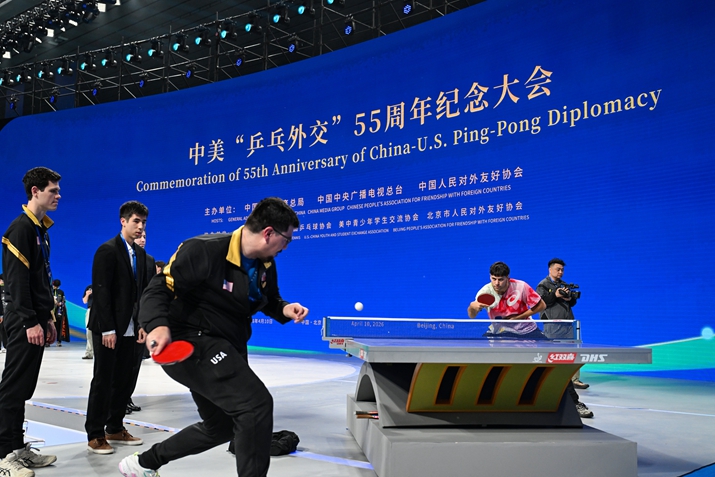
An event commemorating the 55th anniversary of China-U.S. Ping-Pong Diplomacy held in Beijing on April 10 (XINHUA) This year sees the 55th anniversary of the famous Ping-Pong Diplomacy, a historical turning point that began to thaw the frozen relationship between the United States and the People’s Republic of China that began at the latter’s founding in 1949. A chance meeting between a pair of individuals from each country’s ping-pong teams helped reduce tension between the nations, both of which were beginning to understand that the “wall of separation” between the two was negatively impacting both. Although President Richard Nixon’s administration at the time was intent on rebuilding the U.S. relationship with China, the prevailing atmosphere of Cold War hysteria remained a powerful obstacle. Convincing all stakeholders to embrace such a radical shift in foreign policy was no easy feat. An encounter It was a chance encounter between two individuals, one American and one Chinese, that gave the two nations a path toward each other. In 1971, the World Table Tennis Championships were held in Nagoya, Japan, with both the U.S. and Chinese teams in attendance. Exactly how Glenn Cowan, the youngest member of the American squad, ended up on the Chinese team’s bus remains unclear. Maybe he made a mistake; maybe he missed his own bus before it pulled away. Either way, he climbed aboard—and into history. The Chinese players were probably as surprised as he was, at his being there. While some of them were no doubt hesitant to talk with him, Zhuang Zedong, a Ping-Pong master and captain of the Chinese team, came up and shook Cowan’s hand. He had also felt it appropriate to give this unexpected visitor a present, fishing out from his bag a piece of silk cloth depicting China’s famous Huangshan Mountain, which he then presented to Cowan. This immediately created a rapport between the two players. When they got off the bus, there were photographers taking pictures and, to their surprise, both Cowan, an American, and Zhuang left the bus together. These pictures were then broadcast across the world. Two days later, the U.S. team received an invitation no one saw coming: a visit to China for exhibition matches against the Chinese team. They accepted. The U.S. State Department immediately scrambled to figure out the logistics, which was no trivial task as American passports at the time explicitly forbade travel to China. Nixon, who privately supported the diplomatic opening, gave the team permission to go. While tensions can often occur between nations as different as China and the U.S., it is of the utmost importance that people-to-people ties are continually maintained and nourished. Sometimes, as was the case with Ping-Pong Diplomacy, they can create the basis for fundamental change in the relationship between two nations. People-to-people exchange here provided the basis for mutual understanding beyond political or ideological differences that dominated the particular moment.
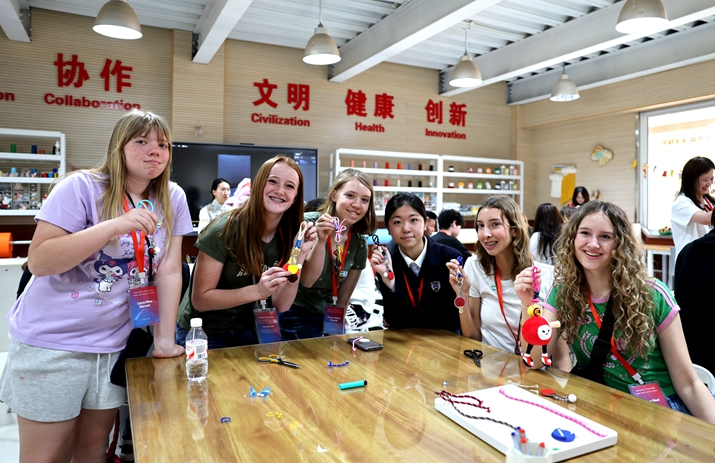
High-school students from the United States hold up their handicrafts at Shijiazhuang Foreign Language School in Shijiazhuang, Hebei Province, on April 11 (XINHUA) People-to-people power Today, ideological tensions still run high in China-U.S. relations. But added to that is a new layer: rivalry. China has emerged as a major force in technology, making it something of a genuine competitor to the U.S. Meanwhile, the desire of President Donald Trump’s administration to return to an era of unchallenged American military and technological dominance has created what can feel like an unbridgeable gap between the two countries. Yet there is a powerful counterweight: the genuine need for stable trade and investment ties. Both nations require a functional economic relationship to prosper. The Trump administration’s recent move to ease some of its punitive measures on Chinese goods suggests an acknowledgment of this reality: If the U.S. economy is to thrive, some degree of cooperation is not optional. But given the restrictive actions against China imposed by the U.S. in recent years, it may take some time to create the necessary climate where this “rivalry” can be transformed back into “cooperation.” The key to progress, however, lies on an entirely different plane from commercial or political dialogue: the plane of people-to-people relations. Lifting restrictions on Chinese students coming to study in the U.S., for instance, would be a step in the right direction; as would encouraging more American students to learn Chinese and study in China. The ban on Confucius Institutes should also be lifted. (A Confucius Institute is a non-profit public educational organization that partners with local universities worldwide to promote Chinese language and culture—Ed.) This should also be the case with regard to cultural exchange between the two nations. Orchestras and choral groups should be encouraged, and supported, to travel to each other’s countries. And, like Ping-Pong Diplomacy, the realm of sports can also become a major venue for profitable and beneficial exchange. Promoting tourism is another useful tool in this respect. This permits the type of cultural “osmosis” among the largest number of citizens to experience the other country. The governments of both countries could take measures to ease the procedure for getting visas and for operating and facilitating tour groups back and forth. Because of the long separation imposed by the Cold War, the Chinese ping-pong team’s return visit to the U.S. in 1972 had an outsized impact. For those Americans attending the matches or simply spending time with the Chinese players, the experience created a genuine, lasting sense of friendship. That feeling, that we are not so different from one another, can go a long way in shaping the political process. When American constituents feel strongly about an issue, their sentiment influences members of Congress and, in turn, political decisions. We see this dynamic clearly today in several Midwestern agricultural states, where local, and even national, politicians tend to hold a more benign view of China and the Chinese people. After all, Chinese buyers are more than willing to purchase their grain, wheat and sorghum. While things may not change overnight, even with a positive outcome from this year’s planned heads-of-state summit in Beijing, such measures over time can create the basis for dramatic changes in the U.S.-China relationship, given that the underlying economic relationship can benefit both nations. As long as the element of “cooperation” triumphs over the element of “rivalry.” The author is the former Washington bureau chief of U.S. publication Executive Intelligence Review. This article was first published on the China Focus website Copyedited by Elsbeth van Paridon Comments to dingying@cicgamericas.com |
|
||||||||||||||||||||||||||||
|