
|
| Voice |
| Walking with history | |
|
|
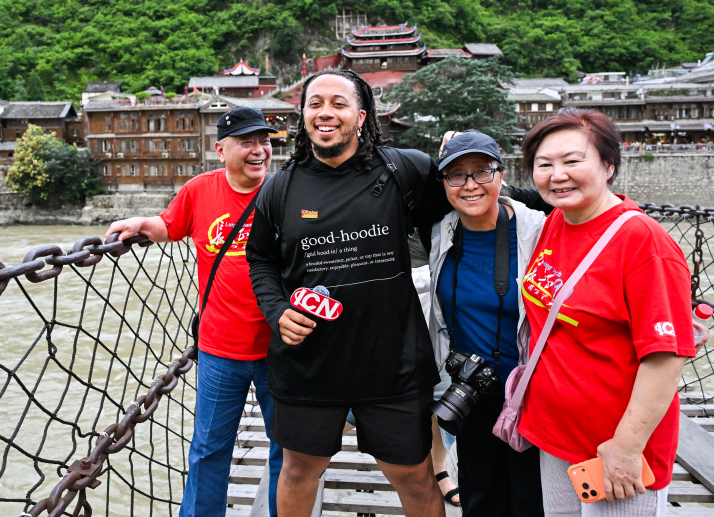 Zhavier Harris meets friends on Luding Bridge, Sichuan Province, on July 5. Harris was on a journey retracing the Long March (1934-36) (WEI YAO)
Some journeys change you the first time you take them. Others reveal their true weight only when you return. Ten years ago, in 2016, I had the incredible opportunity to retrace the route of the Long March (1934-36) as an intern journalist during the 80th anniversary of its completion. At that time, I was a young storyteller eager to learn about China's history. This summer, on the 90th anniversary, I returned as someone who has grown both personally and professionally. Looking back over the last decade, I can confidently say that the spirit of the Long March has not changed for me, it has deepened and enhanced with time. (The Long March was a military maneuver carried out by the Communist Party of China-led Chinese Workers' and Peasants' Red Army, marching through raging rivers, snowy mountains and marshy grasslands to break the Kuomintang regime's siege and continue the fight against Japanese invaders. In total, some of the soldiers marched as far as 12,500 km, enduring hunger, thirst and extreme cold in what became one of history's greatest feats of human resilience—Ed.) As we grow older, history begins to speak to us differently. We begin to understand that behind every monument, every memorial and every museum exhibit are real people who sacrificed everything for something greater than themselves. Traveling this route once again gave me an even greater appreciation for those sacrifices, for the extraordinary sense of unity that carried people through unimaginable hardship, and for the enduring spirit that continues to shape China today. However, the story of the Long March is not just China's story. It's a story for all of us. Experiencing Sichuan People often ask me which location along the Long March route has impacted me the most. Honestly, that is one of the hardest questions to answer because every province has offered something unforgettable. Every village, every memorial, every conversation left its own impression. However, my time in Sichuan Province was one of the most memorable chapters of my journey through China. For the first time, I was able to experience Sichuan through several different perspectives, from the history and culture of the Red Army to what I came to understand as "green culture," the deep connection between the people, agriculture, nature and preservation of the land. I am a living testament to just how welcoming the people of China are. Throughout my journey, I witnessed how the spirit of the Long March and the Red Army continues to live within the people and communities across the provinces along the historic route. I was especially moved by how willing people were to share a piece of what is so sacred to their history and culture with international guests like myself. That openness allowed me to learn about China's history and experience it through the people who continue to preserve and pass it forward. In Sichuan's provincial capital Chengdu, we were introduced to one of China's most recognizable treasures, the giant panda. We spent an entire day learning about the history and conservation of pandas at the Chengdu Research Base of Giant Panda Breeding. While there, I had the opportunity to speak with visitors from around the world, which showed me just how universally loved these animals have become. History, nature and human connection Our journey then took us deeper into Sichuan and the history of the Long March. At the Red Army Long March Monument Memorial Park, I paid homage to the struggles and sacrifices of the Red Army soldiers by climbing more than 600 steps to reach the victory monument. We also traveled through Jiajin Mountain, reaching elevations approaching 4,000 meters where the thin air made it difficult to breathe. Hiking through those conditions gave me an even greater appreciation for the physical challenges the Red Army's soldiers endured during the Long March. Some of my favorite moments along the way came through our encounters with Tibetan people. We were welcomed with open arms, shared yak meat and traditional milk tea, and experienced their culture firsthand while filming our documentary series. Throughout my time in China, I found that every mountain climbed, grassland crossed, staircase conquered and river encountered brought me closer to the people, history and spirit of the country. Sichuan brought together Red Army history, green culture, natural beauty and human connection in a way I will never forget. I am truly honored to have experienced Sichuan and to carry these memories with me long after the journey has ended. A universal message of hope When I reflect on what the Long March spirit truly means, I believe it represents perseverance, determination, sacrifice and perhaps one of the greatest examples of human resilience. It reminds us that even during the most difficult moments in history, people are capable of extraordinary courage when they are united by a common purpose. But I also believe the Long March carries another lesson that transcends borders. It reminds us that every human life has value. Regardless of economic status, background or circumstance, every person deserves dignity, opportunity and hope. The sacrifices remembered along this route remind us that history is ultimately about people. And when we recognize the humanity in one another, we become stronger communities and a stronger world. That is why this experience matters not only for China, but also for the international community. 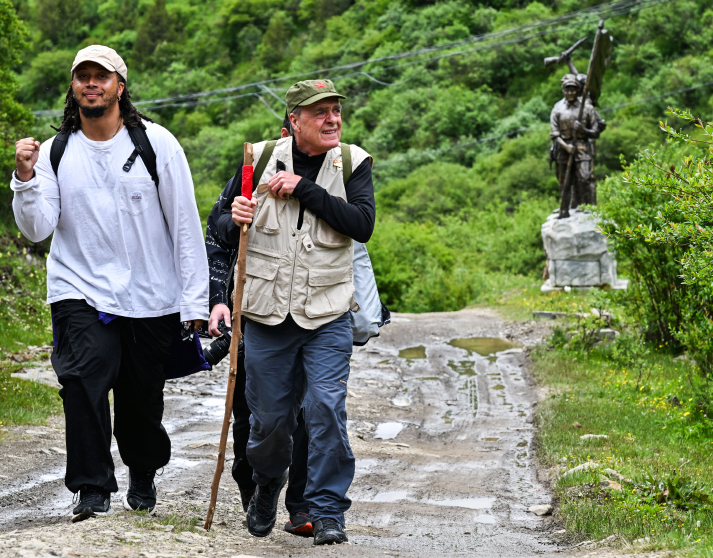 Zhavier J. Harris (left) and David Ferguson, a recipient of the China Government Friendship Award, walk along the Red Army trail on Mengbi Mountain in Ma’erkang, Sichuan Province, on July 7, retracing the Long March (1934-36) Harris meets friends on Luding Bridge in Sichuan on July 5 (WEI YAO)
Building bridges Too often, people form opinions about countries they have never visited and cultures they have never experienced firsthand. That is why exchanges like those along this journey are so important. They replace assumptions with conversations. They replace stereotypes with friendships. They replace distance with understanding. I have dedicated much of my career to building bridges between people. I believe empathy is one of the most powerful forces we possess. When we sit down with families, walk through communities, share meals together and listen to each other's stories, we begin to see one another not as strangers, but as fellow human beings. In many ways, the Long March mirrors the journey we all take through life. There are peaks and valleys, moments of doubt and moments of clarity, and stretches of road that seem endless until we look back and realize how far we have come. The soldiers who walked this path knew something that I am only beginning to understand: The destination matters less than the courage it takes to keep moving forward. As someone who has now walked this historic route twice over the span of 10 years, I leave with an even stronger belief that the spirit of the Long March is much more than a chapter of Chinese history; it is a reminder to all of humanity that perseverance, unity, compassion and hope have the power to transform nations and change the future. BR The author is marketing and communications manager for the Springfield Urban League in Illinois, the United States Copyedited by Elsbeth van Paridon Comments to taozihui@cicgamericas.com |
|
||||||||||||||||||||||||||||
|