|
| Voice |
| From Ping-Pong to Ping | |
|
|
|
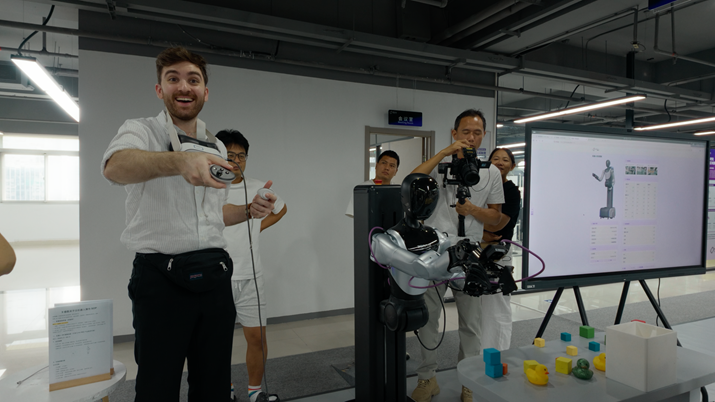
Darren Watkins Jr., known to tens of millions of followers as IShowSpeed,tries local food in Changsha, Hunan Province, on April 7, 2025 (VCG) In March 2025, a 20-year-old American from Cincinnati, Ohio boarded a high-speed train in China, turned on his livestream, and anxiously glanced down at his phone. Four green bars. A low ping, the streamer's term for a signal with no lag. His voice was making the round trip from a moving train in China to phones in Ohio faster than you can read this sentence. When the train plunged into a mountain tunnel and the stream didn't so much as stutter, his audience lost its mind. The People's signal Over the next two weeks, Darren Watkins Jr., known to tens of millions of followers as IShowSpeed, broadcast for hours at a time from cities including Shanghai, Beijing, Chengdu in Sichuan Province, Chongqing Municipality, Shenzhen in Guangdong Province and Hong Kong Special Administrative Region. There was no script and no press office. There was Sichuan opera, acupuncture, and a stick of tanghulu, the candied fruit skewer that turned out to be far sweeter and more sour than he expected. For many of his viewers, it was the first time China had appeared on their screens as a place where people live rather than as a threat described on the evening news. I thought about that train and the logistical feats behind those green bars this week as President Xi Jinping arrived in Washington for his first state visit since 2015, returning the visit President Donald Trump made to Beijing in May. The agenda was crowded, spanning tariffs, rare earths, AI and a trade truce that was running out of time. Those issues matter enormously, but living in Shanghai has convinced me that the most lasting progress between our two countries doesn't happen at state dinners. It happens when ordinary people are allowed to look at each other directly. I'm an American who has made China home, and this year I've spent a good deal of time here behind a camera. In July I filmed in Guizhou Province, among its factories, the bridges spanning its gorges, and the FAST radio telescope nestled into a karst basin. Earlier this month I was in Shenzhen, walking the electronics markets of Huaqiangbei, where a hardware startup can source parts in the morning and have a prototype by evening. What stays with me afterward is rarely the bridges, the trains, or even the green bars. It's the uncles in the Longli Ancient Town in Guizhou who invited me, a total stranger, to their grandfather's funeral to celebrate the life of a man I'd never met while eating their home-cooked pork. It's the young engineers in Nanshan District, Shenzhen, showing off the robot arm they built to take the tedium out of assembly-line work.
Eric Hovagim tries a robot arm in Nanshan District, Shenzhen, Guangdong Province (COURTESY PHOTO) When people back home picture China, these kinds of warm interactions aren't exactly what they're envisioning. That gap is no accident. Hostility toward China is one of the last truly bipartisan positions in American politics. In March 2024, the House of Representatives voted 352 to 65 to force the sale or ban of TikTok, a margin most legislation never comes close to. Much of my working life is spent researching American political campaigns, and in that world, China rarely appears as a country. It often appears as a device, a way to sound strong, to explain away a shuttered factory, to paint an opponent as soft. Candidates of both parties compete over who can sound tougher on Beijing, and with the midterm elections six weeks away, voters should expect plenty more of it. The public has absorbed the message. In a Pew Research Center survey conducted this March, 71 percent of Americans held an unfavorable view of China. Only 18 percent of Republicans and 34 percent of Democrats viewed it favorably. In a country that agrees on very little, that is about as close to consensus as it gets. Yet the same polling contains the most hopeful trend in the relationship. American favorability toward China has nearly doubled since bottoming out at 14 percent in 2023, and the thaw is being led by the young. In a Pew survey this January, 32 percent of younger Republicans called China an enemy, compared with 55 percent of older Republicans. It's hard to prove what moves public opinion. But it's hard to miss that the Americans warming fastest are the ones most likely to have watched Speed on that train, to have flooded onto the Chinese app RedNote in January 2025 when TikTok looked set to go dark, and to have turned “China travel” into a genre of its own online. They watched, and they drew their own conclusions. The trust gap Hasan Piker learned how unsettling that can be to some people. When the left-wing streamer, one of the most influential political voices among young Americans, spent two weeks traveling through Beijing, Shanghai, Chongqing, Chengdu and Hong Kong last November and streamed much of it to his audience, the reaction at home quickly hardened into two camps: either he was a mouthpiece for Beijing or he had turned his back on his country. But much of the outrage treated the trip itself as an affront to his American-ness, as though an American going to see China with his own eyes and reporting back was inherently disloyal.
Fans of Chinese video game "Black Myth: Wukong" pose for a photo in downtown Los Angeles, California, the United States on July 7 (XINHUA) For a good part of Washington and the legacy media class, the worry isn't that Americans hold an inaccurate picture of China. It's that they might start building an accurate one of their own. None of this means a livestream substitutes for real understanding. Speed saw China's megacities at their most photogenic, and two weeks can't capture a country of 1.4 billion people. Not all of them will agree with one another, nor will they entirely agree with the 340 million Americans. That is exactly the point. Exchange was never meant to make Americans agree with Beijing. It's meant to ensure that when they disagree, they're disagreeing with the material reality and not a caricature invented by some media titan whose name is redacted in the Epstein files. The same holds in reverse; Chinese audiences deserve a picture of America more complete than whatever goes viral out of Washington. Indeed ambulance rides in America cost thousands of dollars, and medical debt is among the leading causes of personal bankruptcy. President Xi understands this better than most. His first trip to the United States, in 1985, was with an agricultural delegation to Iowa, where he stayed with a family in the small town of Muscatine. He went back to Muscatine as vice president in 2012 and has retold the story ever since. In San Francisco in 2023, he announced that China would invite 50,000 young Americans to visit over five years. And since late 2024, China's 240-hour visa-free transit policy has made it possible for Americans to come and look for themselves with little more than a passport and an onward ticket. But exchange has to run in both directions, and right now the traffic is badly lopsided. Nearly 266,000 Chinese students were enrolled at American colleges in the 2024-25 academic year. The number of American students in China, which stood at more than 11,000 before the pandemic, had fallen below 2,000 by last year. A generation of Americans who might have learned Mandarin, lived with Chinese roommates, and come home with a textured view of the country is simply not being formed. So alongside the agreements made during the state visit, I hope both governments make room for the unglamorous work of rebuilding the academic exchanges hollowed out over the past six years, adding direct flights, and ending the habit of treating every Chinese student in America as a potential security threat. And above all, I hope both governments keep building the infrastructure that lets their people meet: the bridges, the trains, and the bars that stay green in the tunnels. In 1971, it took a ping-pong team. In 2025, it took a kid from Cincinnati and a ping that held steady deep inside a mountain tunnel. The tools might be changing, but the lessons are not. Governments can open the door to each other, and it's our job to walk through it. The author is an American political commentator and filmmaker based in Shanghai Copyedited by G.P. Wilson Comments to mamm@cicgamericas.com |
|
||||||||||||||||||||||||||||
|