
|
| World |
| Certainty in fractured times | |
|
|
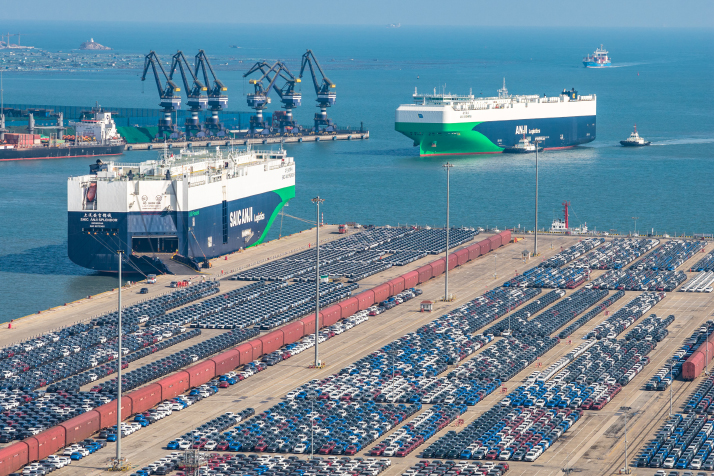 An automobile carrier loads export vehicles at a port in Yantai, Shandong Province, on January 27 (XINHUA)
'The next five years will be defined by the various structural risks and opportunities that we see today." With that assessment in his remarks, Jim Zelter, President of Apollo Global Management, an American asset management firm, captured the mood of one of the symposiums at the China Development Forum 2026, held in Beijing on March 22-23. The symposium centered on the growing reality that uncertainty is being hardwired into geopolitical tensions, trade, capital, technology and industrial strategy. At the symposium, officials, global financiers and business leaders examined a pressing question: How to navigate uncertainty through a clearer understanding of global risks, growth prospects and the future of cooperation. Against a backdrop of geopolitical tensions, tariff frictions and supply chain realignment, the annual forum became more than a routine exchange. It highlighted a larger issue: whether China can still offer policy stability, market opportunity and practical cooperation in an increasingly fragmented world. When risk turns structural Zelter argued that risk is now being treated not as a passing disruption but as a more lasting feature of the global economic environment. Liu Jun, President of Industrial and Commercial Bank of China, made a similar point from the financial system's perspective, arguing that global risk is no longer a linear sequence of economic variables but a multidimensional matrix in which geopolitical conflicts and unilateral measures can trigger systemic shocks. For Georges Elhedery, Group Chief Executive of global banking giant HSBC Holdings plc, tariffs are not new, but their unpredictability is. That uncertainty is already weighing on confidence and investment. Yet the tone in the room was not one of resignation. Several speakers pushed back against the idea that globalization is simply ending. Yan Dong, one of China's Vice Ministers of Commerce, argued that while the international trade order is under strain, the larger historical trend of economic globalization has not been reversed. That view was echoed from the business side. Chip Kaye, Chairman of Warburg Pincus, a global growth investor headquartered in New York, warned against becoming overly pessimistic at a moment of geopolitical realignment and technological disruption. His point was not that the old order will return, but that long-term investors still have to distinguish between turbulence and structural decay. The more persuasive argument running through the symposium was that fragmentation is a policy choice, not an inevitability. Chen Liang, Chairman of the Board and Management Committee of China International Capital Corp. Ltd., described a world in which supply chains are being rebuilt around both efficiency and security, while technology competition increasingly shapes industrial advantages and even rule-making power. But the answer he offered is not withdrawal. Instead, it is stronger industrial cooperation, more resilient capital markets and new forms of international technological collaboration. Why China carries weight That is where China entered the conversation—not as a country outside the turbulence, but as one of the few major economies still trying to present development, openness and long-term planning as a coherent response to it. Yan framed that response in practical terms: more opportunities to buy in China, export to China, invest in China and innovate in China. The official message was that high-standard opening-up is not a slogan attached to growth, but part of the growth strategy itself. Zheng Yongnian, Dean of the School of Public Policy at the Chinese University of Hong Kong, Shenzhen, pushed the argument further. In his telling, global imbalances cannot be interpreted only through bilateral tensions between major powers. A deeper problem is the insufficient development of large parts of the developing world, which suppresses demand and feeds instability. China's modernization path, he suggested, carries international significance to the extent that it links domestic upgrading with broader development opportunities for other countries. That framing matters because it casts China in multiple roles at once: as a stabilizer, a market, an innovation platform and a partner in development. Kaye argued that China's basic advantages remain intact: a stable macro framework, strong infrastructure, entrepreneurial energy and policy pragmatism. He described the opportunity set in three layers: "China for global," "China for China" and the application of AI in real business workflows, especially for small and medium-sized enterprises. Observing the rewiring of trade and investment from within a global banking network, Elhedery said China would remain central to the next phase of global expansion as domestic demand, innovation and industrial upgrading reshape growth. Ola Källenius, Chairman of the Board of Management, Mercedes-Benz Group AG, offered perhaps the clearest corporate vote of confidence. Rather than retreating, he said, Mercedes-Benz is doubling down on investment in China, from AI research and development to its application in smart new-energy vehicles. In a market he described as the most competitive and dynamic in the world, global leadership requires engagement. As he put it, "You have to be in China. This is the place." For global firms operating under rising geopolitical pressure, China matters even more not only because of its scale, but because of the density of its industrial ecosystem, the speed of application in new technologies, and the relative clarity of its long-term policy direction. Zheng said China's five-year plans themselves function as an institutionalized source of certainty. Foundations for confidence The symposium acknowledged not only China's strengths, but also the real constraints surrounding its growth and external engagement. Pierre-Olivier Gourinchas, Economic Counsellor and Director of the Research Department of the International Monetary Fund, offered a note of caution. Global growth, he said, has shown resilience despite trade disruptions and uncertainty, but resilience should not be mistaken for safety. More importantly, he argued that global imbalances are widening again and that, for China, the key challenge is the sustainability of its growth model. In his assessment, weaker domestic demand and a greater reliance on external demand create risk of intensifying deflationary pressure and misallocating resources. His prescription is not decoupling, but rebalancing: stronger domestic demand, a stronger social safety net and structural reforms that improve the allocation of capital. That view highlighted an important question for China: What kind of growth can remain sustainable in a more uncertain external environment? China is being seen as a source of certainty precisely because it offers scale, capacity and policy continuity in an increasingly unstable world. But for that certainty to remain credible, it must rest on more than export competitiveness and manufacturing depth. It also requires a healthier balance between what China produces for external markets and what its own economy can absorb through stronger domestic demand. Another foundation is equally important: trust beyond China's borders. Källenius spoke candidly about the anxiety in Europe over China's vast cost and technology advantages. He called for a more proactive Chinese response instead of mutual closure, saying greater openness at home and a stronger physical investment presence in Europe can help reshape European perceptions of Chinese firms—from exporters to participants in local industrial ecosystems. Chen likewise underscored the importance of synergizing multilateral and bilateral efforts to diversify supply chains, securing technological autonomy through innovative international collaboration and fortifying capital markets to ensure financial stability. Zelter emphasized that for China's economic engagement with global partners, especially in Europe, transparency and regulatory trust are becoming essential foundations for business confidence, not optional extras. This is perhaps the most important conclusion to draw from the symposium. In an era of persistent shocks, certainty no longer means the absence of conflict or competition; rather, it means the presence of frameworks that make risk investable, cooperation viable and adjustment manageable. BR Copyedited by G.P. Wilson Comments to zhaowei@cicgamericas.com |
|
||||||||||||||||||||||||||||
|