
|
| Xinjiang Today |
| The legacy of the Grand Anxi Frontier Command | |
|
|
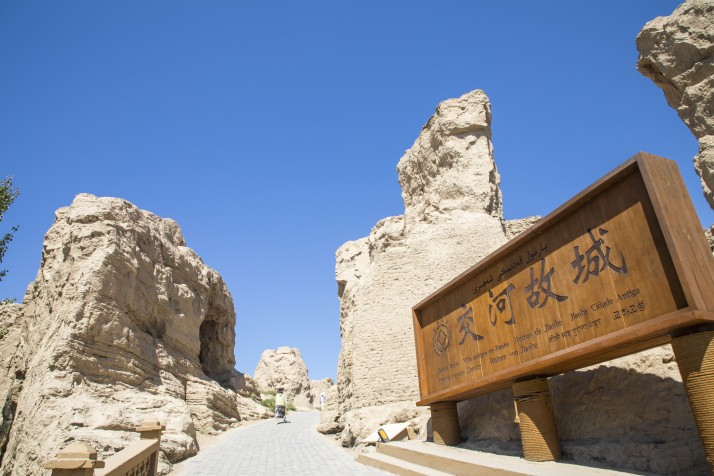 The Jiaohe Ancient City Ruins in Tulufan (Turpan), where the Grand Anxi Frontier Command of the Tang Dynasty (618-907) was first based (VCG)
In 640, the Tang Dynasty (618-907) established the Grand Anxi Frontier Command as part of its governance framework in the Western Regions. The command was first located in Jiaohe, which is near present-day Tulufan (Turpan) City. Later it moved to Qiuci in today's Aksu Prefecture. The historical sites of ancient Qiuci are spread across what are now Kuche (also spelt Kucha and Kuqa) and Aksu cities as well as Baicheng, Xinhe and Shaya counties in Aksu. For over a century and a half, the grand Anxi and Beiting frontier commands were the highest military and administrative bodies in the Western Regions, respectively governing the south and the north of the Tianshan Mountains. 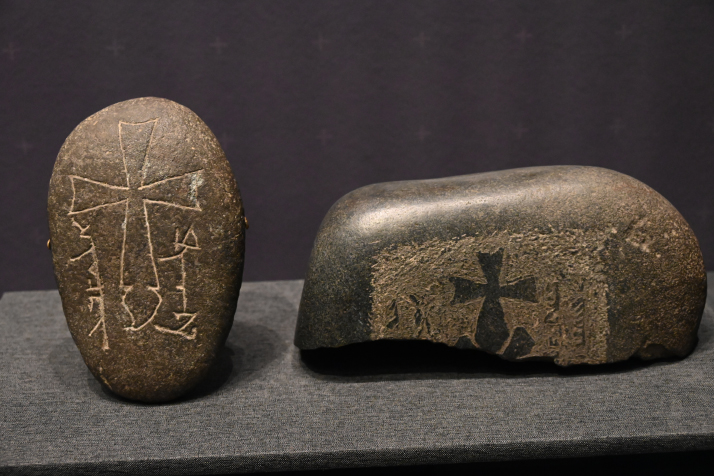 Yuan Dynasty (1271-1368) Nestorian stone carvings at the Xinjiang Museum in Urumqi (VCG)
Governing by local customs The establishment of the Grand Anxi Frontier Command marked the Tang government's shift from a policy of nominal control to systematic and regularized direct governance over the Western Regions. The central authorities governed through integration—a combination of military discipline and cultural openness. The command's officials brought the institutions of the central authorities westward, but not in the spirit of conquest. They initially practiced "governing by local customs," honoring indigenous laws and traditions while aligning them with Tang administration. Direct administration by the central authorities was gradually regularized, ending centuries of fragmentation and conflict among local city states. Even during the calamitous An Lushan-Shi Siming Rebellion, the eight-year civil war that broke out in 755, when the Central Plains, a vast area covering the middle and lower reaches of the Yellow River, descended into chaos, the outposts of the Grand Anxi Frontier Command continued to fly the Tang banner, maintain records and keep the Silk Road active. The governance model of the command provided a mature blueprint for the later dynasties in governing the Western Regions, and its endurance reflected a shared identity: People who saw themselves not as subjects of a faraway power, but as participants in a common civilization. A web of roads and ideas The command established four major garrison towns—Qiuci, Yutian, Kashi (Kashgar) and Suiye (later replaced by Yanqi). Located in what is today south Xinjiang, they were known in history as the Four Garrisons of the Grand Anxi Frontier Command, with a total military force ranging from 20,000 to 30,000 troops. These garrisons were not mere military strongholds; they also set up courier stations and repaired roads, thereby establishing an administrative and transportation network that linked the Western Regions. The Grand Anxi Frontier Command's geographical location was strategically crucial—the Tianshan Mountains rose like a natural spine, splitting the north steppe and the southern basin. Whoever held the corridor between Tulufan and Kashi controlled the Silk Road's pulse. The Silk Road was not only a network of trade routes but also a corridor for cultural, technological and religious exchanges connecting Asia, the Middle East and Europe. The Grand Anxi Frontier Command helped this fragile yet invaluable passage to function effectively. Courier stations dotted its dunes and valleys; beacon towers blazed from ridge to ridge. The Six Codes of Tang—a Tang Dynasty administrative statute that systematically outlines the government's structure, official hierarchies and institutional regulations—describes more than 100 official posts across the Grand Anxi Frontier Command, forming a transportation network spanning the Tianshan Mountains. Along these roads, music, technology and faith moved freely along with traders' wares. A trader leaving Qiuci might carry bolts of silk and snippets of Sanskrit, coins stamped with Chinese calligraphy and contracts written in Sogdian. The Silk Road, under the command's protection, was an exchange of imaginations. Realm of many faiths The cultural atmosphere in cities in the Grand Anxi Frontier Command was astonishingly pluralistic. Archaeological finds reveal Buddhist sutras alongside Nestorian crosses, Zoroastrian funerary tablets beside Manichaean icons. Qiuci, where the Grand Anxi Frontier Command was based, was a renowned center of Buddhism. Monks from the Central Plains, such as Xuanzang (602-664), who journeyed to India in search of sacred teachings, were assisted by the command during their travels. The Grand Anxi Frontier Command established official schools, where standard Chinese language instruction was promoted and Confucian classics, rites and cultural traditions were taught. It also encouraged the sons of local nobles to study in the capital city Chang'an, now Xi'an, nurturing a generation of local talents well versed in Confucianism, the official ideology. Confucian ethics helped structure social hierarchy, but the moral vocabulary of the borderlands expanded beyond the Confucian canon. Far from suppressing diversity, the command's officials encouraged it. They saw spiritual multiplicity not as chaos but as complementarity, understanding that sustainable governance required cultural partnership. 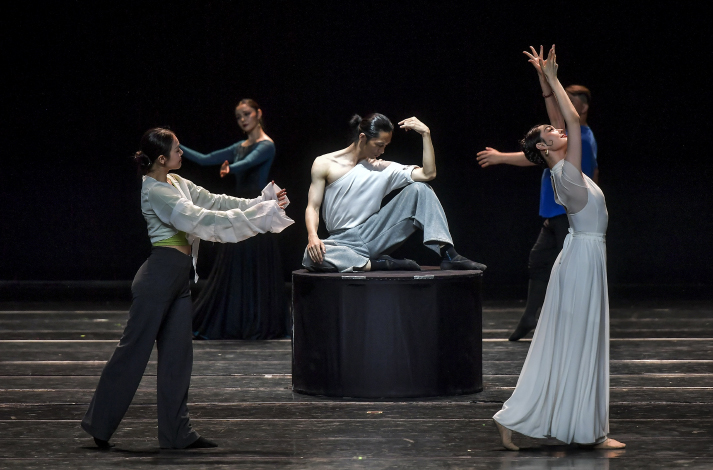 A dance drama titled Qiuci is staged in Urumqi in May 2025 (VCG)
Art as a common language Art on this frontier was not a mirror of empire—it was a conversation. The murals from the Kizil Caves near Kuche, a complex of Buddhist rock-cut caves featuring numerous murals and statues of Buddha, offer proof: Graceful bodhisattvas painted in Indian style bear the facial features of Central Asians, while the arrangement of halos and flowing ribbons echoes Central Plains techniques. Painters and sculptors blended pigments and motifs from across continents, creating an aesthetic that belonged to no single culture yet spoke to all. In music and dance, too, influences swirled. The Huteng dance, with acrobatic spins and leaps, gained such popularity that it became a court spectacle in Chang'an. The Qiuci melodies transformed imperial orchestras. Central Plains musicians studied Western Regions rhythms as eagerly as scholars studied Confucian texts, treating art as one of the dynasty's most enduring bonds. These exchanges were acts of synthesis. The Grand Anxi Frontier Command respected the religious beliefs and customs of all ethnic groups, fostering a cultural ecosystem characterized by "diversity within unity and harmony amid differences." Ethnic integration in the Western Regions deepened, and a sense of shared identity took shape. A legacy of lasting influence When the Tang Dynasty eventually declined, the institutions of the Grand Anxi Frontier Command lingered. Later dynasties borrowed its principles—military-civil fusion, frontier schools and cultural integration—to manage distant territories. The Yuan Dynasty (1271-1368) used similar systems. The Qing Dynasty (1644-1911) revived its spirit in the post of Yili (Ili) General in the 18th century. But the Grand Anxi Frontier Command's influence ran deeper than administrative continuity. It offered a vision of how contact could replace conquest—how the margins of a dynasty could generate creativity rather than conflict. That vision remains relevant in today's world of contested borders and cultural misunderstandings. When we stand among the Jiaohe Ancient City Ruins, another Silk Road landmark, today, the cracked earthen walls bear faint traces of ancient scripts: Chinese bureaucratic notes, Buddhist verses and trade tallies. Each fragment is a testimony that civilization's edge was never barren—it was busy, vibrant and alive. The Grand Anxi Frontier Command guarded China's frontier, but it also guarded something larger—a belief that the boundaries between cultures need not be barricades. In its time, under the gold dust of the Silk Road sun, Chinese and Central Asian voices built a shared world of exchange and trust. For modern readers, that legacy feels surprisingly fresh. It reminds us that global dialogue does not begin in capitals or summits, but where travelers meet on the road, where languages mix in the market, and where a frontier becomes a home. The role of the Grand Anxi Frontier Command in the Tang-era governance of the Western Regions affirmed a timeless truth: A civilization grows its strongest roots when it is open to the world. Comments to lanxinzhen@cicgamericas.com |
|
||||||||||||||||||||||||||||
|








