
|
| Xinjiang Today |
| Preserving a rich history | |
|
|
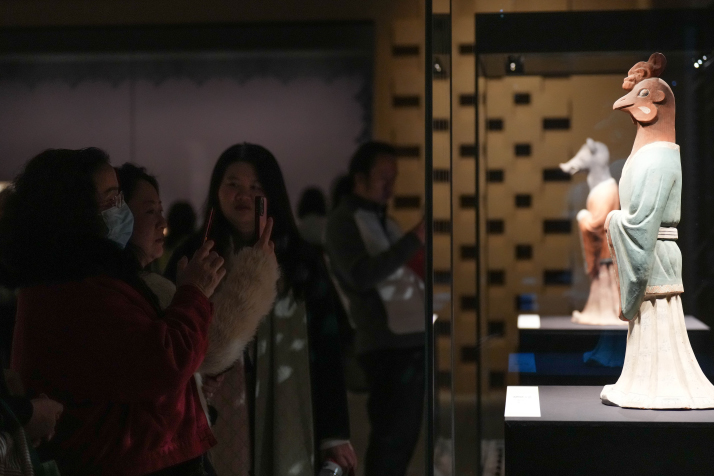 A rooster-headed human-bodied figurine from the Tulufan (Turpan) Museum on display at the Hunan Museum, Changsha, Hunan Province, in January 2025 (XINHUA)
Xinjiang is home to one of China's most extensive and diverse collections of cultural heritage. Across this vast region, spanning deserts, mountains and grasslands, lie over 9,500 immovable cultural relic sites, including six World Heritage locations and 133 major historical and cultural sites protected at the national level. Protecting these sites has never been easy. The region's size alone makes comprehensive monitoring difficult. Many sites are remote, accessible only by days of travel across difficult terrain. Natural forces take a constant toll: Wind and rain slowly erode exposed walls, temperature fluctuations crack murals, and shifting riverbeds threaten cave complexes. Human activities such as illegal construction, livestock grazing and industrial pollution add another layer of pressure on protected zones. For years, the gap between the scale of these problems and the tools available to address them seemed insurmountable. Manual inspection could only cover a fraction of the territory. When damage occurred, prosecutors and heritage protection officials often lacked the precise data needed to prove liability or justify intervention. That situation is now changing. Over the past five years, Xinjiang has emerged as a testing ground for new approaches to heritage preservation—approaches that combine cutting-edge technology with novel legal mechanisms and cross-agency collaboration. At the same time, a series of major archaeological discoveries has reshaped scholarly understanding of the region's place in Chinese history. Together, these developments are rewriting both the story of Xinjiang's past and the methods used to safeguard it for the future. "Xinjiang has been a vital meeting point of Eastern and Western civilizations since ancient times. Protecting and presenting its cultural heritage demands multidisciplinary collaboration and the application of modern technology. We must also interpret the cultural and historical significance of archaeological findings from multiple perspectives and with greater depth. This is not only a pressing need of our time but also the future of heritage preservation," Song Xinchao, Chairman of the Chinese National Committee for the International Council on Monuments and Sites (ICOMOS China), said at the Symposium on Innovative Development Strategies for Cultural Heritage under the 15th Five-Year Plan (2026-30), held in Shaya County, Aksu Prefecture, last November. 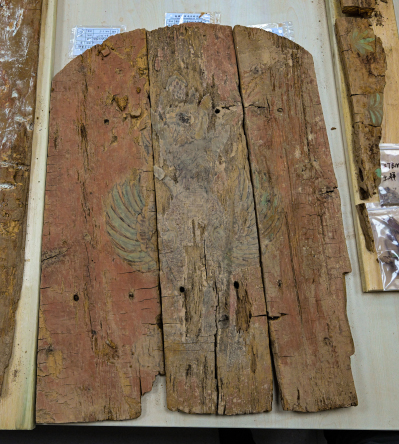 A wooden coffin front panel painted with a Vermilion Bird motif, unearthed from the Badamu Cemetery, at the laboratory of the Xinjiang Institute of Cultural Relics and Archaeology at the Chinese Academy of Social Sciences in Beijing in February (XINHUA)
A window into history Discoveries made at Badamu Cemetery are among the most significant archaeological findings made in Xinjiang. Nestled in the Tulufan (Turpan) Depression, the cemetery is the final resting place of many Tang Dynasty (618-907) officials who administered this far western territory more than 1,200 years ago. Since 2022, a team from the Xinjiang Institute of Cultural Relics and Archaeology, working with partner institutions, has excavated 27 tombs dating to the Jin (265-420) and Tang dynasties. Among them, three stand out. The tombs of officials Cheng Huan, Li Chonghui and Yin Gong have yielded inscribed epitaphs that read like chapters of a forgotten history book. Cheng's epitaph records his service as deputy commander of the Grand Beiting Frontier Command, a high-level military post in what is today's Jimusaer (Jimsar) County. Li Chonghui served as a senior official in the Western Prefecture, located in modern Tulufan. Yin, buried in a single-chamber brick tomb of a type reserved for high-ranking Tang officials, held the title of deputy commander of the Grand Anxi Frontier Command, an outpost established by the Tang Dynasty to govern the region. "These three tombs all date to the mid-to-late Tang period, a time of upheaval following the An Lushan Rebellion (755-763), a devastating civil war that weakened the Tang Dynasty," Li Wenying, Deputy Director of the Qiuci Academy in Xinjiang, told newspaper China Culture Daily. "Yet here we have centrally appointed officials, completely unknown from historical texts, serving out their careers and being buried in the land they administered. It is direct, physical evidence that the Tang court's governing institutions continued to function in the then-called 'Western Regions,' even in times of turmoil." The tomb of Yin, discovered in 2025 during the fifth excavation campaign at the Friendship Road Cemetery in Kuche (Kuqa), another key site about 700 km southwest of the Badamu cemetery, is particularly important. Buried in the eighth year of the Zhenyuan era (792), Yin died at a moment when the Tang's grip on the region was supposedly weakening. Yet his tomb followed central Chinese burial customs to the letter, with bronze coins placed in his mouth, a layout mirroring metropolitan Tang tombs and a ceramic figurine army to accompany him into the afterlife. "Seeing this epitaph moved me greatly," Rong Xinjiang, a professor in the history department at Peking University, said while addressing a meeting on the 2025 Xinjiang Archaeology Work Report, held on February 8 in Beijing. "It records Yin's mission to the Abbasid Caliphate (stretching from Morocco to Afghanistan from 750 to 1258) on behalf of the Tang court. We knew the court had sent diplomats by sea, but here is evidence that officials stationed in the west also traveled the land routes, maintaining connections that spanned the Eurasian continent." The tomb also contained coins from Byzantium and Sassanian Persia, alongside ceramics showing Hellenistic influences. "These finds testify to the dual identity of these frontier communities," said Guo Wu, a researcher at the Chinese Academy of Social Sciences (CASS). "They were administratively and culturally part of the Tang, while simultaneously engaged in vibrant exchange with Eurasia." Across Xinjiang, a string of major archaeological campaigns is strengthening people's cultural confidence and earning national recognition. The Husta site in Wenquan County, nestled in the west Tianshan Mountains, is a sprawling Bronze Age settlement dating back to around 1600 B.C. In its eastern cemetery, however, archaeologists uncovered an unusually large tomb dating back to between 2800 and 2600 B.C., 1,200 years older than the main settlement and featuring burial customs distinct from the later Bronze Age culture that defined the region and is among the oldest of its kind ever found in Xinjiang. "The discovery proves that even in the Bronze Age, the cultural landscape of the Bortala River valley was far from uniform," Wang Peng, an associate researcher with the CASS, told newspaper Xinjiang Daily. "These early burials may hold the key to tracing the origins of other important archaeological cultures across the Eurasian steppe." Then there is Tulufan's Xipang Jingjiao monastery site, an example of the region's religious diversity. First established around the mid-eighth century, the site has yielded over 1,300 documents in multiple languages, including Chinese and Syriac, alongside well-preserved murals and organic remains. "What we've found here is remarkable," Liu Wensuo, a professor at Sun Yat-sen University, told China News Service. "Over 1,300 ancient manuscripts in seven or eight different scripts—Syriac, Arabic, Persian, and more—all coexist at a single site. It paints a vivid picture of how multiple religions and cultures lived side by side along the Silk Road." The monastery's architecture also reveals unmistakable influences from the central part of China: Interlocking dougong wooden brackets, a quintessential feature of traditional Chinese construction, have been identified among the ruins. Further east, in Hami's Yiwu County, the Jianjiaopo Cemetery tells a different story, one of nomadic splendor and ritual sacrifice. This high-status burial ground from the Warring States Period (475-221 B.C.) has yielded over 200 horses interred alongside their owners, their bodies adorned with gold and bronze ornaments. "The horses closest to the main tomb are unadorned, likely intended as food offerings," Xi Tongyuan, a professor at Northwest University in Lanzhou of Gansu Province, told China Media Group. "But the others are covered in glittering gold decorations. It's a striking display of wealth and power." DNA and stable isotope analyses are now underway to trace the origins of these animals, offering potential clues about ancient exchange networks along the early Silk Road. Accolades have followed these discoveries. In February, both the Badamu Cemetery and the Husta site were named among China's top six archaeological discoveries of 2025 by the CASS. The following month, the two sites, along with the monastery in Xipang, were shortlisted for China's prestigious Top 10 New Archaeological Discoveries of 2025. Alongside its discoveries, Xinjiang's museum sector is also earning national acclaim. At the 22nd National Top 10 Museum Exhibitions awards, granted on International Museum Day in May 2025, the permanent exhibition of the Qiuci Wei-Jin Ancient Tomb Site Museum in Kuche, a museum built directly atop the Friendship Road Cemetery where the Yin Gong tomb was found, received a Special Award. The exhibition uses glass walls and multimedia displays to let visitors peer directly into 15 ancient brick-chamber tombs, combining on-site preservation with public engagement. Meanwhile, in a landmark moment for Xinjiang's cultural creativity industry, the Five Stars Rising in the East cultural and creative product line, inspired by the pattern of stars on a legendary Han Dynasty brocade arm guard unearthed from Niya, won a Gold Award at the 18th IAI Design Awards in March, the first time a cultural product from a museum in Xinjiang has received international design recognition. 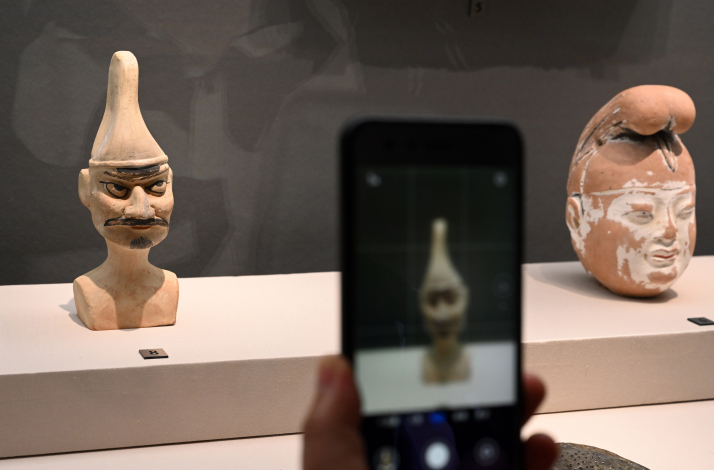 A painted clay bust and head from Xinjiang on display at the National Museum of China in Beijing in June 2023 (XINHUA)
A hard environment Xinjiang's geography and environment create novel challenges for those concerned with the preservation of immovable relics. With cultural heritage sites widely dispersed across remote and environmentally complex areas, in the past, it was difficult to carry out regular manual inspections, so key data, such as crack widths and pollution spread, was recorded only roughly. This led to insufficient precision in evidence collection and poorly targeted protection measures. In 2020, the People's Procuratorate of Xinjiang Uygur Autonomous Region launched a year-long special supervision campaign titled Protection of Cultural Relics and Historic Sites across the region. During this campaign, prosecutors discovered significant risks to both the cave structures and murals at the Kumutula Grottoes in Kuche due to two main factors. First, the downstream hub on the Weigan River had been impounding floodwaters and causing sediment buildup, which raised the riverbed and water levels in front of a major grotto cluster. Industrial pollution from nearby coking plants added a chemical assault to this physical threat. The prosecutors deployed a three-pronged technological arsenal: satellite remote sensing to track pollution plumes, drones to model cave cracks, and 3D imaging to digitally document the damage for use as evidence. They also brought in more human resources to tackle pollution problems. "We had experts pointing at the murals and explaining the damage, and talking about preservation while looking right at the cracks. This kind of on-site work was more effective than issuing prosecutorial recommendations," Song Xiaoling, Director of the Sixth Prosecution Department at the Aksu branch of the People's Procuratorate of Xinjiang, told Guangming Daily. In the end, water conservancy authorities and cultural heritage experts jointly developed a solution that included establishing a safe water level and conducting consultations during the flood season. At the same time, the culture and tourism bureau pushed for the coking plant to halt operations and relocate. A national framework In June 2023, the High People's Court of Xinjiang and the Xinjiang Cultural Heritage Administration signed an agreement on judicial protection cooperation, creating five major mechanisms for information sharing, collaborative case handling, joint research and training, public education, and regular consultations. The agreement operationalizes the principle that heritage protection is not a solo performance. "Procuratorial authorities need to act as 'glue,'" Song Xiaoling said. "We bring together administrative responsibilities, corporate accountability and expert knowledge, allowing legal supervision to nurture the evergreen trees of cultural inheritance." In Changji Hui Autonomous Prefecture, the procuratorate and the prefecture's culture and tourism bureau have established long-term mechanisms including joint relic preservation meetings and coordinated case handling. Through public interest litigation supervision, they pushed cultural heritage departments to innovate their public outreach—launching "mobile museum" lectures across townships, educating residents and grassroots officials on the importance of heritage sites. In 2024, the People's Procuratorate of Emin County of Tacheng Prefecture spearheaded the signing of a collaboration mechanism with the county's Bureau of Culture, Sports, Radio, Television and Tourism and the Bureau of Ecology and Environment. The mechanism clearly delineates the protected zones, prohibited acts and allocation of responsibilities. As a result, the protection outcomes have surpassed what any single agency could have accomplished alone. As a result, the Yemili ancient city site within Emin County has seen annual visitors grow to over 10,000, hosting more than 50 study tours annually. "Leveraging the resources of Yemili, we established a cultural study and legal education base, allowing visitors to experience the charm of history while receiving legal education during their tours," He Kangming, Director of the Second Prosecution Department at Emin County People's Procuratorate, told Guangming Daily. The long march While courts and prosecutors build their frameworks, another army is already in the field: the 600-plus team members conducting the Fourth National Cultural Relics Census across Xinjiang. Their stories read like adventure novels. In Hetian (Hotan) Prefecture, team leader Maitikasimu Tumuer led his team into the Taklimakan Desert, searching for ancient sites along the southern Silk Road routes. Their supplies included surveying equipment, extra water, medicine and even camels to carry it all. "We often hit storms along the way, and we have to be ready for that," Maitikasimu told China Youth Daily. In Huoerguosi (Horgos), another team battled a different adversary: locusts. "Every meal was a race," Zhang Huiling, who leads the local census effort, said. "You'd open your instant noodles, take one bite and have to cover it immediately. Otherwise, the locusts would jump right in." Despite these conditions, the results are staggering. In the 11 months since Xinjiang's census fieldwork began in May 2024, teams had surveyed 11,109 immovable cultural relic sites as of April 28, 2025, including 9,165 rechecked from the third census and 1,944 newly discovered. Some of these discoveries come from ordinary people. In Qinghe County, local villagers reported rock carvings on a black stone hillside. The next day, census team members arrived with herder guides and documented 60 petroglyphs, featuring camels, horsemen chasing ibex, and Buddhist mantras and symbols. "In Xinjiang, we are promoting an atmosphere where everyone is a guardian of cultural relics," Shamali Mulatibake, Curator of the Qinghe County Museum, said. A digital future for relics Technology continues to transform the work of preservation. For Zhang, who has worked in cultural relic preservation for over three decades, the change is almost unbelievable. "During the third census, measurement and mapping were done manually," she said. "Accuracy was our biggest headache. Now we have RTK (Real-Time Kinematic, a centimeter-level satellite positioning system), centimeter-level positioning and drones. Mapping is so much easier." Her team now carries subscriber identity module (SIM) cards from every telecommunication carrier. At remote sites with spotty coverage, they swap phones until one finds a signal, upload their data and move on. In Altay, Zoya Bahit, a deputy to the National People's Congress, has spent the past year pushing for digital protection of rock carvings. "These petroglyphs are invaluable historical cultural heritage, yet they are also incredibly fragile," she told Guangming Daily. Many are attached to entire mountain faces; traditional "ontological protection" would require reinforcing the geology of entire peaks. Ontological protection means physically preserving the original artifact or structure itself, rather than creating a digital copy. "First, we need to move their truest form into the digital world," Zoya said. Her team spent 2025 surveying representative rock art sites across Altay's six counties and one city, assessing sun exposure, water erosion patterns and equipment transport routes. They drafted protection plans tailored to each site's unique conditions. "When I imagine future visitors experiencing these ancient patterns through immersive digital exhibitions, clearly perceiving the charm of petroglyphs on mountain peaks thousands of kilometers away, all our efforts feel deeply worthwhile," she said. Comments to zhangyage@cicgamericas.com |
|
||||||||||||||||||||||||||||
|