
|
| Xinjiang Today |
| A multicultural border city, built for trade with Central Asia | |
|
|
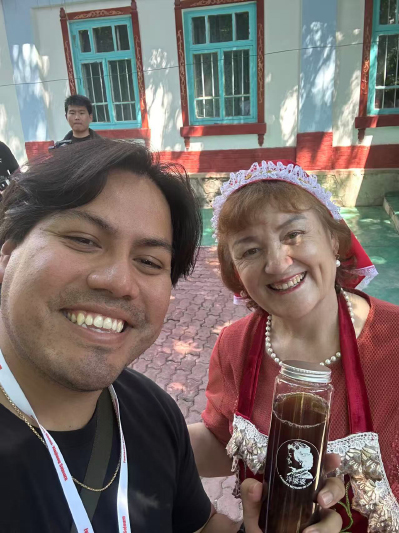 Antonio Alvarez (left) interacts with locals at the Yimanshu Manor in Tacheng City, Tacheng Prefecture, on June 14 (COURTESY PHOTO)
Trucks queue up at the gate to Kazakhstan every morning at Baketu (Baktu) Port in Tacheng City, Tacheng Prefecture. This border town has turned its location into its whole identity, and it has done so without losing the Han, Kazak, Hui and Tatar communities that actually make up the place. Walk down any street here, and you hear different languages before you reach the corner.
Tacheng sits so far northwest in Xinjiang that the border markers with Kazakhstan are visible from the road. For most of its history, that was just a fact of geography. Now it is the whole business plan, and the city shows it in two ways: on the loading docks at the border and around the dinner tables a few miles into town. Baketu Port is the reason Tacheng shows up on China's trade map. A walk through the port and the exhibition hall next door laid out the plan: a designated pilot zone built to speed up commerce between China and Central Asia. At the National Gate, customs staff work through paperwork and wave vehicles across in a steady, practiced rhythm. Nothing about it looks like a quiet border outpost. The city is mid-project on an upgrade to Baketu's customs clearance capacity, and that single detail says everything about where local officials expect growth to come from: more lanes, faster processing and tighter logistics. Manufactured goods and vehicles head west out of China, while raw materials and agricultural products come back the other way. All of it points to one goal: Get more of that traffic across the line, faster, in both directions. Businesses are already showing up to cash in. Xinjiang Shengda Xingtai Trading runs on international trade, and a few minutes away, inside the Tacheng Key Pilot Zone for Development and Opening Up, Xinjiang Qinggeng International Trading is doing the same. Tacheng, on the border with Kazakhstan, is not a wall; it is a door. 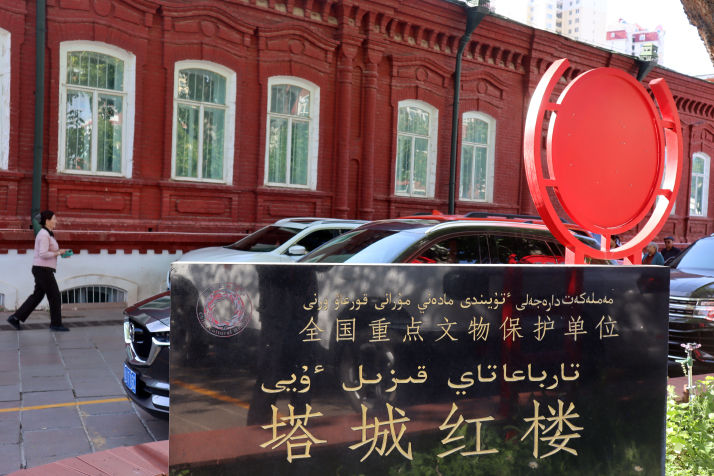 The Red Mansion Museum in Tacheng (VCG)
A mosaic of cultures the trade numbers don't capture None of that growth tells you much about who actually lives in Tacheng, and that is where the city gets interesting. The Red Mansion Museum holds its own chapter of the city's past, and a short walk away, the Tacheng Accordion Museum and the Oil Painting Museum tell a completely different story. Tacheng carries a reputation across Xinjiang as a city built on music and art, and the accordion in particular took root here through decades of trade and cultural interaction with Russia and Central Asian countries. Room after room of oil paintings, all made by local artists, show a border city that absorbs influence from every direction and turns it into something that is unmistakably its own. Such blend is not something stored away in a museum. It is the city today. Han residents, Kazak families, Hui shop owners and Tatar hosts share the same streets, and often enough, the same table. The Tatar presence is what makes Tacheng stand out. Tatars are one of the smallest ethnic groups officially recognized in China, and Xinjiang holds a decent share of that population, with Tacheng among the cities where the community has kept its language, food and traditions intact for generations rather than folding into the wider mix around it. That kind of staying power does not happen by accident. It takes a city willing to give a small community room to hold onto what makes it distinct, generation after generation, instead of pressuring it to blend in. 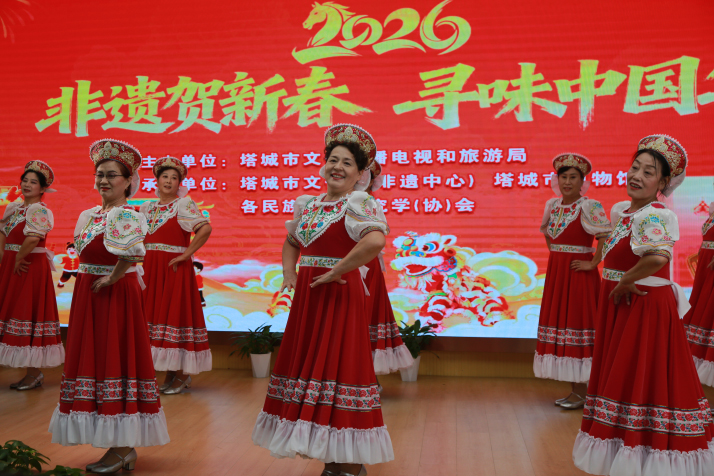 Ethnic Russians stage a traditional tap dance performance in Tacheng on February 5 (VCG)
Everyday connections, one meal and one dance at a time Nothing captured that better than Yimanshu Manor, where a Tatar family opened their home for lunch. A Tatar grandmother worked the dough by hand while the rest of the family set out plate after plate of food, more than any table could reasonably hold. Traditional Tatar pastries came out of the kitchen still warm, followed by a spread that stood out as one of the best meals of the entire trip. It appeared like a genuine invitation, not a scheduled stop. Friends Manor earned its name later that same day. Dancing with people from several of Xinjiang's ethnic communities and passing around snacks had nothing to do with trade volume or customs data. It was just people enjoying each other's company, period. Someone would grab a hand and pull you into the circle before you had time to say no, and the music never really stopped long enough to sit back down. A stop at Rose Manor in Haerdun Community added one more example of a city that folds its ethnicities into everyday life instead of holding them at arm's length for show. None of these stops felt staged for visitors. They felt like the way Tacheng spends a typical evening. The map runs out here, but the story doesn't Tacheng may not have the name recognition of Urumqi or Tulufan (Turpan). What it has instead is a plan, and it is executing that plan without apology: Build the ports, court the trading companies, stage the vehicles and let the border do the heavy lifting. None of that has come at the cost of what makes the city distinct: an accordion tradition that goes back generations, a Tatar family that hands strangers a plate before anything else, and a dance floor at the end of a long day that belongs to everyone in the community. Urumqi points toward Xinjiang's energy future, and Tulufan shows how deep the region's history runs. Tacheng ties both of those threads together at the literal edge of the map, proving that a place built on trade numbers can still hold onto everything that has nothing to do with trade at all. Not one story, but a dozen running at once, doing business and building lives right on the end of China bordering on Central Asia. The author is a staff reporter with China Focus, an international media platform based in Beijing under China International Communications Group Comments to yanwei@cicgamericas.com |
|
||||||||||||||||||||||||||||
|