
|
| Xinjiang Today |
| Seventeen travelers, one journey | |
|
|
 Young visitors pose for a group photo at a bonfire party at the N39° Desert Scenic Area in Maigaiti County, Kashi Prefecture, on July 26 (XIANG YUTING)
What does Xinjiang look like? There may never be a single answer to this question.
Some describe it as a place of "nature, culture and a welcoming atmosphere." Others summarize their impressions with words such as "contrasting, hospitable and lively." Still others see Xinjiang as "vibrant, ancient and irreplaceable." For some who have visited the region before, this land has even become a place they affectionately call "home." These impressions came from a group of Gen Z travelers who had just wrapped up their journey to Xinjiang. From July 25 to 31, 17 young people from Europe, Central Asia, Southeast Asia, East Asia and a few Arab countries visited Urumqi, Changji Hui Autonomous Prefecture, Kezilesu (Kizilsu) Kirgiz Autonomous Prefecture and Kashi (Kashgar) Prefecture in Xinjiang. Many of them are active content creators on overseas social media platforms with large followings. For them, this trip to Xinjiang was not only a journey of exploration and content creation, but also an experience of cross-cultural exchange built on firsthand encounters, visual storytelling and social media sharing. During the seven-day Global Youth Multicultural Forum in Xinjiang, they visited the Ancient City of Kashi. There, they watched the forum's lively opening ceremony, which was a cultural performance featuring Silk Road stories, historical figures, traditional music and ethnic dances; and explored the Preservation and Comprehensive Renovation Memorial Hall of the Ancient City of Kashi, learning how the thousand-year-old city has gradually regained vitality after overcoming past challenges. They also traveled deep into Maigaiti (Makit) County on the southwestern edge of the Taklimakan Desert, discovering the story behind the large-scale windbreak and sand-control ecological forest project. In the desert scenic area, they rode camels, drove desert motorcycles, and experienced the tranquility and vastness of the desert night beneath a sky full of stars. Along their journey, they savored Xinjiang's sweet fruits, including figs from Shangatushi Town in Atushi (Artux) City of Kezilesu, and new varieties of prunes from Jiashi County in Kashi Prefecture. Yet what left the deepest impression on them was more than the spectacular landscapes and exquisite local delicacies. During their journey, they interacted with local residents, took photos together and learned about the everyday lives of people from different ethnic groups in Xinjiang. Through eye contact, face-to-face conversations, shared photos and even moments of communication despite language barriers, friendships gradually formed. For many of these first-time visitors, Xinjiang was no longer a place on a map; it became a real experience—something they could remember, feel and share. 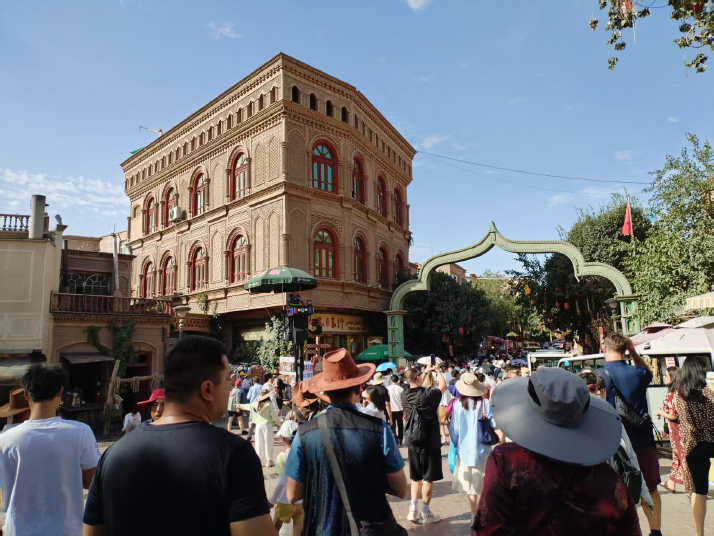 A view of the Ancient City of Kashi (XIANG YUTING)
Living with history Kashi offers a window into Xinjiang's rich history, diverse cultures and evolving urban life. As a renowned trading hub along the ancient Silk Road, Kashi has witnessed centuries of exchanges between Eastern and Western civilizations and serves as a living testament to interactions among different ethnic groups. For many of the young visitors arriving in Xinjiang for the first time, the ancient city became a gateway to discovering the region. On July 26, outside the eastern gate of the Ancient City of Kashi, visitors gathered early in anticipation of the opening ceremony of the Global Youth Multicultural Forum. As the sound of suona horns and powerful drums filled the air, the ceremony began. Historical figures such as Zhang Qian and Ban Chao appeared through performances, bringing Silk Road stories from the past to life. Traditional ethnic dances followed one after another, while the humorous figure of Afanti added joy and laughter to the atmosphere. As the ceremony reached its climax, the city gate slowly opened, and performers waved to visitors gathered outside. Walking into the Ancient City of Kashi, visitors found themselves surrounded by winding streets, traditional earthen-colored houses and workshops showcasing local craftsmanship. Blacksmith shops, pottery workshops and embroidery studios line the streets, while lively markets buzz with the vibrant rhythm of everyday life. Residents going about their routines, children playing, shopkeepers running businesses and tourists exploring the city—all are naturally blended together to create this vivid urban tapestry. Known for its large-scale earthen architecture and unique maze-like street layout, the Ancient City of Kashi has preserved the urban fabric formed over centuries. Traditional customs remain vibrant, while the development of cultural tourism has brought new vitality, attracting young entrepreneurs and emerging businesses to the historic neighborhood. For Yu He from Viet Nam, the charm of Kashi lingered until the end of the journey. "This was my first time visiting Xinjiang, and I was so happy to be here. During our free time, I chose to visit the Ancient City of Kashi again because I loved it so much," she said. At the Preservation and Comprehensive Renovation Memorial Hall of the Ancient City of Kashi, the young visitors learned that the ancient city once faced serious challenges, including inadequate infrastructure, weak earthquake resistance of old houses and poor living conditions. The difficult living conditions of the ancient city more than a decade ago were described in the saying "Sewage evaporates into thin air, rubbish drifts with the wind, water pipes hang on walls, and residents climb rooftops to relieve themselves." In 2010, Kashi launched a renovation project for old and unsafe residential buildings. Following the principle of "repairing the old as the old and rebuilding the new in the old style," the project adopted a "one household, one design" approach. Rather than simply demolishing and rebuilding, the renovation focused on preserving the original architectural features and maintaining the daily life of local residents while improving infrastructure such as water, electricity, gas and fire safety facilities. In 2024, the Regulations on the Protection of the Ancient City of Kashi of Xinjiang Uygur Autonomous Region officially came into effect, providing a legal framework for the living preservation of the ancient city. Today, the Ancient City of Kashi has retained its traditional character while becoming a place where residents enjoy improved living conditions, visitors experience diverse cultures, and local communities benefit from tourism development. Egyptian participant Ahmed Mohamed Ahmed Abdelazizm Ohamed, who speaks fluent Chinese, had little direct understanding of Xinjiang before. After arriving in Xinjiang, seeing the blend of old and new in Kashi's urban landscape, experiencing local culture firsthand and communicating openly with fellow participants and residents, he was deeply impressed. "This is the best travel experience of my entire life. This first trip to China is unforgettable. I will never forget every moment here." In Maigaiti, the visitors also experienced the region's distinctive Dolan culture. The word "Dolan" is believed to originate from a Uygur expression meaning "to gather" or "to assemble." Emerging from the unique natural environment of the Yarkant River basin and the interaction of diverse cultures, the Dolan people created a distinctive artistic tradition featuring bold yet delicate music and dance. Among its most representative forms are Dolan Muqam and Dolan Meshrep, which continue to be passed down today. For these international visitors, culture was not a static symbol displayed behind glass. It was brought to life through distinctive architecture, music echoing through streets, expressive dances and the aroma of local cuisine. "The real Xinjiang is far more diverse and vibrant than I had imagined," said Jowairia Hamdy, a 21-year-old participant from Egypt. "Experiencing it in person was completely different from what I had heard before." 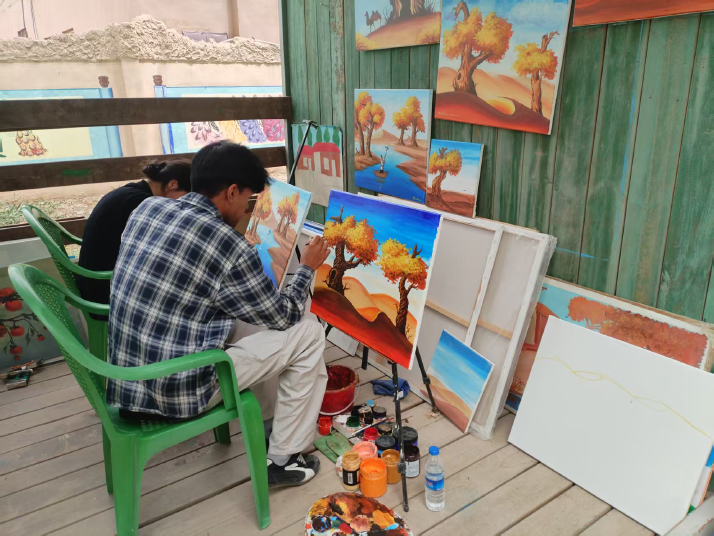 A Dolan farmer painter creates a painting in the Ancient City of Kashi on July 27 (XIANG YUTING)
Making peace with the desert Xinjiang's charm lies not only in its profound history and vibrant cultural traditions. The desert is another defining feature of this vast land. The Taklimakan Desert, China's largest and the world's second-largest shifting desert, stretches across southern Xinjiang and forms a unique backdrop to the region. Yet behind the endless sand dunes lies a story that goes beyond desolation—a story of people confronting harsh conditions, restoring ecosystems and exploring new possibilities in harmony with nature. Maigaiti, located on the southwestern edge of the Taklimakan Desert, was once severely affected by drifting sands. At its closest point, the desert was less than five km from the county seat. More than a decade ago, the area was locally known as a "sea of death," where "not a bird flew in the sky and not a blade of grass grew on the ground." The fragile environment posed serious challenges to local residents' livelihoods and restricted the county's economic development. Today, a green barrier is gradually taking shape on this once barren land. Along the northern section of the desert edge, Maigaiti has implemented measures including forest tending, ecological protection and floodwater diversion irrigation, building a natural ecological barrier. In the central section, the county has strengthened patrols and conservation efforts across 20,000 hectares of natural grassland, protecting a valuable 60-km natural sand-blocking belt. In the southern section, where sandstorms once directly threatened the county seat, Maigaiti launched large-scale windbreak and sand-control ecological forest project in 2012. Behind this transformation are the memories of those who witnessed the battle against desertification firsthand. Xiang Ke, a local resident with years of experience in grassroots work, including serving as a village official, township official and head of publicity work in Maigaiti, still remembers the hardships of the early years. At that time, roads into the desert had yet to be built. Local officials and people from different ethnic groups traveled by donkey, tractor or on foot to reach planting sites. Finally, they turned an impossible task into a green miracle. He recalled that he once accompanied a group of foreign visitors to the desert, and one of them asked a straightforward question: "Why didn't people simply move to a place with better living conditions?" His answer was simple: "When local people did not want to leave, the solution was not relocation, but to devote manpower, resources and time to improving the environment." For generations of Maigaiti residents, the fight against desertification was not only about controlling sand, but also about protecting their homeland and creating a better future where they had lived for generations. Standing before the vast green belt, Mahri Bayramova from Turkmenistan was deeply impressed. "I was amazed by the collective strength of China and the speed of China's tree-planting efforts," she said. While continuing efforts to combat desertification and build ecological barriers, the county has also explored ways to transform its unique desert landscape into a resource for sustainable development. Through carefully planned desert tourism, the once harsh environment has become a destination where ecological restoration and tourism development come together. As night fell, the young visitors entered the heart of the desert, where they watched traditional performances and fireworks beneath the vast sky. As an influencer who has nearly 11 million followers on overseas social media platforms, Hamdy later shared videos of the experience online. She noticed that many of her followers were fascinated by the tourism facilities built in the Chinese desert. "Many people are used to seeing luxury resorts by the seaside or in city centers, but they never expected China to build high-standard five-star hotels deep in the desert," she said. For Chua Kokyeong from Singapore, the most unforgettable moment of the entire journey was also the night spent in the desert. "We drove deep into the desert and watched performances there. It was an absolutely unforgettable and breathtaking experience," he said. For these visitors, the desert is no longer simply a distant and harsh natural landscape; it has become a place where people and nature interact, where ecological conservation meets tourism development, and where new possibilities continue to emerge. From strangers to friends If the landscapes and cultural experiences allowed these visitors to discover Xinjiang, it was the interactions between people that truly allowed them to feel the warmth of the region. Before the journey began, the 17 participants had mostly never met each other. Yet after several days of traveling together, they quickly became friends, sharing jokes and giving each other playful nicknames. Chua, who was passionate about fitness, was affectionately called "Mr. Muscle" by the group. Meanwhile, Bui Quangthuy from Viet Nam, who was quiet but highly observant, earned the nickname "Mr. Quiet." Small moments that happened along the way also became shared memories. On the afternoon of July 27, while returning from Maigaiti to Kashi City, the group's bus stopped briefly at a service area. Umutcan Deniz Gunes from the Netherlands struck up a friendly conversation with a Chinese driver who was also taking a break there. Speaking in somewhat imperfect Chinese, the Dutch visitor introduced himself as being from the Netherlands. However, the driver was unfamiliar with the country and did not know where it was located. Catching only the Chinese pronunciation of "Helan" (the Netherlands), which sounds similar to "Henan," a province in central China, the driver smiled and replied, "I'm from Henan." The unexpected humor caused by the similar pronunciation quickly drew laughter from the international visitors and other people nearby. After the brief exchange, everyone took photos together and recorded videos to share online. The driver happily told his colleagues, "I've made some foreign friends." Before leaving, he waved goodbye and warmly invited them to visit his home. Simple moments like this became the most authentic expressions of cross-cultural exchange. Meanwhile, the young visitors also used social media platforms to record and share their experiences in Xinjiang. Bayramova said she had already posted many pieces of content about Xinjiang on her social media platforms, attracting considerable attention from her followers. "Many friends living in China also send me messages asking for travel guides to Xinjiang," she said. According to Bayramova, there is a great deal of inaccurate information about Xinjiang circulating overseas, while many people have little understanding of what the region is really like. "I am glad that I have the opportunity to show people the real Xinjiang. Those rumors are not true," she said. Lee Chaeeun, a participant from the Republic of Korea, was most impressed by the kindness of local residents. "What I love most about this city is the kindness of the people here," she said. "I tried many local snacks, and when vendors learned that I was Korean, they even told me that I did not need to pay if I did not like the food." The warmth of the people in Xinjiang, she said, gave her a feeling of being at home. A journey may not be enough for a person to fully understand a place. But a genuine encounter can be enough to change the way they see it. From the historical heritage of the Ancient City of Kashi to the green transformation on the edge of the desert, from stories of the relationship between people and nature to encounters between people from different backgrounds, these young visitors from around the world have recorded Xinjiang through their cameras and words. What they saw was not merely a landscape. They saw a city constantly evolving between tradition and modernity, a land seeking a greener future amid challenges, and people who are warm, open and eager to connect with others. When they left Xinjiang, they took with them not only photos and videos, but also a shared memory of the Xinjiang they experienced firsthand. And these memories will continue to travel farther through their videos and their voices. Comments to xiangyuting@cicgamericas.com |
|
||||||||||||||||||||||||||||
|