
|
| Xinjiang Today |
| Xinjiang through many lenses | |
|
|
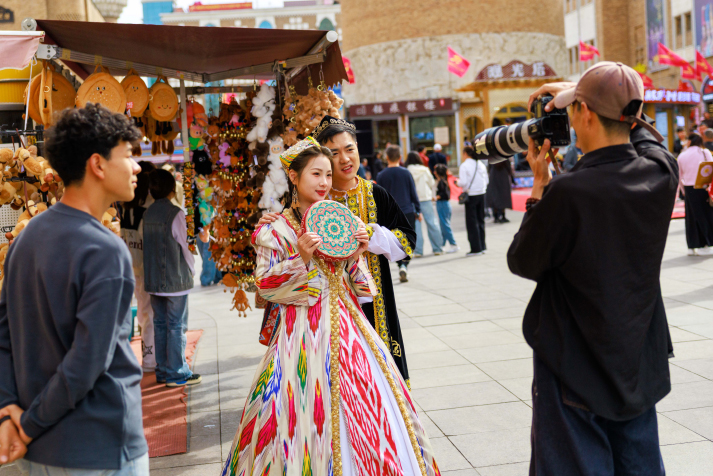 A photographer takes pictures of a couple wearing traditional Uygur costumes at the Grand Bazaar in Urumqi on October 1, 2025 (VCG)
In China, daka, literally "punching a card," has become a defining travel ritual. It means showing up at the most iconic landmark, snapping a photo and posting it on social media as proof of having been there. It is a quick, accessible way to document a journey and leave a digital souvenir. Across the country, scenic areas have scrambled to create ever more photogenic "daka spots," installing artificial backdrops and novelty signs with catchy buzzwords to attract the crowds.
But in Xinjiang, something different has emerged. Rather than manufacturing new photo opportunities, the region's vast natural landscapes and deep cultural wealth have given rise to a more sophisticated industry: travel photography. Unlike the quick daka snapshot, this is a full-service production, including professional makeup, traditional costumes, curated locations, dedicated photographers and hi-tech devices. Walking through the alleys of the Grand Bazaar of Urumqi, capital of Xinjiang, you will see this transformation firsthand. The streets were bustling with tourists dressed in local costumes posing against the iconic landmarks. In Uygur language, bazaar means "market," and the old bazaar of the Uygur people has been transformed into a vibrant street featuring food, souvenirs, and the travel photography business. "We came from Sichuan in July and as a last part of our journey, we want to memorize this tour by taking these photos," Liu Xiangrui told Xinjiang Today at the Urumqi International Grand Bazaar. She had chosen a traditional Uygur dress with an Atlas silk pattern, a handwoven silk whose origins trace back nearly 2,000 years in Xinjiang's Hotan region. "I have a special preference for clothing with rich ethnic characteristics and vibrant colors," she explained, adding that she was equally drawn to the Grand Bazaar's unique architecture—its ornate arches, intricate brick carvings, and the warm amber glow of its walls under the setting sun. From 'addon' to 'must-have' Xinjiang's embrace of the travel photography boom mirrors a national trend. According to data from third-party agency Tianyancha, as of late 2025, China was home to more than 6,800 travel-photography-related registered enterprises, with nearly 370 new registrations in the first quarter of 2026 alone and monthly registration growth exceeding 51 percent. Industry data show China's travel photography market was valued at nearly 50 billion yuan ($7 billion) in 2025. Xinjiang's numbers tell an even more dramatic story. In the Ancient City of Kashi (Kashgar), a single street can host more than 100 photography studios offering services ranging from 128 yuan to 500 yuan ($18-73), covering makeup, styling, costumes, shooting and retouching. The Ancient City of Kashi is a 2,000-year-old settlement and the world's largest surviving earthen architecture complex, with a maze of winding alleyways that have earned it the reputation of China's only "labyrinthine city." "The rise of travel photography stems from the upgrading of Chinese tourists' consumption concepts," Cang Ming, a professor at the School of History and Culture at Minzu University of China, wrote in a commentary in newspaper Guangming Daily. "More and more tourists are no longer satisfied with merely 'arriving at a destination.' Instead, they seek to 'immerse themselves in the scene.'" He argued that while travel photography serves as a form of self-expression, it also objectively facilitates cultural exchange and dissemination. It transforms cultural elements into visual images that can reach hundreds of millions of users, generating public interest and further promoting cultural diffusion. "In the past few years, travel photography has experienced high growth, and our business was good," Minawar Rohemat, an Urumqi-based makeup artist and co-runner of a travel photo studio, told Xinjiang Today. "But competition has intensified in recent years." "We have enriched our products to cater to our customers' needs and gain our edge in this competitive market," she added. Her strategy is threefold. "First, we segmented our offerings by ethnicity, focusing primarily on Uygur, Kazak and Tajik costumes, because many visitors are drawn to Xinjiang precisely by its rich ethnic cultures. Second, we created exclusive shooting backdrops, including a rooftop terrace that captures the iconic mosque of the Grand Bazaar in the frame, and we provide local props such as Xinjiang fruits, traditional musical instruments, and even goats to add authenticity to the shots. Third, we offer flexible pricing: Customers can opt for a 150-yuan ($22) makeup-only service, or choose a more comprehensive 499-yuan ($73) package that includes two outfits, full styling photographing and retouching. This tiered approach allows clients to adjust their budget and select the level of service that best suits their needs." For many visitors, the appeal goes beyond souvenir and extends toward a more in-depth cultural experience. "Every time I go to a new place, I get a different cultural experience. I'm often amazed by the richness of traditional Chinese culture," Chen Qiyun, a university student from Shanxi Province who traveled to Kashi for a local attire experience, told Beijing-based magazine China Comments. "I had watched documentaries about the making of Atlas silk, so I really wanted to wear an Atlas dress and dance with the locals." This desire for immersion has turned what was once a side service into a core part of the travel itinerary. "Travel photography has become a must-have in our product design," Yang Mei, General Manager of Xinjiang Kangtai Zhilü International Travel Service, told news portal Tianshan.net. "What used to be an optional addon is now a standard part of the experience for many travelers." Xiao Bing, Manager of Xinjiang Zhihu Tour Guide Co. Ltd., which has provided professional travel photography services to over 500 travel agencies since entering the industry in 2023, told Tianshan.net that the role of travel photography is quietly shifting. "Previously, travel photography was meant to add a touch of brightness to the journey, a kind of 'going viral' accent. Now it has become an important part of emotional consumption," he said. "It can make a journey immersed in Xinjiang's beauty more textured and more brilliant." His firm now provides photographers who double as tour guides. "In a group of over 20 travelers, everyone visits the same attractions and experiences the same cultural scenes, but their needs differ—some want to catch the sunrise, others prefer stargazing at night," Xiao said. "When the main guide is busy, our travel photographer steps in to help, meeting visitors' individual needs while also promoting Xinjiang tourism." Xiao's company is also experimenting with cinematic techniques—using film-grade lighting and composition to turn travel footage into short movies. "We try to use cinematic storytelling in our shoots, presenting Xinjiang's beauty and culture through a film lens," he told Tianshan.net. "This is no longer a simple record of a trip, but a creative collaboration between the traveler and the photographer, set against Xinjiang's cultural backdrop." In 2025, such high-end custom packages accounted for about 10 percent of his company's annual volume. 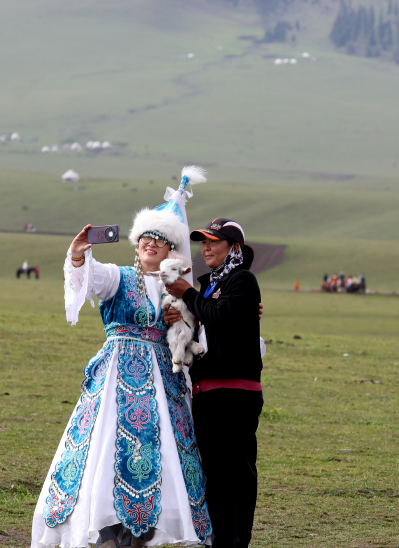 A visitor takes selfies while dressed up in a Kazak costume at Sayram Lake in Bole City, Bortala Mongolian Autonomous Prefecture, on August 24, 2025 (VCG)
Rich connotations Xinjiang's appeal as a travel photography destination is inseparable from its ethnic diversity. For millennia, this region has stood at the crossroads of civilizations, where Central Asian, Persian, Indian and China's Central Plains influences converged along the Silk Road. The result is a rich cultural tapestry, with 13 major ethnic groups calling Xinjiang home, including Uygur, Kazak, Tajik, Kirgiz and Hui communities. Each group has preserved distinct sartorial traditions that tell stories of nomadic heritage, religious beliefs and artistic expression, making the region a treasure trove for those seeking authentic cultural imagery. The Uygur people, the largest ethnic group in Xinjiang, are perhaps best known for their use of Atlas silk. Uygur women traditionally wear long dresses made of this brightly patterned silk, often paired with embroidered vests and elaborately decorated small caps, while men favor long robes with sash belts. The Kazaks, known for their nomadic heritage, favor embroidered white gowns paired with leather-trimmed vests and distinctive headwear: Unmarried girls often wear hats adorned with owl feathers, a symbol of beauty and freedom. The Tajik people, who inhabit the high-altitude Pamir Plateau, are known for their ornate headpieces embellished with pearls and silver ornaments. The Kirgiz are recognized by their crimson velvet round caps and patterned robes, each stitch reflecting a lineage of mountain-dwelling traditions. "I've done travel photography in many places across China," Liu said. "I shot hanfu (the traditional attire of the Han Chinese—Ed.) in Luoyang and Xi'an, Miao and Dai costumes in Xishuangbanna, and the Zanhua flower-headpiece style in Fujian, southeast China. Now, when people see those photos, they immediately associate them with those cities. It's almost like a visual shorthand for the destination." She said her Xinjiang photos have achieved the same effect. "When I posted them on social media, my friends couldn't recognize the Grand Bazaar in the background, but they could instantly tell I was wearing Uygur Atlas silk. That, to me, is the power of ethnic culture in travel photography." Weddings and drones But Xinjiang's appeal as a travel photography destination is not limited to its cultural richness. The region's dramatic natural landscapes, such as snow-capped mountains, pristine lakes, rolling grasslands and deep canyons, have become an equally powerful draw, offering backdrops that rival any studio set. From the spruce-fringed shores of Sayram Lake, often likened to a real-life Zelda fairyland, to the rolling meadows of Kalajun and the winding river bends of Bayinbulak, where the Kaidu River mirrors multiple sunsets in the famous "Nine Suns Reflecting on Water" spectacle. The region offers an almost overwhelming array of photographic opportunities. In the Yili (Ili) Valley, spots like Kuerdening and the Guozigou Bridge have become magnets for photographers. At Guozigou, a soaring S-shaped bridge threading through a canyon of spruce and snow peaks, visitors can frame shots that seem to suspend them in midair. On May 13, Xinhua News Agency photographers captured images of both a wedding couple and tourists taking photos at the site, a testament to the location's surging popularity. Wedding photography, in particular, has become a major driver of this natural-landscape boom. Xinjiang's sweeping vistas offer couples a grandeur that traditional studio backdrops cannot replicate. "In the past, when people talk about wedding travel shoot, the places that first came to mind would be Sanya of Hainan Island and Dali of Yunnan Province, both known for their stunning natural landscapes," Kashi-based wedding photographer Li Xian told Xinjiang Today. "And now they are adding Xinjiang to the list. Xinjiang's landscape is one of a kind." "A wedding photo package in Xinjiang usually costs 6,000-8,000 yuan ($887-1,182), and it contains both sightseeing and entertainment programs—as well as photoshooting. For example, the 8,888-yuan ($1,315), four-day tour customized package I acquired earlier this month, covered four major attractions in the southern part of Xinjiang. We were offered a seven-seat vehicle, a driver, a stylist, wedding gown rentals, food and accommodation for all. Young couples prefer customized package for wedding photos particularly, given it allows them to take their time and enjoy the tour as well as taking pictures," Li added. Beyond the iconic landscapes, animals also add to the fun: posing with white yaks on the grasslands of the Pamir Plateau, galloping across Nalati's rolling hills on horseback, and trekking through the Gobi Desert atop a camel. The technological frontier of this industry is also impressive. Drones have become a common tool, with some professional travel photographers now obtaining drone licenses to offer clients aerial shots. The most viral trend to emerge from this is the so-called "Handi Ba Cong," literally "pulling a scallion from dry land," which refers to a dramatic drone technique that uses a zoom lens to create the illusion of a subject or landmark rising abruptly from the earth. The effect is visually stunning: a rocky outcrop, a person standing on a cliff or even the winding curves of the Panlong Ancient Road on the Pamir Plateau appear to "lift off" against a backdrop of snowy peaks and cobalt sky. The technique has become so popular that some photography studios now list Handi Ba Cong as a standalone service, priced from 199 yuan ($29) for a short clip. "Drone photography has become inseparable from shooting Xinjiang's natural landscapes," Li said. "The scale of Xinjiang's landscape—the vast grasslands, the towering snow peaks, the serpentine mountain roads—you simply cannot capture that grandeur from ground level. A drone gives you a perspective that reveals the true majesty of the terrain. In wedding shoots especially, aerial shots have become almost essential." He noted that viral techniques like Handi Ba Cong have fundamentally changed how tourists approach photography in Xinjiang. "Since those clips went viral on social media, we've seen a massive surge in demand for the same shot at the same locations. A spot that was relatively quiet a year ago can now have a dozen photographers queuing up with their drones, all waiting for that perfect moment to pull off the 'lift.' Many of my colleagues have stopped traveling between sites altogether. They just set up at one iconic location and receive a steady stream of orders, sometimes six or seven an hour during peak season. The landscape itself has become the studio, and the drone is simply the brush that paints it," Li added. Comments to zhangyage@cicgamericas.com |
|
||||||||||||||||||||||||||||
|