
|
| Xinjiang Today |
| A bike's-eye view | |
|
|
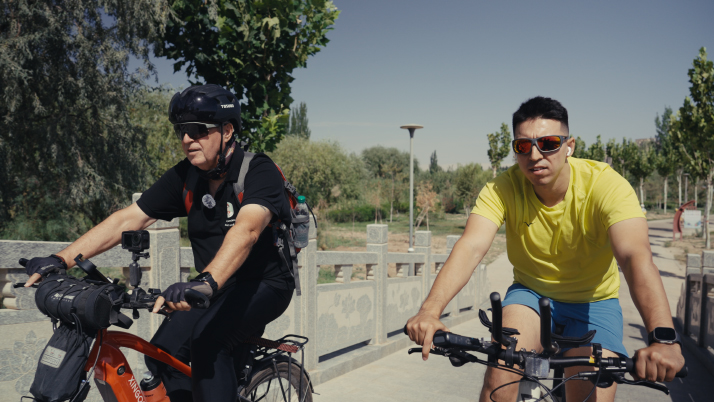 Jerry Grey chats with a local cycling enthusiast as they rode together through urban Kashi on July 17 (EMRAN MAVLAN)
Jerry Grey, a British-born Australian national, has lived in Zhongshan, Guangdong Province, for over two decades. A former police officer in London, the United Kingdom, and a retired educator in China, Grey is a cycling enthusiast and an active commentator on X (@Jerry_grey2002) with over 95,000 followers. Having cycled extensively across China, he has visited Xinjiang multiple times, developing a nuanced understanding of the region's rapid development and local realities.
On his latest expedition, Grey embarked on a long-distance cycling journey across the country alongside his Chinese wife and two companions. During a stopover in Kashi (Kashgar), he spoke with Xinjiang Today reporter Frieda Li to share his firsthand observations on poverty alleviation, public safety and cultural preservation in the region. Edited excerpts from the interview follow: 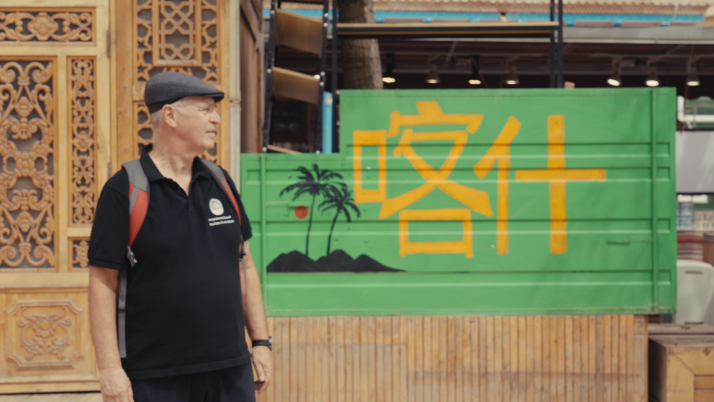 Grey explore a historic alley in Kashi Ancient City on July 14 (EMRAN MAVLAN)
Xinjiang Today: Could you briefly introduce your route? Jerry Grey: We traveled from Zhongshan to Hohhot in Inner Mongolia Autonomous Region by green trains [with relatively low speed] in May to begin this cycling journey. Our route took us across Qinghai Province, located on the Qinghai-Xizang Plateau—the world's highest and largest plateau, often referred to as the "Roof of the World." Much of the route was above 4,000 meters, where the thin air and lack of oxygen made riding especially challenging. From there, we crossed vast stretches of barren desert that looked almost Martian. It was an unforgiving landscape, with hundreds of kilometers where virtually no one lives. One section, about 900 km of true no man's land, was simply too dangerous to cycle, so we transported our bikes by vehicle before continuing. We then descended from the Qinghai-Xizang Plateau into Milan in Ruoqiang County, which is our first stop in Xinjiang. From there, we rode west through Kuerle (Korla), Kuche (Kucha or Kuqa) and Aksu before finally reaching Kashi along the northern edge of the Tarim Basin. For me, there were two particularly difficult stages. The first was crossing the mountain passes west of Xining on the Qinghai-Xizang Plateau, where we climbed to nearly 4,000 meters. The second was the desert stretch between Aksu and Kashi, where almost nothing grows. There was never a moment when I wanted to give up or end the journey. But there were certainly many days when I found myself thinking, "I just wish today were over." I would look forward to reaching a hotel, taking a shower, enjoying a cold drink and getting some rest. Then I'd remind myself that tomorrow would be another day. 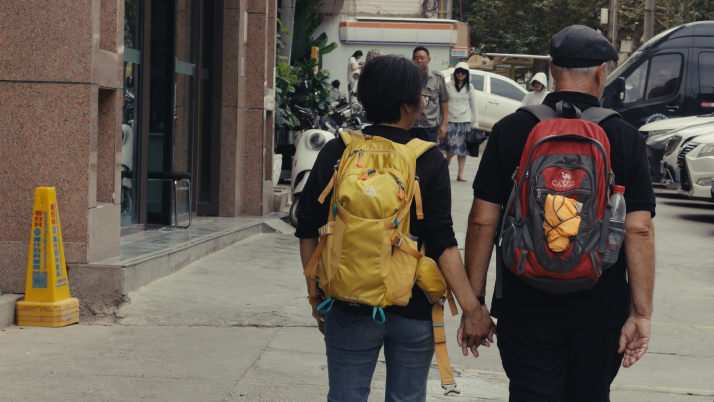 Grey and his wife, Anne Liang, walk through a street in Kashi on July 14 (EMRAN MAVLAN)
You've been to Kashi several times. What differences have you noticed? This is my third trip to Kashi. Although my first visit here was only about 14 or 15 months ago, my first trip to Xinjiang was back in 2005. The changes since then have been remarkable, and the most striking one, in my view, is poverty alleviation. I first came to Xinjiang with my father. We visited Hami, Tulufan (Turpan) and Urumqi, and what I saw at the time was genuine poverty. It was the first time in my life I'd ever seen camels walking through a city center. The city's Grand Bazaar was also very different then. It felt much more like a traditional Turkish-style street bazaar than the modern complex that stands today. Personally, I preferred the character of the old market. But from the perspective of the people who live and work there, today's bazaar offers far better conditions. People often say that China has torn down its old towns—that Kashi's ancient city or Beijing's narrow alleyways (hutongs) have disappeared. That's simply not true. Much of the historic architecture has been preserved, while other parts have been rebuilt to improve living conditions. Kashi is in an earthquake-prone region. Many of the old homes were built from mud and straw and were highly vulnerable to earthquakes. They also lacked basic necessities such as running water and electricity. In winter, families cooked over open fires inside their homes because there was no alternative. From a tourist's perspective, those old neighborhoods may seem picturesque. But for the people who actually lived there, life was often extremely difficult. I've come to appreciate that partly because of my wife, Anne Liang. There have been times when I've said, "It's a shame that old neighborhood is gone." She would always remind me, "Yes, but it was much harder for the people who had to live there." She was born in a simple house made of wood, grass and straw in the southern Chinese province of Guangdong just over 50 years ago. Today, her parents live in a comfortable three-story house with modern facilities. They're not wealthy by any means; they're an ordinary family living in an ordinary village. But that transformation reflects the dramatic improvement in living standards that has taken place during their lifetime. I've seen similar changes across Xinjiang, Guangdong and many other parts of China. When Anne and I first met, we became involved in charity work, raising money to support impoverished communities. Every year, we would visit rural areas in places like Guangxi Zhuang Autonomous Region and Jiangxi Province, where the funds we had raised were being used. Places that once struggled with poverty can look completely different just a few years later. I remember cycling through Zhongning in Ningxia Hui Autonomous Region several years after my first visit. The first time I saw it, many people were still living in makeshift shelters and cave dwellings. When I returned six years later, the county had been transformed, with high-rise buildings and a beautiful riverside park under development. That's what China is doing and it's doing it at warp speed. You worked as a police officer in London for many years. Does that give you a sharp eye when observing Xinjiang? I'm not sure I'd describe it as having particularly sharp observation, but I am naturally an observer. I like to research, ask questions and look a little deeper into how things work. I've noticed people in Xinjiang have a strong sense of security. In my view, that's because robust public safety measures make them feel safe. Of course, some people are uncomfortable with the presence of police. But the relationship between police and public here feels quite different from what I experienced in the West. In many Western countries, most people only encounter police officers when something has gone wrong, either they've become victims of crime or they're the subject of a police investigation. In China, people interact with police officers as part of everyday life. Some people said to me they wouldn't be comfortable seeing a police officer standing outside their child's school. And I would say why not. As a Chinese parent, you appreciate that system. But parents in Australia don't. They disliked that the society deemed such measures necessary. It shows very different perceptions: Westerners tend to view this as oppressive and authoritarian, whereas Chinese see it as safe and protective. This divergence in perspective explains, for instance, how satellite images of a factory compound, with a fence, a gated entrance and uniformed staff, are interpreted by outsiders as signs of incarceration, as if the dozens of doors inside must belong to prison cells. Yet in reality, this describes virtually every factory in China. Each one has dormitories, a canteen, a workspace, and often a basketball court and a car park. These dormitories are not cells; they are not prisons. The gates at the perimeter are there to protect what lies within, not to confine the people inside. Another contrast I've noticed is the role police officers play in guiding public behavior. Let me give you a simple example from this cycling trip. There were many occasions when I rode on the road instead of using the bicycle lane. Police officers would tell me, politely but firmly, to move back into the bike lane. They were correcting my behavior, not punishing it. They didn't issue a fine or try to penalize me—they simply reminded me to follow the rules. That experience stands in sharp contrast to what I would expect in Australia, where I would likely receive a fine for the same behavior. The Chinese police manage our behavior, while Western police profit from our misbehavior! 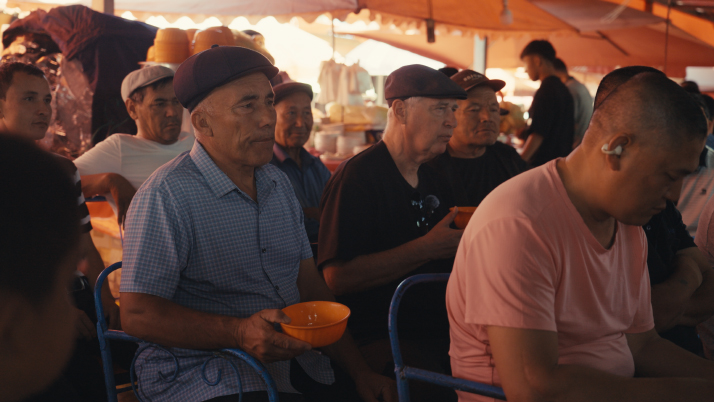 Grey enjoys a local shaved-ice yogurt while watching an outdoor film with local residents at a village livestock market on the outskirts of Kashi on July 15 (EMRAN MAVLAN)
How would you judge whether a city is safe? From a policing perspective, I'd start with the statistics. Does the city have a high crime rate? The second is much simpler: Go out in the evening and observe everyday life. When you walk through cities across China, not just in Xinjiang, you see people dancing in public squares, families taking evening walks, children playing outside and elderly people exercising in parks. China's homicide rate is extremely low by international standards. If you compare it with cities such as New Orleans in the United States, where the murder rate is around 46 per 100,000 people, China's national rate is approximately 0.4 per 100,000. Some people attribute this to the visible police presence or the widespread use of surveillance cameras. Those factors may play a role, but I don't think they tell the whole story. Most don't wake up in the morning wanting to become criminals or terrorists. When people have opportunities and a reasonable standard of living, they're less likely to turn to crime. Since we're in Kashi, we have to talk about Uygur culture. What's your impression? One common narrative in the West is that Uygur culture is being erased. Based on what I've seen, I don't believe that's the case. In fact, you're an example of this yourself. You grew up singing Uygur songs and wearing Uygur clothing, even though you're Han Chinese. That suggests to me that Uygur culture is not isolated, but that it is part of the region's broader cultural life. I also think it's important to avoid oversimplifying people's identities. Not all Uygurs are Muslims, not all Muslims are Uygurs and certainly not all Muslims are terrorists. During my travels, I've met Muslim friends from different ethnic backgrounds, including the Mongolian and Hui communities. They're all different, and reducing such diversity to a single narrative doesn't reflect the reality I've experienced. My own experience with the Uygur people has been that they are welcoming, generous and hospitable. That's why I believe the best way to understand Xinjiang is to come here, travel, meet people and draw your own conclusions. (Zhang Shasha contributed to this article) Comments to ffli@cicgamericas.com |
|
||||||||||||||||||||||||||||
|








