
|
| Xinjiang Today |
| What's behind Hami melons? | |
|
|
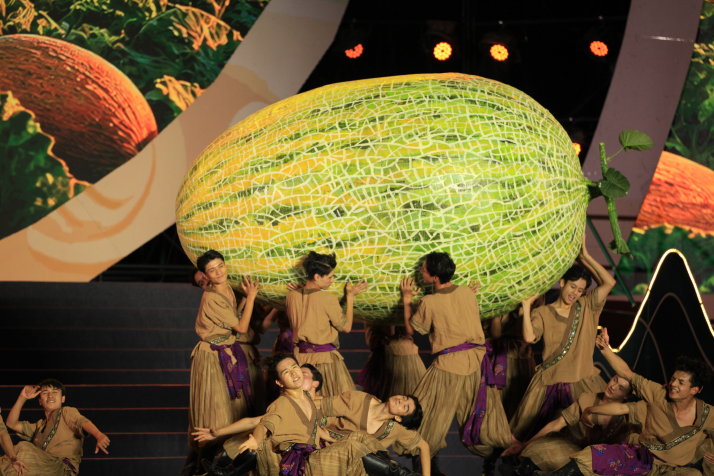 A performance at the opening ceremony of the 20th Hami Melon Festival in Hami on July 10 (VCG)
For most Chinese people, the Hami melon is one of Xinjiang's most iconic symbols. With its crisp, tender flesh and rich sweetness, this sun-drenched flavor is almost the very first impression many have of the region. Yet few pause to ask: Why Hami? What geographical endowments, historical threads, and urban realities lie behind this sweet melon?
Enter Hami, and one soon discovers that this melon means far more than just a fruit. The eastern Tianshan Mountains have shaped its unique growing environment, the interweaving of multiple ethnic groups has formed its cultural foundation, and the new energy and digital industries have given it a brand-new contemporary significance. To understand the Hami melon is to understand Hami's past, present and future. 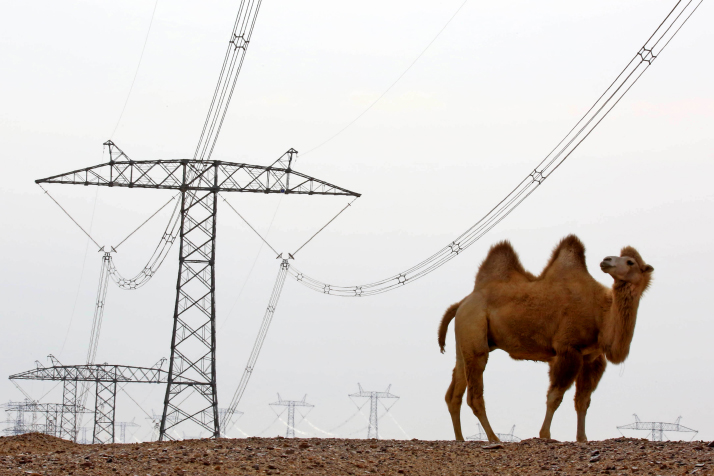 A camel looks back beneath a power transmission line of the Hami South-Zhengzhou ±800-kilovolt ultra-high-voltage direct current project (VCG)
A piece of extreme terroir The most distinctive natural endowment in Hami comes from the eastern Tianshan Mountains, which run through its central region. This mountain range divides the land into two strikingly different climates and landscapes. To the south lies a closed basin, where expansive Gobi deserts stretch under abundant sunlight; the arid, rain-scarce environment and significant day-night temperature swings allow the melons to fully accumulate sugar. To the north, the climate is cooler, and meltwater from the snow-capped mountains nourishes vast forests and grasslands—among them, the Barkol Grassland, one of the three major grasslands of the Tianshan mountain system in Xinjiang. In Hami, one can behold both the majesty of the Gobi and the freshness of the steppe. Locals often say that here, you can traverse the essence of both northern and southern Xinjiang in a single day. For this reason, Hami is known as a "microcosm of Xinjiang"—nearly all of Xinjiang's iconic landforms and cultural charms can be found within its bounds. The yardang landform in Dahaidao (Great Sand Sea Route) is set against the night sky, where red auroras and the Perseid meteor shower interweave in a spectacular celestial display. This diverse topography brings abundant cultural and tourism resources. To the south of the mountains, the Dahaidao scenic area boasts the most complete yardang landform complex in China and is a renowned destination for self-driving and off-road adventures. To the north, on the Barkol Grassland, the Mingsha Mountain (Singing Sand Mountain) sits alongside wetland lakes, with scattered remnants of ancient cities dotting the area. In the eastern Yiwu County, the Naomao Lake primitive poplar forest is one of only three remaining wild poplar forests in the world. From Gobi yardangs to snow-capped mountains and grasslands, from geological wonders to historical ruins, Hami's tourism resources are remarkably diverse and exceptionally rare. Today, the melon and fruit industry is being deeply integrated with tourism. Centered around the city brand "There is a sweetness called Hami," the locality has linked together experiences such as fruit picking, folk cultural immersion, Gobi self-driving tours, and grassland leisure itineraries. During 2026-30, Hami aims to elevate the Dahaidao Motorcycle Cross-Country Rally to an international event, develop cultural tourism products related to General Zuo Zongtang's legacy (Zuo reclaims Xinjiang from Russia in late 19th century), and leverage its strategic position as the eastern gateway to Xinjiang to establish itself as the premier cultural tourism entry point into the region. Sweetness has become the most defining hallmark of Hami tourism.  The yardang landform in Dahaidao is set against the night sky, where red auroras and the Perseid meteor shower interweave in a spectacular celestial display (VCG)
This topic inevitably brings to mind The Lychees of Chang'an —a bestselling historical novel by Chinese author Ma Boyong, which has since spawned film, television, and other adaptations. Set in the Tang Dynasty (618-907), the story revolves around the imperial court in the capital Chang'an, which demands fresh lychees from Lingnan (present-day Guangdong). In an era without cold-chain logistics or rapid transportation, delivering the fruit over a thousand miles before it spoiled required mobilizing the entire official postal-relay system—a frantic relay of mounted couriers racing day and night across mountains and plains. The tale vividly illustrates the extravagance and sheer difficulty of transporting fresh produce across long distances in premodern society In Hami, a similar "sweet pursuit" had long played out in reality. The Hami tribute melons presented to the imperial court during the Qing Dynasty (1644-1911) serve as a vivid example of ancient Silk Road logistics. They were testament to a well-established transportation network and organizational capability—a shared hallmark of connectivity and social prosperity across all ancient civilizations, and, of course, a sweet vehicle for cultural exchange. Hami has long been known as the "throat of the Western Regions" and the "gateway to Xinjiang," serving throughout history as a strategic pivot for the central dynasties in administering the Western Regions, as well as a vital hub along the Silk Road. Since ancient times, it has been a necessary passage for east-west travel—caravans, envoys, and garrison soldiers would rest and replenish supplies here, while different languages and ways of life met and merged. Centuries have passed, and the sound of camel bells has long faded, yet the hallmark of multi-ethnic integration remains deeply woven into the city's developmental fabric. Today, Hami is home to 39 ethnic groups, including Han, Uygur, Kazak and Hui. Ethnic integration manifests in every aspect of daily life. The Uygur people's millennia-old oasis farming techniques, the Han people's accumulated experience in land reclamation and cultivation, and the Kazak people's wisdom in mobility and trade have long intertwined and complemented one another on this land. From cultivation and breeding to distribution, the entire journey of the Hami melon is itself a product of the interactive integration of production methods and lifestyles across different ethnic groups. In 2019, Hami was first named a National Demonstration City for Ethnic Unity and Progress, and in 2025, it received this honor once again. 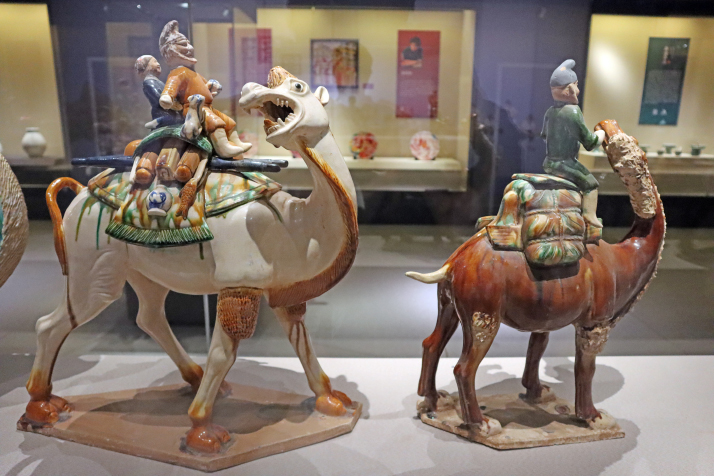 A Tang-dynasty (618-907) sancai (three-color glazed) ceramic sculpture titled “Silk Road Camel Caravan and Plump Figurines” on display at the Hami Museum (VCG)
A modern industrial hub On an early summer morning at Nanhu Township in Hami, the melon fields are still steeped in the night chill brought by meltwater from the Tianshan Mountains. Melons at just the right ripeness are gently cut from the vines by farmers. From harvest to boxing and loading onto trucks, the entire process takes no more than four hours—as the growers put it, "It's like sealing the desert sunlight straight into the boxes." At the same time, customs inspectors are already stationed at the production site, ready for inspection. Given the Hami melon's susceptibility to heat and bruising, the locality has opened an around-the-clock green channel for fresh agricultural products. Scheduled inspections and "cloud-based" certificate issuance are carried out in tandem, with every step from declaration to release closely coordinated. This is a typical scene during the 2026 Hami melon export season. Since the peak harvest began in late June, in just over 10 days, 1,300 tons of Hami melons have been shipped from here to Southeast Asia—3.2 times the export volume of the same period last year, setting a new record for the season. 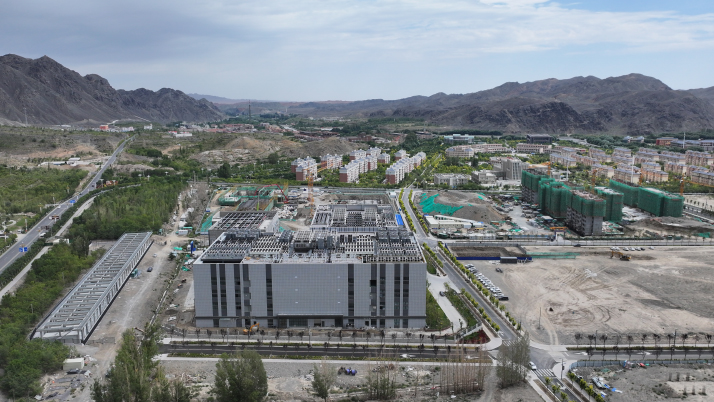 Yiwu County Cloud-Silk-Road Integrated Computing Center in Hami in August 2025 (VCG)
Today, beyond the sprawling melon fields in the oases, the rows of wind turbines and solar panels across the Gobi are equally striking. The abundant sunlight and strong winds that nourish the growth of sweet melons are now being converted into clean energy to power modern industry. Hami's wind-prone areas account for 66.3 percent of Xinjiang's total, and it is also one of the regions with the most sunshine hours in China. Leveraging its wind and solar resources, Hami has already built a national-level 10-gigawatt wind power base and a million-kilowatt photovoltaic base. It serves as a core hub for transmitting electricity out of Xinjiang and is the largest bundled wind-solar-thermal power transmission base in the country. To date, the city's total installed power capacity has reached 51.77 gigawatts, with new energy accounting for 74.5 percent, transmitting clean electricity to provinces and municipalities in the interior. This ancient Gobi is now becoming a key node in the national energy security layout. Its energy advantages have also spurred rapid development in two emerging productive forces: computing power and hydrogen energy. Hami is deeply integrating into the national integrated computing network, positioning itself as a pioneer zone for the computing-power economy along the Digital Silk Road. The transportation network is also being continuously upgraded. Major arteries such as the Lanzhou-Xinjiang High-Speed Railway, the G30, and the G7 run across the entire region. Hami has been designated as a national-level land-port logistics hub city, and the Laoyemiao Port operates year-round. From the camel caravans and relay stations of antiquity to today's multi-dimensional transportation network comprising railways, highways, aviation, and pipelines, Hami's strategic location—connecting east to west and south to north—continues to unlock its value in the new era. Hami melons planted in standardized ways, channeled through modern logistics networks, are sold across China and exported to Central Asia and Europe. The sweetness that once had to traverse thousands of miles of Gobi to reach its destination is now a common commodity in international trade. In every bite of Hami melon lies the wind of the Gobi, the imprint of the ancient Silk Road, and the unbroken connections and growth of this city from ancient times to the present. It has walked out of history and is striding toward the future, always embracing every new encounter with an open spirit. Comments to shangzhouhao@cicgamericas.com |
|
||||||||||||||||||||||||||||
|








