
|
| Xinjiang Today |
| A new course for culture and tourism | |
|
|
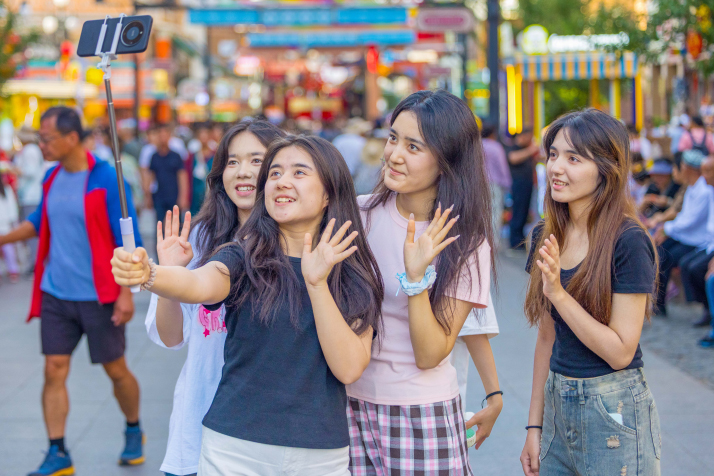 Tourists take photos at the Xinjiang International Grand Bazaar in Urumqi on July 2 (VCG)
From June 16 to 18, the 2026 Xinjiang Culture and Tourism Development Conference was held in Hetian (Hotan) City, Hetian Prefecture. It featured an international travel industry conference and more than 100 supporting events covering culture, sports and tourism, including the 2026 Culture and Tourism Industry Exchange and Project Cooperation Fair. Participants included representatives from 19 provinces and municipalities providing paired assistance to Xinjiang, overseas travel operators from 24 countries across five continents, leading domestic culture and tourism companies, and industry experts. The conference reviewed Xinjiang's culture and tourism achievements during the 14th Five-Year Plan period (2021-25) and set the stage for the region's next phase of development, as Xinjiang works to advance coordinated regional development, deepen culture-tourism integration, expand opening up, and promote prosperity and revitalization across the region. Paired Assistance to Xinjiang is a long-term national strategy of China, initiated in 1997, through which more developed provinces, municipalities, and central government departments are paired with specific prefectures and cities in Xinjiang to provide systematic support. 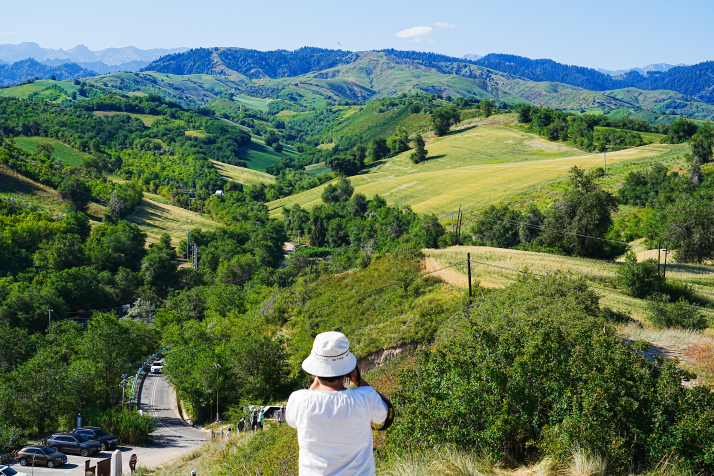 A picturesque road in Mulei County, Changji Hui Autonomous Prefecture, on June 20. The road is a popular route for self-drive tours (VCG)
Culture and tourism momentum At the opening ceremony, Erkin Tuniyaz, Chairman of the regional government, delivered an address on Xinjiang's thriving culture and tourism sector. He said the sector has, in recent years, helped people of all ethnic groups increase their incomes and improve their lives, promoted interaction, exchange and integration among different ethnic groups, offered visitors from across the country a poetic destination, and created fertile ground for entrepreneurs to invest and grow their businesses. "Guided by the goal of forging a strong sense of community for the Chinese nation, we will accelerate the development of region-wide culture and tourism, and strive to build an industrial cluster worth 1 trillion yuan ($147 billion) and a major world-class tourism destination," he said. Figures released at the conference highlighted the strong momentum of Xinjiang's culture and tourism industry. Annual tourist visits to the region rose from 190 million in 2021 to 323 million in 2025, while total tourism revenue in 2025 reached 370.09 billion yuan ($54.5 billion), up 8.4 percent year on year. From January to May this year, tourist visits and tourism spending across Xinjiang grew by 5.9 percent and 6.9 percent year on year, respectively. Xinjiang is now home to 779 A-rated scenic areas, including 18 rated 5A, the highest rating, placing it among the country's leading regions in this regard. It also has more than 10,000 rural homestays, supporting employment and income growth for over 100,000 local residents. In addition, more than 510,000 culture and tourism-related businesses and over 1 million industry workers are jointly shaping a new model of region-wide tourism development. According to information released at the conference, Xinjiang aims to receive 400 million tourist visits annually and generate 520 billion yuan ($76 billion) in total tourism spending in 2030, supporting its goal of building a culture and tourism industrial cluster worth 1 trillion yuan and becoming a major world-class tourism destination. At a press conference held in Urumqi on June 8, Guli Ablim, Director of the Department of Culture and Tourism of Xinjiang Uygur Autonomous Region, said the department will roll out the 2026 Autonomous Region "Culture and Tourism Plus" Consumption Promotion Plan to further boost spending in the sector. In partnership with financial institutions and online travel agency platforms, the department will introduce targeted incentives such as vouchers, instant discounts, points-based rewards, prize draws, cash-back offers and stackable coupons. Xinjiang will also launch an initiative to improve tourism service quality, focusing on enhancing tour guide professionalism, supporting the transformation and upgrading of travel agencies, cultivating service brands, and strengthening regulation of industry associations. Statistics show that in the first quarter of 2026, Xinjiang's culture and tourism authorities received 1,235 tourist complaints, resolved 1,016 of them, and helped tourists recover 320,600 yuan ($47,200) in losses. "We will continue to implement national and regional policies aimed at boosting consumption. Through a series of culture and tourism activities, we hope more visitors will experience Xinjiang's unique charm and the warm hospitality of its people, while further driving the expansion and upgrading of culture and tourism consumption," Guli Ablim said.  The Nalati (Narat) Scenic Area in Yili (Ili) Kazak Autonomous Prefecture is packed with visitors on June 17 (VCG)
Coordinated support A major innovation at this year's conference was the on-site presentation of certificates appointing the frontline leaders of the 12th batch of paired-assistance teams from provinces and municipalities supporting Xinjiang as Xinjiang Culture and Tourism Promotion Ambassadors. "Appointing these team leaders as promotion ambassadors is a key step in upgrading the culture-and-tourism assistance to Xinjiang. It transforms project-based, periodic support into a regularized, market-oriented, long-term cooperation mechanism," said Zhang Liying, Deputy Director of the Department of Culture and Tourism of Xinjiang. Drawing on the consumer markets, marketing channels, and industrial resources of Beijing and other assisting provinces and municipalities, the ambassadors will help promote two-way visitor flows, bring more visitors, capital and visibility to Xinjiang, improve the quality of region-wide tourism, and support rural revitalization. Beijing provides paired assistance to Hetian Prefecture. At the conference, Zhang Guowei, head of the Beijing Assistance Command in Hetian and a newly appointed Xinjiang Culture and Tourism Promotion Ambassador, delivered a keynote speech highlighting years of culture and tourism cooperation between Beijing and Hetian. He noted that during the 14th Five-Year Plan period, Beijing invested about 1 billion yuan ($147 million) in cultural programs for Xinjiang and implemented 48 culture and tourism projects. "Xinjiang is a land of boundless potential and opportunity, where snow-capped mountains, Silk Road heritage and diverse folk traditions come together to create a unique and unforgettable charm," Zhang Guowei said. He added that Beijing will continue to advance landmark projects such as Hetian's Tuancheng Historical and Cultural Block, Kungang Airport, and the No.1 Farm Highland Health and Wellness Base. It will also launch the "100,000 Workers Travel to Hetian" campaign, promote Hetian's culture and tourism resources on public transit platforms and airports in Beijing, and make better use of Beijing's inbound tourism resources. Looking ahead, Xinjiang will further integrate resources from the 21 provinces and cities providing paired assistance, reinforce the positive cycle of "supporting culture and tourism through paired assistance, and revitalizing border areas through culture and tourism," and expand its development landscape through mutual visitor exchanges, joint brand building, coordinated project promotion and talent co-training. These efforts will help build a region-wide market system rooted in Xinjiang, connected to the rest of China and open to international markets. Strong inbound tourism At the 2026 Xinjiang Culture and Tourism Development Conference, Ge Lei, Secretary General of the China Tourism Association, said Xinjiang boasts world-class culture and tourism resources and is well positioned to develop into a leading international tourism destination. He noted that the industry should pursue innovation-driven transformation, develop more distinctive tourism products, improve region-wide services, and raise overall quality to international standards. With inbound tourism policies and opening-up measures continuing to improve, Xinjiang's international tourism market has been recovering steadily and gaining momentum. According to data from the Department of Culture and Tourism of Xinjiang and official statistical bulletins, Xinjiang received 2.36 million inbound tourist visits in 2025 and generated $2.07 billion in international tourism revenue, up 5.65 percent and 6.16 percent year on year, respectively. As channels for opening up continue to expand, Xinjiang's overseas source markets are becoming increasingly diverse, laying a solid foundation for the International Travel Trade Conference and the sector's international development. In an interview with Xinjiang Today, Zhang Liying outlined the measures Xinjiang has taken in recent years to develop inbound tourism. She said that in November 2025, the regional people's government issued the Measures on Accelerating the High-Quality Development of Inbound Tourism and Border Tourism. Focusing on six key targets—streamlined visa and customs-clearance procedures, integrated aviation-tourism development, high-quality product supply, improved comprehensive services, overseas marketing and promotion, as well as targeted support and safeguards—the measures introduced a package of practical policies to address key bottlenecks. To energize market players, the autonomous region has implemented special incentive and subsidy policies for inbound tourism for two consecutive years, providing targeted support to key travel agencies with a strong presence in overseas markets. To date, 1.3 million yuan ($191,500) in incentives and subsidies has been granted to eight high-quality culture and tourism enterprises. To make inbound travel more convenient, Xinjiang has worked to improve services across the visitor experience, covering dining, accommodation, transportation, sightseeing, shopping, entertainment and other travel-related needs. By improving payment services and upgrading accommodation registration procedures, Xinjiang has significantly enhanced the travel experience and satisfaction of foreign visitors. As a supporting event of the conference, the International Travel Trade Conference invited 31 leading overseas travel operators from five continents. Through four days of familiarization tours across the region and a focused 80-minute round of targeted one-on-one business talks, the event helped build a long-term platform for international exchanges and matchmaking. It is expected to create new opportunities for Belt and Road culture and tourism cooperation and position Xinjiang as an important window for exchanges and mutual learning between Chinese and other civilizations. Comments to liangxiao@cicgamericas.com |
|
||||||||||||||||||||||||||||
|