
|
| Xinjiang Today |
| The grassland doctor | |
|
|
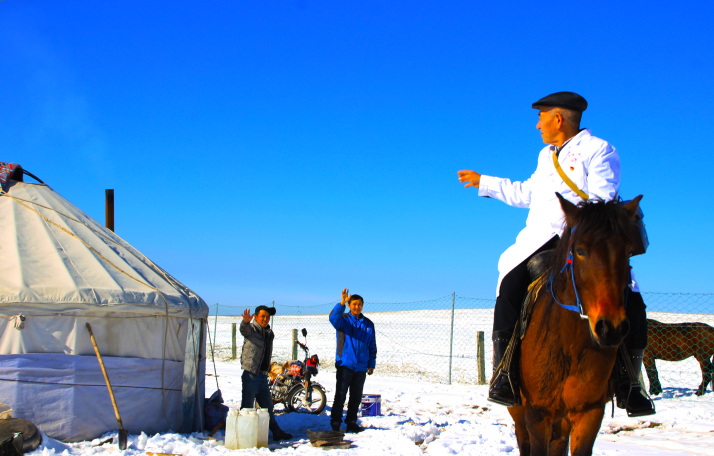 Wuhasi Sulaiman on his rounds in a pastoral area in Yumin County on October 24, 2021 (VCG)
On July 1, at the Great Hall of the People in Beijing, the July 1 Medal, the highest honor of the Communist Party of China, was pinned to the chest of 71-year-old Wuhasi Sulaiman, a Kazak doctor. His eyes grew moist as he admitted he was "nervous, really nervous." "Before I went up on stage, my legs didn't even feel like they belonged to me." But those were the same legs that had trudged through snow up to his knees, bounced along on horseback over cliffside paths, and crisscrossed the ravines of the Baerluke Mountains in Tacheng Prefecture for 50 long years. 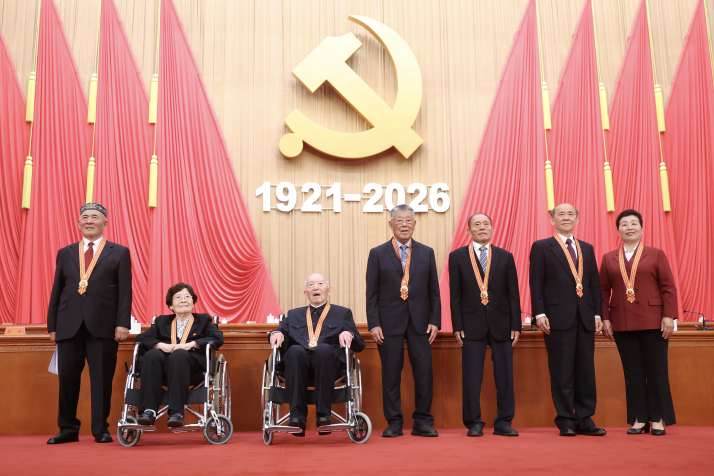 Wuhasi Sulaiman (left) and other recipients of the July 1 Medal pose for a group photo at a ceremony held in Beijing to mark the 105th anniversary of the founding of the Communist Party of China on July 1 (VCG)
A lifetime of service Born in 1955 to an ordinary farming and herding family in Yumin County in Tacheng, Wuhasi was 12 when he visited relatives in a pastoral area and overheard the adults talking about women dying in childbirth and men falling gravely ill. "It broke my heart," he recalled. In those days, the mountain pastures were crisscrossed with treacherous trails and desperately short of medical care. Herders suffering from minor ailments simply toughed it out; when it came to obstructed labor or critical illness, they could only resign themselves to fate. "That day, I made up my mind about the path I would take for the rest of my life. I was going to be a doctor for the herders." Wuhasi began studying under a local doctor in his village. When he graduated from Tacheng Health School in 1970s, he could have stayed in the county town. Instead, he volunteered: "Please assign me to the pastoral area. That is where doctors are needed most." The clinic he was sent to lay deep in the Baerluke Mountains, more than 260 km from the county seat, a five-day journey on horseback. The "clinic" was nothing more than three wooden shacks: one for medicine, one for surgery and one for rest. Their equipment consisted of nothing but a stethoscope, a thermometer and an old-fashioned sphygmomanometer. More than 10,000 herders scattered across 60-plus km of mountain terrain depended on just a handful of doctors. The "clinic" on the grasslands was never in one place for long. As the herders moved with the water and grass, Wuhasi moved right along with them. A horse, a medicine box and a whip were his only possessions. In four decades, he traveled more than 200,000 km on his rounds, treated over 100,000 patients, rescued thousands of patients in critical condition, and delivered over 3,200 babies. Behind these numbers lay dangers and hardships beyond most people's imagination. The most perilous trip came in the winter of 1987. A herder named Alega had been in agonizing labor for what felt like an eternity, her waters long since broken, yet the baby refused to come. Wuhasi rode through a blizzard for over 5 km to reach her. The delivery took more than 20 hours. When the baby finally emerged, there was no cry. The infant's throat was blocked with amniotic fluid. With no suction tube on hand, Wuhasi knelt on the felt floor, pressed his mouth to the baby's, and sucked the fluid out, mouthful by mouthful, spitting and repeating until finally a cry cut through the storm. Alega still weeps when she tells the story. "He saved my life, and he saved my child's life," she told the Global Times newspaper. On the vast grasslands, urgent hoofbeats in the dead of night were the most unmistakable call for help. "Especially in winter, the moment the hoofbeats stopped, before the herder even knocked, I was already dressed with my medicine box in hand," he told People's Daily newspaper. On winter house calls, snow blanketed the mountain trails, and cliffs loomed at the edge. "No matter how many times I walked that road, I was still scared. I didn't dare look down." He had fallen off his horse, lost his way, and been surrounded by wolves. But if a herder needed him, "Even if knives were raining from the sky, I would still go." His apprentice Yeerjiang Kukangao recalled that in all those years of riding to house calls, Wuhasi got thrown from his horse more than once. But he never worried about himself. He always checked on his medicine box first. Years of riding left him with severe arthritis in both legs. Even now, when seated, he habitually taps his knees. Yeerjiang recalled that when he first met Wuhasi in 2004, "He looked like just an ordinary guy. But as time went on, I came to see how truly great he is. Mention any corner of the pastoral area, and he knows exactly who lives there, what their situation is. He has it all in his head." 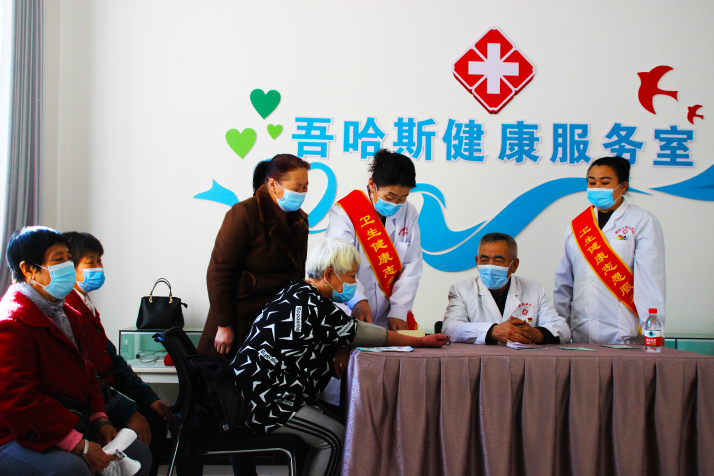 After retirement, Wuhasi Sulaiman (second right), together with volunteers, provides free clinic services to local farmers and herders in Yumin County, Tacheng Prefecture, on October 26, 2021 (VCG)
Still on call In 2015, after 40 years on the job, Wuhasi retired. But less than a week later, he had his medical kit slung over his shoulder again and was back to seeing patients for free. "There is no retirement when it comes to serving the people," he said. "I'm just doing it in a different place now." He set up the Wuhasi Health Service Room, a volunteer-run health station named after himself, in his residential community, holding clinic at least three days a week. Over the next 10 years, he treated more than 65,000 patients. In 2023, he started a volunteer initiative to provide health checkups and medical consultations to low-income families and remote herding communities. It now boasts more than 350 volunteers. Today, the Baerluke Mountains have changed beyond recognition. Paved roads have been laid, Internet access is available, and the medical stations in the pastoral areas are now equipped with electrocardiogram machines, ultrasound devices and other modern tools. Seeing a doctor has become easier than ever for the herders. Yet there are still doctors stationed at the remote pastures, and Wuhasi's story continues to be told across the grasslands. The local herders often say, "As many flowers as there are on the grasslands, that's how many good deeds Wuhasi has done." Late at night on July 2, Wuhasi returned to his hometown of Yumin from Beijing. Fifty meters from his gate, the car came to a stop. The road ahead was packed with people: neighbors, former colleagues, young parents holding their children. They stood under the moonlight with flowers in their hands, singing and dancing. The short 50-meter walk took him nearly 10 minutes. Facing the crowd that had gathered around him, Wuhasi paused for a moment and said, "I'm just an ordinary doctor from the pastoral areas who did what I was supposed to do all my life. The way everyone has received me... all I can do is keep working hard and prove myself worthy of this heavy honor." Comments to luyan@cicgamericas.com |
|
||||||||||||||||||||||||||||
|