
|
| Xinjiang Today |
| Verdicts from visitors | |
|
|
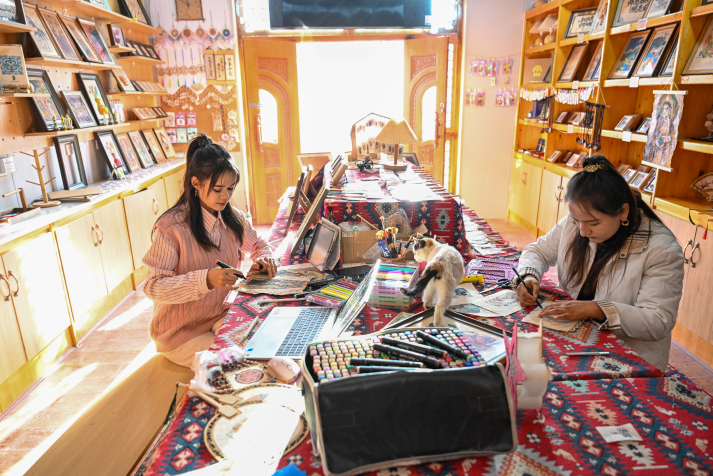 Muyesser Ehmet Tohti (left) and her apprentice make cultural products at the mulberry bark paper industrial park in Moyu County, Hetian (Hotan) Prefecture, on January 13. Mulberry bark paper is a local intangible cultural heritage (XINHUA)
When Cameroonian Ambassador to China Martin Mpana rose to speak at an exchange meeting attended by diplomats from 40 countries and international organization representatives on March 20, he wore a Xinjiang-style cap in a nod to the occasion as well as the venue—Xinjiang Mansion in Beijing, a representative office for Xinjiang and a premier destination for authentic Xinjiang culture and cuisine. The agenda at the meeting was broad: economic development, human rights protection, opening up and regional cooperation. But the underlying message was very focused: Xinjiang wants to be seen not as a place shaped by secondhand narratives but one with its own reality, rhythms and ambitions. 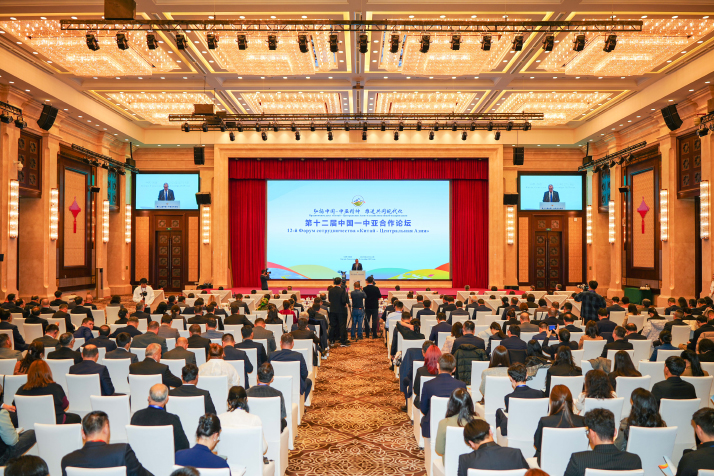 The 12th China-Central Asia Cooperation Forum opens in Urumqi on November 6, 2025 (XINHUA)
Myth vs. reality The argument is simple: Visit and see for yourself. In recent years, the region has invited growing numbers of foreigners as visits on the ground carry more weight than assumptions made from a distance. For many at the meeting, Xinjiang was no blank slate. They had already been there, some repeatedly, and their comments gave the event an authentic experiential tone. Mario Alzugaray Rodriguez, Minister Counselor of the Cuban Embassy in China, who first visited Xinjiang 20 years ago, pointed to its infrastructure, developing rapidly since then, as one of the clearest markers of change. "Xinjiang's development achievements since then are truly amazing," he said. "I've learned that Xinjiang now has more than 20 airports, with a crisscross and well-connected network of railways and expressways stretching in all directions." Selçuk Ünal, Turkish Ambassador to China, has visited both Urumqi and Kashi (Kashgar). "I witnessed firsthand the solid measures taken by the local government to advance development across various fields in Xinjiang," he said. The exhibition on Xinjiang's history and development at the venue compressed a large story in a nutshell. A book on the China-proposed Belt and Road Initiative (BRI), which aims to boost connectivity along and beyond the ancient Silk Road routes, and Xinjiang's vital role in it was distributed in a trilingual version, Chinese, English and Turkish, to reach a broad international readership. "I never expected Xinjiang to have such a strong development momentum," Diane Sidikiba, Economic Counselor and Charge d'Affaires ad interim of the Guinean Embassy in China, said. Remarks like hers explained why Xinjiang keeps making the same argument: When people draw conclusions about the region, they should be shaped by firsthand contact rather than preconceived views. 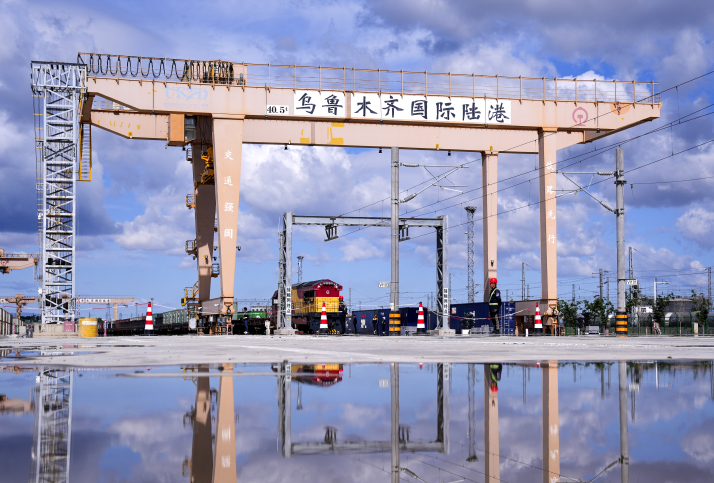 A China Railway Express train loaded with export products at the Urumqi International Land Port Area in Urumqi on May 27, 2024 (XINHUA)
Stats and lives A substantial part of the meeting focused on Xinjiang's 2025 economic indicators, evidence of both the pace and the breadth of its development. Last year, Xinjiang's GDP exceeded 2.14 trillion yuan ($312 billion), up 5.5 percent year on year; per-capita GDP stood at 81,574 yuan ($11,840), an increase of 4.7 percent; value-added output of major industrial enterprises, or those with an annual main business revenue of at least 20 million yuan ($2.9 million), rose 7.7 percent, and that of the manufacturing sector grew 11.2 percent. On paper, those figures tell a story of scale. At the meeting, the effort was to connect them to something more tangible: jobs, mobility, livelihoods and social confidence. Pakistani Ambassador to China Khalil-ur-Rahman Hashmi, who has visited Xinjiang multiple times, framed the transformation in precisely those terms. "I have visited Xinjiang at least seven times. There is a sea change in the development of infrastructure, but I think it is more evident in the livelihoods of people. Their incomes have risen," he said. Xinjiang's urbanization rate climbed to 61.61 percent in 2025 and its permanent population increased 162,000 over the previous year. The per-capita disposable income of urban residents rose 5.3 percent last year, while that of rural residents went up 7 percent. The indicators point to a consequential shift: More people are choosing to stay, settle or build their futures there, a sharp contrast to the earlier migration outside in search of employment. Xinjiang's cotton output crossed 6 million tons in 2025, accounting for 92.8 percent of the national total. The entire textile and apparel industrial chain alone created more than 1 million jobs. Energy was another case in point. Xinjiang's oil and gas equivalent output ranked first nationwide for a fifth consecutive year last year, reinforcing its importance as one of China's strategic resource bases. However, Xinjiang's story is no longer being framed solely through extraction or geography, with its strengths emerging in frontier technologies such as AI, scientific innovation and green development. One of the most significant developments is that Xinjiang has not seen a single violent or terrorist incident for more than nine consecutive years. Ethnic equality and freedom of religious belief are protected by law and the government treats development, security and human rights holistically. Gateway to Eurasia One compelling reason Xinjiang commands so much attention is its geostrategic position. It borders eight countries—Russia, Kazakhstan, Kyrgyzstan, Tajikistan, Pakistan, Mongolia, India and Afghanistan—and sits at the hinge between China and Central Asia. Central to the ancient Silk Road, it is now a crucial hub for advancing cooperation under the BRI and a gateway for China's opening up to the west. Sohail Khan, Deputy Secretary General of the Shanghai Cooperation Organization (SCO), pointed out how this has given Xinjiang a unique role in SCO cooperation, key to commerce, diplomacy and security. "As China's western gateway, Xinjiang is a natural bridge connecting eight countries, six of which are SCO member states," he said. Recalling his own time in the region, he added, "Xinjiang is welcoming people from all over the world with an increasingly open attitude." This is Xinjiang's philosophy: a frontier that wants to be perceived less as an endpoint and more as a bridge. The trade data support that framing. In 2025, Xinjiang's foreign trade exceeded 500 billion yuan ($72.35 billion), rising to a new high for the fourth consecutive year. China Railway Express freight trains passing through Xinjiang ports accounted for more than half of the national total. As a flagship project and a landmark brand of the BRI, the China Railway Express has established a comprehensive logistics network across Eurasia. Both Huoerguosi (Khorgas or Horgos) and Alashankou (Alataw Pass), two of the region's best-known land ports, hit record cargo volumes. Additionally, private investment in Xinjiang increased 12.6 percent last year, outpacing the growth of total fixed assets investment by 5.4 percentage points, an indication that companies are not only being encouraged to invest in the region, but are increasingly choosing it. For neighboring countries, the opportunities are concrete. Kazakhstan's Ambassador to China Shakhrat Nuryshev underscored how Xinjiang has become crucial to bilateral economic ties. "In 2025, the trade value between Kazakhstan and Xinjiang reached $23.5 billion, accounting for about half of the total trade value between Kazakhstan and China," he said. Belarusian Ambassador to China Charviakou Aliaksandr pointed to expanding regional links, saying, "We look forward to further expanding cooperation with Xinjiang and lifting cooperation in various fields to a new level." Mpana said, "Xinjiang has accumulated rich experience in developing desert agriculture and renewable energy, which provides valuable reference for us," a reminder that cooperation is not limited to logistics alone. What emerged in the meeting was a portrait of Xinjiang as a region trying to convert location into leverage, development into credibility, and contact into trust. It showed how the region wants to be encountered, through visitors' impressions, through evidence of change and through the practical language of shared interests. Xinjiang's message is clear. It is saying openness is not just a slogan, but the beginning of how it hopes to be understood and how it intends to work with the wider world. Comments to zhaowei@cicgamericas.com |
|
||||||||||||||||||||||||||||
|