
|
| Xinjiang Today |
| Forging a strong sense of community | |
|
|
 A view of Xinjiang Museum in Urumqi (VCG)
The Chinese nation's sense of community is rooted in China's realities. It reflects both the individual awareness of belonging to the Chinese nation and the deep identification across political, economic, cultural and social dimensions. In 2014, Chinese President Xi Jinping first proposed forging a sense of community for the Chinese nation. This concept has moved from theory to governing principle. China's Ethnic Unity and Progress Promotion Law was adopted on March 12 this year. The concept now shapes policy across ethnic regions, where the challenge is not only economic development but also the cultivation of emotional and civic integration. One of the evident cases is Xinjiang. Situated along the ancient Silk Road connecting Asia and Europe, Xinjiang is both a geographic frontier and a strategic fulcrum. As a core region of the Belt and Road Initiative [which aims to boost connectivity along and beyond the ancient Silk Road routes—Ed.], it has been widening its doors, becoming a key corridor in China's westward opening up. At the same time, it remains a region of significant ethnic diversity, where questions of identity, development and stability intersect. To speak of Xinjiang today is to speak of transformation—not only economic, but institutional and social. The region is in the midst of an effort to integrate the concept of a shared national community into every aspect of governance. This is not a single policy but a layered approach, combining legal frameworks, cultural initiatives, economic development and social integration.  Ophthalmology doctors examine a young patient at a hospital in Yingshaji County of Kashi (Kashgar) Prefecture on September 15, 2023 (XINHUA)
Forging bonds In recent years, the regional government has launched a dense framework of policies, regulations and administrative bodies to coordinate efforts around ethnic unity. To date, Xinjiang has established 101 national demonstration bases for ethnic unity and progress in 14 prefectures and cities, while 108 counties and districts have set up offices for related work. Local authorities have also invested heavily in public cultural infrastructure, from libraries to museums, while promoting artistic productions with Xinjiang's multi-ethnic character. Efforts to build a "shared spiritual home" have translated into significant investment in cultural infrastructure: libraries, museums, cultural centers and community spaces. Today, Xinjiang has 111 public libraries, 118 cultural centers, 1,130 township-level cultural stations, as well as 150 museums (memorial halls). Awards have been instituted to encourage literary and artistic creation and a series of Xinjiang-themed film and television works aired to showcase the diversity and magnificent scenery in Xinjiang. They include the TV drama To the Wonder, the story of a young Han girl's self-discovery after she returns to her mother's small, remote grocery store in the mountains. Education plays a central role, particularly efforts to expand the use of standard Chinese as the common national language and improve understanding of the Chinese culture. The regional government has launched exchange programs for students in Xinjiang with schools in other regions across China. Fourteen universities and 20 primary and secondary schools have been set as demonstration bases to strengthen the awareness of the Chinese national community. 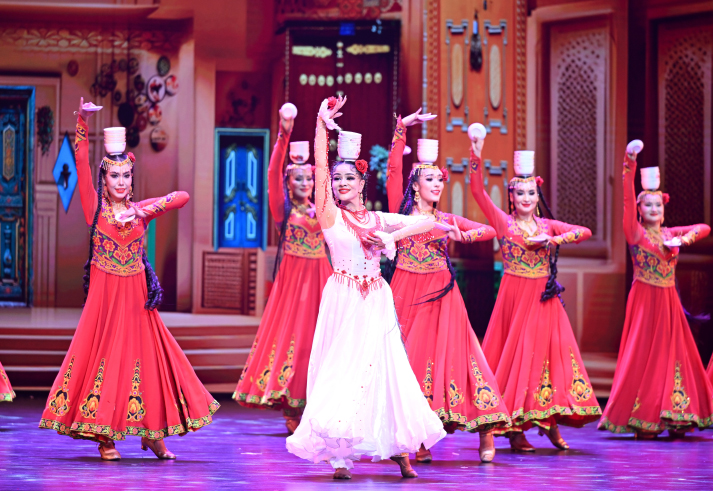 Performers from Xinjiang Uygur Autonomous Region perform a musical drama on the ancient Silk Road in Beijing on February 28 (XINHUA)
Improving wellbeing In recent years, Xinjiang, with its abundant resources, geographical advantages and industrial foundation, has built a distinctive modern industrial system, ensuring stable employment and income growth of people of all ethnic groups through multiple channels. Over the past decade, Xinjiang's growth has outpaced the national average, accompanied by large-scale investments in housing, healthcare and environmental improvement. In 2025, the region's GDP was around 2.146 trillion yuan ($310.8 billion), outpacing the national average level for three consecutive years. The per-capita disposable income of urban and rural residents reached 45,106 yuan ($6,533) and 20,793 yuan ($3,011), respectively. The number of newly employed people in urban areas exceeded 488,000, and the total number of people covered by basic medical insurance was over 20 million. From 2011 to 2025, over 11 million farmers and herdsmen have moved into new homes. Xinjiang is promoting a new type of urbanization centered on people, especially in its south. It aims to develop industries to retain people with high skills, ensure equal public services, and promote all-round development of all ethnic groups. A large number of labor-intensive industries such as deep processing of agricultural and sideline products, textile and clothing manufacturing, and electronic product assembly have settled in southern Xinjiang, pooling labor, capital and technology in urban areas and accelerating urbanization. The regional government has also been partnering with 29 other provinces or municipalities for labor mobility, and improving community-level engagement to create environments where people of different backgrounds live, work and socialize together. As of 2025, Xinjiang had over 1 million public rental housing units, and 119,800 units of various affordable housing. Over 6,000 old urban communities were renovated to benefit over 1 million households. Legal frameworks are ensuring equal rights for residents while reinforcing the norms of civic identity. Public legal education campaigns seek to embed these principles more deeply within society. Since 2021, Xinjiang has carried out over 600,000 legal education activities in rural areas, benefiting more than 7 million people. Legislation to protect cultural heritage—including intangible traditions—underscores an attempt to balance unity with preservation. The message is that national cohesion need not come at the expense of cultural diversity. 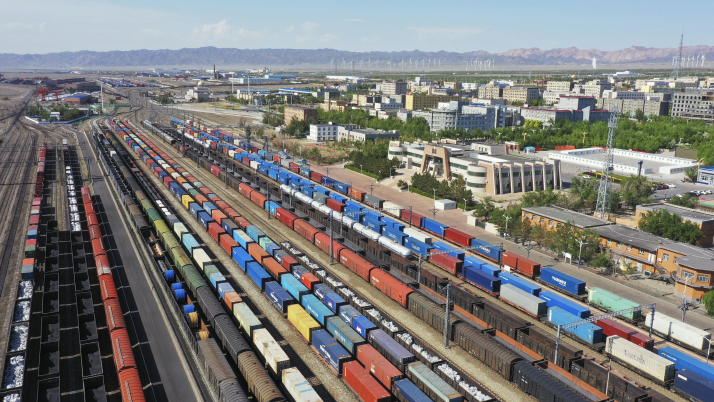 China-Europe (Central Asia) freight trains at the Alashankou Port, also known as the Alataw Pass, a primary land port in the Bortala Mongolian Autonomous Prefecture, on May 25, 2024 (XINHUA)
In the past, Xinjiang experienced periods of significant unrest, including violent incidents attributed to extremist groups. From 1990 to 2016, thousands of such cases were recorded. The absence of similar incidents in the last decade can be attributed in part to these policies. Today, Xinjiang is engaged in China's national development strategy, has anchored its strategic positioning, and is leveraging the opportunities brought by the Belt and Road Initiative. It attaches greater significance to economic and social development, while ensuring stability, improving people's wellbeing, and following a people-centered approach to promote high-quality economic growth. In this way, Xinjiang has sought to articulate its own version of modernization, at the core of which is building a strong sense of community for the Chinese nation. It treats cohesion not as a byproduct of development, but as its organizing principle. Human civilization is neither linear nor uniform. Each society, shaped by its own history and constraints, experiments with different models in pursuit of a common aim: a more stable, prosperous and dignified life for its people. And within China, Xinjiang offers a particularly concentrated example of this process. In recent years, the region has advanced a set of policies to strengthen a shared sense of community, while simultaneously pursuing economic growth and social stability. The result is a trajectory marked by increasing cohesion, sustained development and a measure of social calm that contrasts with the earlier periods of unrest. Its ongoing transformation is not simply a regional story, but part of a larger global inquiry into how nations navigate differences in an age of rapid change. If there is a lesson to be drawn, it is perhaps a modest one: Modernization is not a single road, but many. And each path, however distinct, reflects a shared human aspiration—to build a society in which more people can see themselves, and their futures, within it. The author is an associate professor at the School of Journalism and Communication, Xinjiang University Comments to lixiaoyang@cicgamericas.com |
|
||||||||||||||||||||||||||||
|