
|
| Xinjiang Today |
| One lane, one family | |
|
|
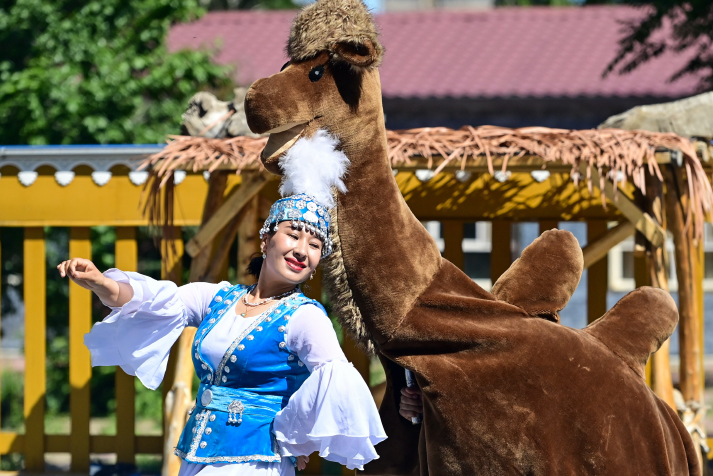 A local dancer greets tourists at Yuliu Lane in Emin County, Tacheng Prefecture, on May 30, 2024 (XINHUA)
Yuliu Lane in Tasierhai Village is a street just 640 meters long. The lane takes its name from a century-old tree where an elm (yu) and a willow (liu) have grown into one. As seen on the street, sturdy willow shoots straight toward the sky, while an elm twines tightly around it, their branches and leaves intertwined beyond distinction.
"The life in our lane is just like this tree—closely connected," said Xu Li, Curator of the Yuliu Lane Memory Hall. Tasierhai is located in Emin County, Tacheng Prefecture. The lane is home to 32 families from nine ethnic groups, including Han, Uygur, Kazak, Hui and Russian. These villagers live side by side, sharing meals, celebrating festivals together, and treating each other as family, intertwined like the branches of the ancient tree, close and inseparable. 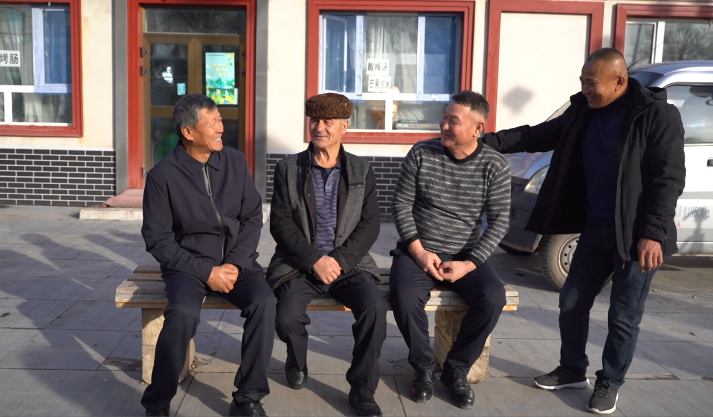 Lin Zhongdong (left) and Kuerluxi Wusiman (second left) chat with fellow villagers (COURTESY PHOTO)
Decades of neighborly bonds "I've known my older brother for decades; our bond spans four generations," Lin Zhongdong, a villager in Yuliu, told Xinjiang Today. As he recalled his connection with his "older Uygur brother," 72-year-old Kuerluxi Wusiman, his eyes grow soft. "In the fall of 1964, my family had just moved here. We knew no one and didn't speak the language of other ethnic groups," the 65-year-old Han recalled. The first to lend a helping hand was Kuerluxi's father, Wusiman Akenbai. "He didn't speak standard Chinese, so he used gestures to communicate with us, helping us move our things. He also brought us freshly baked naan and told us to come to him if we needed anything." "At first we couldn't understand each other well, but as time went by, we grew close. Kuerluxi taught me Uygur, and I taught him Chinese language characters. Before we knew it, we were close friends," Lin said. In 1991, when Lin's family ran into financial trouble, Kuerluxi did not hesitate to help. He suggested they go into business together, raising livestock and making dried meat to sell. "Whenever we face difficulties, we always support each other. Once, when our sheep got sick, Kuerluxi rode a horse through the night to fetch a vet. He came back soaked with sweat," Lin said. "All these years, I've been in charge of raising money to buy livestock and handling sales, while Kuerluxi takes care of fattening the animals and smoking the meat. We're like real brothers—sharing the good times and the bad. We've worked together for over 30 years, and we've never once argued or fallen out over money." Their families support each other in daily life as well. When Lin's wife was hospitalized after a car accident and their daughter was just 3 years old, Kuerluxi's wife quietly stepped in to cook, do laundry and look after the child. Another time, when Kuerluxi's son was badly injured in a fall, he considered selling his cattle to cover medical expenses. Lin immediately sent enough money to cover the hospital bills. "My daughter and his daughter grew up together. My granddaughter and his grandchildren are childhood friends too. Our two families just can't do without each other," Kuerluxi said. 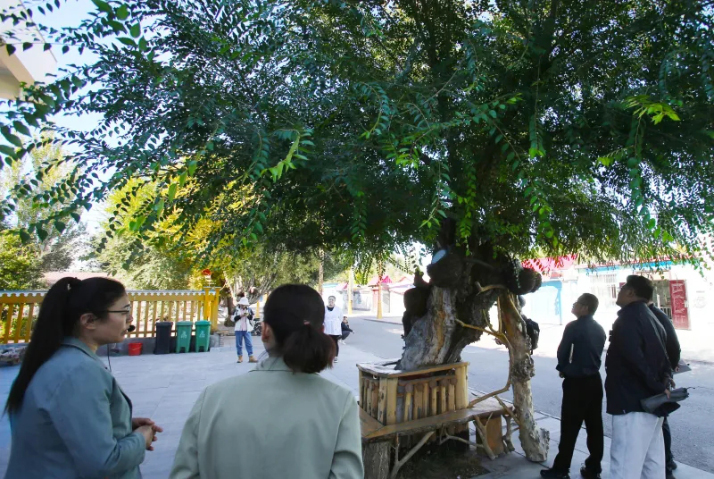 A century-old tree where an elm and a willow have grown into one in Yuliu Lane in Tacheng Prefecture (COURTESY PHOTO)
Strangers no more A few hundred meters from Lin's and Kuerluxi's homes lives fellow villager Ma Xinhua, a retired police officer. In Emin, her name is known to just about everyone. Entering her home, the first thing you notice is a family portrait hanging prominently on the wall. The image radiates warmth and joy. Family members come from different backgrounds—Ma is Hui, her husband is Uygur, her daughter-in-law is Kazak. There are also "family members" Ma "found on the streets": her Han "father" Yang Jichun, her Kazak "brother" Yeermulate Kezihan and her Kazak "son" Wulazibieke. "Father Yang" was the first person Ma brought home. One night in early winter of 2004, she found him huddled by the roadside, thinly dressed in shoes without socks, shivering in the bitter cold. Ma took him home and made him a warm bowl of hand-pulled noodle soup. As they talked, she learned that his wife had passed away and he had no children. Watching him warm himself by the coal stove while devouring his meal hungrily, tears came to her eyes. "This old man needs a warm home, a place to sleep and have regular meals," she recalled. After discussing it with her husband, she decided to take him in as her "Han Chinese father." She has cared for him ever since. Over the past two decades, Yang gradually became part of the family, and gave Ma a feeling of having a true father. Sometimes, when Ma worked late, he would wait by the roadside. Only when she safely returned would he finally go to bed. In 2009, Ma brought home two more strangers. This time, a Kazak couple. She came across a pregnant woman struggling to carry a heavy sack of sunflower seeds. After inquiring, Ma learned that the woman's husband was ill and couldn't work, so she had to labor on her own, and they could hardly afford rent. Ma pointed to a house not far away and said, "That's our home. It'll keep you out of the wind and rain just fine. I won't charge you any rent. Come and stay." From then on, the couple lived and ate together with Ma's family. A few months later, their child was born there, and the health of Yeermulate Kezihan, the husband, gradually recovered as well. 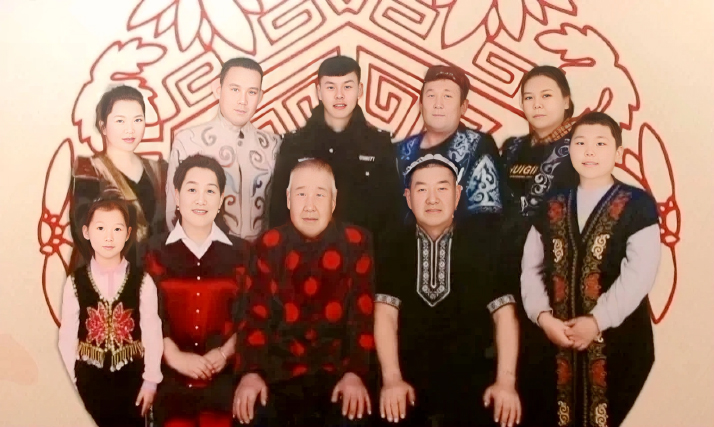 A family photo of Ma Xinhua (second left, front) (COURTESY PHOTO)
To help the family become self-reliant, Ma taught them how to bake naan, get a driver's license, learn basic life skills, study standard Chinese and find decent jobs. Now, they have bought their own home in town, and their life is better than ever. Wulazibieke Madate, Ma's "Kazak son," lost his mother as a young child, and at the age of 12, his father died in a car accident. Left with no support, he considered dropping out of school. In 2012, a distant relative of Wulazibieke came to Ma for help, who said she often grazed livestock in uninhabited areas and was unable to address the child's schooling and daily care needs. Looking at the child in front of her—thin and dark-skinned, with hands covered in frostbite—Ma decided to help. She quickly arranged for the child to enroll in a school and applied for financial aid. Ma didn't stop there. She also took Wulazibieke into her own home. Under her care, the child gradually opened up and thrived both academically and emotionally, becoming a true member of the family. Since retiring, Ma has transformed her living room into a community gathering space. Every week, a meeting is held here, where residents of different ethnic groups gather to share stories, exchange ideas and resolve problems. Moreover, it has also become a place where neighbors bring their disputes and settle them with understanding. The space serves as a "classroom" as well, where residents learn about the Civil Code, first aid skills and even basic psychology. During festivals, it transforms into a dance hall, where people of all ethnicities gather, sing, and dance together in joy. "Seeing everyone sitting together like one family makes me truly happy," Ma said with a smile. "Ethnic unity starts with the small things around us—making sure everyone feels the warmth of home. It's all about love." Comments to luyan@cicgamericas.com |
|
||||||||||||||||||||||||||||
|