
|
| Xinjiang Today |
| Q1 data highlight shifting economic gears | |
|
|
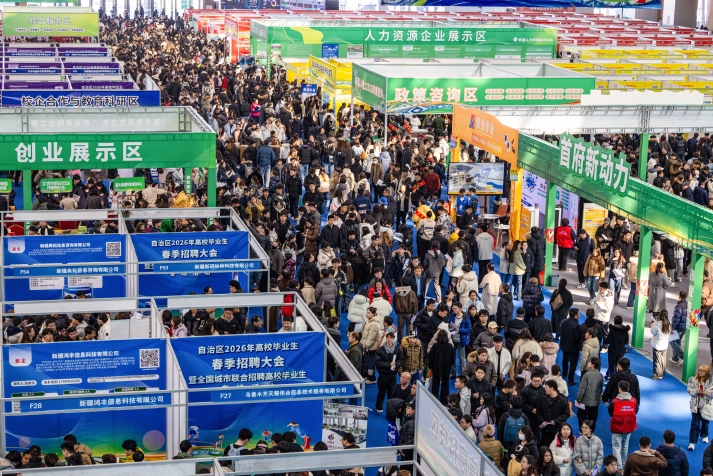 A job fair for university graduates at the Xinjiang International Convention and Exhibition Center in Urumqi on March 13 (VCG)
On December 26, 2025, a hydrogen purification unit went into operation in Xinjiang's oil city Karamay, supplying fuel cell-grade hydrogen at a purity of more than 99.999 percent—a first for the city. Karamay Petrochemical, a subsidiary of China National Petroleum Corp., the country's largest oil and gas producer, led the project, building end-to-end hydrogen capabilities spanning production, refueling, utilization and recovery. Karamay's energy transition captures the shift in Xinjiang's economy: Traditional growth drivers are giving way to new ones, and innovation is becoming a stronger force in regional development. Xinjiang's GDP crossed 482 billion yuan ($70.6 billion) in the first quarter (Q1) of 2026, a year-on-year increase of 3.5 percent, according to data released by the Bureau of Statistics of Xinjiang on April 24. Wei Hong, deputy head of the bureau, said the regional economy got off to a steady start in the first three months of the year. In breakdown, the value added of the primary industry was 15.45 billion yuan ($2.3 billion), up 3 percent; that of the secondary industry reached 189.16 billion yuan ($27.7 billion), up 5.2 percent; and that of the tertiary industry came in at 278 billion yuan ($40.7 billion), up 2.3 percent. Candid about the headwinds, Wei said Xinjiang's economy is currently under pressure, with supply outweighing demand and market expectations remaining subdued in some sectors, leading to a slight slowdown in overall growth rate. But the current slowdown, she assured, marks a transition period for Xinjiang's economy as it reorients toward higher-quality and more sustainable growth drivers. "Key industries have maintained steady growth, investment is expanding rapidly and development continues to improve in both quality and efficiency. The region's economy is seeing a continuous increase in both its substance and innovative capacity," she pointed out. 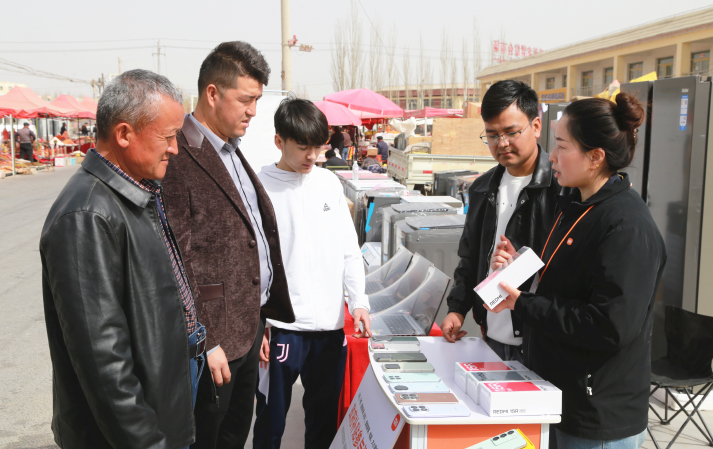 Staff members of a smartphone company promote their products covered by a government consumer goods trade-in subsidy program in a village in Awati (Awat) County, Aksu Prefecture, on March 27 (VCG)
Industry anchoring growth The figures point to industry as the bedrock of Xinjiang's economy. In Q1, the value added of major local industrial enterprises, or those with an annual main business revenue of at least 20 million yuan ($2.9 million), rose 7.8 percent year on year—1.7 percentage points above the national average and 0.9 percentage points higher than a year earlier. Among the three broad categories, the production and supply of electricity, heat, gas and water led the way at 12.1 percent, followed by manufacturing at 7.9 percent and mining at 5.2 percent. Nine of the region's 12 key industries posted growth, with six reaching double digits. Nonferrous metal mining and processing topped the list at 32.1 percent, followed by textiles at 22 percent and food manufacturing at 18.9 percent. Electricity and heat production and supply, nonferrous metal smelting and rolling, and chemical raw materials and chemical products manufacturing rounded out the double-digit group at 13.1 percent, 12 percent and 11.1 percent, respectively. Corporate performance improved in step. In January and February, the business revenue of major local industrial enterprises rose 6 percent year on year, 0.7 percentage points above the national average, while total profits surged 54 percent—outstripping the national figure by 38.8 percentage points. "Xinjiang has continued to improve the business environment, implemented policies to support enterprises and ease their difficulties, and helped companies cut costs and raise efficiency. Corporate performance has been improving steadily," Wei said. The message is clear: Growth may be moderating, but it is getting better, not just bigger. 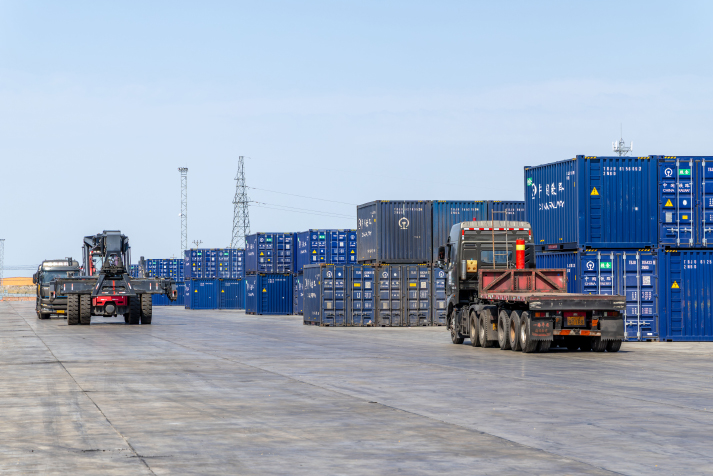 Containers at the China Railway Express freight yard in Wusu, Tacheng Prefecture, in July 2025. China Railway Express is the international intermodal train service for containers between China and Europe, a key program under the China-proposed Belt and Road Initiative (VCG)
Investment surging, services reformed In Q1, fixed assets investment across Xinjiang rose 12.9 percent year on year—outpacing the national average by 11.2 percentage points. Spearheading this growth was infrastructure investment, which skyrocketed 34.7 percent, with industrial investment close behind at 11.5 percent. Major projects did much of the heavy lifting. The region had over 1,700 projects under construction, each with planned investment of at least 100 million yuan ($14.5 million). Together, they accounted for 77.2 percent of Xinjiang's total fixed assets investment, with completed investment up 16.7 percent. What stands out is the pace at which work is advancing on the ground. Of the 103 major projects that started or resumed in Q1, 14 pushed through the winter without pause, 67 fully resumed work and 22 broke ground in succession. Xinjiang is proving equally effective at attracting new projects. In Q1, the Huoerguosi (Khorgas or Horgos) Economic Development Zone, China's first cross-border free trade zone on the border between China and Kazakhstan, signed 17 new project agreements worth a combined 2.78 billion yuan ($390 million). These span equipment manufacturing, new materials and green building materials. The Hami Hi-Tech Industrial Development Zone secured 1.99 billion yuan ($280 million) in paid-in investment, up 10 percent year on year. In Karamay, authorities have identified 341 priority projects for 2026 and introduced an online land supermarket that flips the old model on its head: Instead of projects chasing land, land now waits for projects. Construction project approval time has been cut by 36 percent. It is this kind of proactive, service-first reform of the business environment that is providing institutional support for rapid investment growth. New drivers, new direction The Q1 data also reveal growing momentum in innovation, green transition and opening up. The value added of major local enterprises in strategic emerging industries rose 7.8 percent, led by a 57.2-percent surge of those engaged in high-end equipment manufacturing. Meanwhile, the value added of hi-tech manufacturing went up 9.3 percent, outpacing the overall industrial growth by 1.5 percentage points. On the green front, clean energy generation reached 39.5 billion kilowatt-hours, up 11.2 percent and accounting for 26.5 percent of power generation by major local electricity production enterprises, Xinjiang ranked third nationwide in installed wind power capacity and first in installed photovoltaic capacity. Xinjiang's foreign trade hit 111.68 billion yuan ($15.5 billion) in Q1, up 3.4 percent year on year, hitting a new record high for the same period since it first surpassed 100 billion yuan ($14.5 billion) in the first three months of 2025. Just as striking is Xinjiang's push into computing infrastructure, a fast-emerging field. Since the start of 2026, data center and intelligent computing projects have been gathering pace. In Changji Hui Autonomous Prefecture, CICC Data signed an agreement to develop the Xinjiang Zero-Carbon Computing Power Cluster, with total investment exceeding 31 billion yuan ($4.36 billion). In Tuoli (Toli) County, Tacheng Prefecture, the Green Carbon Intelligent Computing Industrial Park is advancing steadily, with 22 firms already based inside. In Kashi (Kashgar), south Xinjiang's first intelligent green computing facility, the Silk Road Huitu Intelligent Computing Center, officially went into operation at the Xinjiang Kashi Aerospace Information Industrial Park. From a cleaner energy mix to a stronger digital infrastructure build-out, Xinjiang is channeling investment into higher-value projects that are laying a deeper foundation for high-quality development. Closing the gap, raising the bar South Xinjiang, long relatively less developed, is entering a critical period of accelerated growth. In Q1, Hetian (Hotan), Kezilesu (Kizilsu) Kirgiz Autonomous and Kashi prefectures posted year-on-year economic expansion of 8.9, 8.1 and 6.1 percent, respectively, outpacing the regional average by 5.4, 4.6 and 2.6 percentage points. Growth momentum in south Xinjiang is strengthening, making it an important growth driver for the regional economy. The Xinjiang regional government has unveiled 10 public wellbeing initiatives for 2026, ranging from employment, elder care and education to health services, science and technology, culture and sports, and road networks. Official data show that Xinjiang created 134,600 new urban jobs in Q1, 4,500 more than a year earlier and equivalent to 28.6 percent of the full-year target. Its investment in education rose 10 percent, while investment in culture, sports and entertainment sectors grew 23.6 percent. Making sense of the gear shift With 2026 being the opening year of the 15th Five-Year Plan (2026-30) period, Xinjiang is transitioning from a resource-dependent, volume-driven development model to one prioritizing structural optimization and efficiency gains. The signal from the Q1 data is unambiguous: Xinjiang's economy has not veered off its positive trajectory, but is building more durable momentum through a deliberate shift in gears. The mismatch between strong supply and weak demand, along with subdued expectations in some sectors, is part of the normal friction of an economy in transition. Looking ahead, Wei said Xinjiang will move faster to build a new development paradigm, focusing on high-quality development and seeking progress while maintaining stability. The region will continue to expand domestic demand, improve supply, and optimize the allocation of new resources while making best use of existing ones thereby consolidating the economy's steady upward momentum, according to her. "Over the long run, the underlying trend of Xinjiang's economy remains positive," she concluded. (Print Edition Title: A Strong Signal) Comments to liangxiao@cicgamericas.com |
|
||||||||||||||||||||||||||||
|