
|
| Xinjiang Today |
| Beyond the border | |
|
|
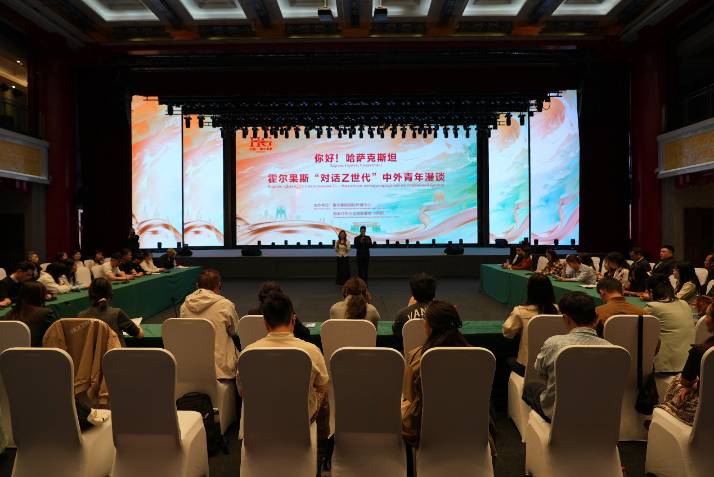 Participants speak at a dialogue on Gen Z exchange between China and Kazakhstan, held in Huoerguosi (Khorgas or Horgos) on March 30 (COURTESY PHOTO)
Huoerguosi (Khorgas or Horgos), a Chinese city bordering Kazakhstan, has grown from a trading post into a laboratory for crossborder cooperation. The Huoerguosi International Border Cooperation Center, straddling the China-Kazakhstan border, is the first crossborder economic cooperation zone China established together with another country. Launched in 2012, it allows citizens from both countries and any third country to enter it without visas, and purchase up to 8,000 yuan ($1,110) of products duty-free per person per day.
The center has become a testing ground for cross-border trade and mobility. Since it opened, over 120 million people have passed through the cooperation center, with 9.99 million in 2025 alone, as shown by data from the city's border inspection station. Geographically and economically, the two countries are neighbors and partners. But proximity does not guarantee understanding. "Understanding a different culture isn't just about respect," Aruzhan, a drama major student from Kazakh National University of Arts, said at a dialogue on Gen Z exchange between China and Kazakhstan, held in Huoerguosi on March 30. "When you understand how another nation expresses love or fear or hope, your stage becomes bigger." The dialogue on Gen Z exchange has offered a new platform for enhancing mutual understanding. Aruzhan was one of nearly 100 young people from 11 Chinese and four Kazakh universities who gathered for the dialogue. On the same day of the event, a media salon, themed on communication between Central Asia and Huoerguosi, was convened, followed by the launch of a cross-border short video festival. 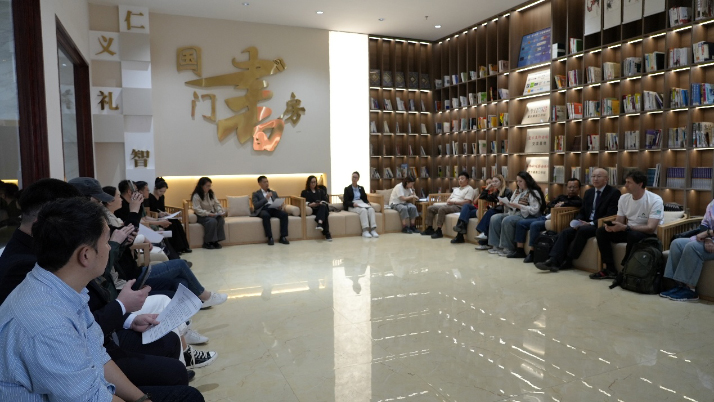 A media salon themed on communication between Central Asia and Huoerguosi, held in Huoerguosi on March 30 (COURTESY PHOTO)
Open dialogue In addition to economic and trade ties, Huoerguosi has stepped up efforts to promote cultural exchange, youth engagement and cross-border communication. "The distance between China and Central Asian countries is not just geographical. It's also a distance of understanding," Wang Jinsheng, Editor in Chief of China News Service's Xinjiang branch, said at the media salon. "Xinjiang is not only a physical gateway. It is a comprehensive hub for policy, infrastructure, trade, finance, and most importantly, people-to-people connection." Zhang Yaqing, a student from Harbin Institute of Technology's Shenzhen campus, told the audience that her generation see themselves as carriers and builders of China-Kazakhstan friendship. "As young people, we are both witnesses to China-Kazakhstan friendship and its inheritors," she said. "Every time we meet, every time we work together on a project, we pour fresh youth energy into this relationship." Zhanbolat Kadiza, a student from Abai Kazakh National Pedagogical University, said that young people today are "open-minded, hungry for knowledge and ready to connect with the world." "I have seen the growing young Chinese interest in Kazakh culture, and our young people are also starting to learn Chinese," Kadiza said. "This shows the power of our two-way exchange and mutual respect." As Chen Wenhao, a student from Shenzhen University, put it during the youth dialogue: "We are willing to use our lenses as pens, recording the beauty of China-Central Asia cooperation. We want to use our young voices to let more people see Huoerguosi's openness and vitality and to see the common efforts of China and Central Asian countries." For Aruzhan, the motivation was even more intimate. "When students from different countries work together, creative dialogue happens immediately," she said. "One person brings an idea, another adds their own understanding, and a new form is born." From 'telling' to 'sharing' While the youth dialogue focused on energy and idealism, the media salon focused on the prospect. The media salon was the first of its kind in 2026, building on a joint media working station established in Huoerguosi to facilitate regular collaboration between Chinese and Central Asian outlets. The goal was to move beyond telling stories separately toward telling shared stories together. "Communication forms and products from China sometimes remains overly formal or state-centric, which can limit emotional connection," Murad Shamilov, a professor at Kazakh Ablai Khan University of International Relations and World Languages, said. "Central Asian viewers, especially younger ones, respond better to human-centered storytelling, which is about real lives, shared experiences and relatable voices, rather than abstract narratives." The remedy, as Shamilov suggested, lies in co-creation. "Content exchange is important, but co-creation is even more valuable," he said. "It ensures that narratives are balanced from the outset." He specifically recommended joint reporting projects, youth media labs, and bilingual digital platforms. "These initiatives should not be limited to official media," he added. "Creative and talented journalists should be actively involved." "Unlike previous generations, these young people are not constrained by ideological legacies or historical stereotypes," he said. "Their interest in language and culture is pragmatic, but also genuinely curious. They are digital natives, which means they engage directly with content, bypassing traditional filters," Shamilov said. Tang Yi, an influencer from Chongqing-based Maiya Media, a major Chinese multi-channel network, agreed that the old top-down model no longer works for younger audiences. "Communication is nothing like preaching," she said. "Instead, we embed meaning into everyday scenes. For example, we should start with small scenes like a Chinese and a Kazakh driver learning each other's language and sharing food at the Huoerguosi port. That's how young audiences connect: through real, natural, and unforced moments." This point was echoed by others at the salon, including Wang Fei, a lecturer from Xinjiang University. "In an era of globalization, encounters and even collisions between different civilizations are normal," Wang said. "But they also create space for mutual complement and mutual achievement. Through each other's lenses, we hope to capture not just scenery, but trust." A digital Silk Road The Short Video Festival, themed on "being neighbors," is now in its second iteration. The first competition, held in 2025, received 103 submissions from 12 countries, including China, Russia, Kazakhstan, Bangladesh and the Republic of Korea. The videos ranged from vlogs and microfilms to AI-generated works. Topics included street-level warmth in Xinjiang's cities, the daily life of cross-border families and one particularly memorable piece titled Dancing With the Dragon, which showcases the spectacular fire dragon dance of Chongqing's Tongliang District. Chi Hui, creator of Dancing with the Dragon, said after receiving her award that the honor was not just a personal recognition but "a great encouragement for our creative team." "The work tells a warm story of inheritance, allowing more people to see the magnificent beauty of Tongliang dragon dance," Chi said. "In the future, we will continue to use our lenses to tell cultural and tourism stories, making traditional culture live and become popular." The 2026 edition expands the thematic focus, explicitly inviting creators from Belt and Road partner countries to submit works that capture "everyday neighborliness." In both Chinese and Kazakh culture, neighborliness carries a moral weight: It implies mutual aid, and forgiveness of small annoyances. It is an even more durable bond than a "partnership." Tang said the theme of the short video festival spoke directly to the spirit of solidarity and communication. "Short videos are a very accessible vehicle for cross-cultural exchange. They are fast-paced and highly empathetic. It only takes a simple image, a familiar sound, or a small hint of daily life to quickly bring people from different cultures closer," Tang told Xinjiang Today. "Chinese media have made notable progress in recent years," Shamilov, told Xinjiang Today. "There is greater effort to localize content, to engage audiences in Russian and other regional languages, and to present more nuanced stories beyond economic success." "I think vlogs and AI creation have the biggest potential regarding communication through short video platforms. Vlogs are about first-person, everyday storytelling and real moments that touch people. AI creation opens new doors for cross-border stories: It lets you create across time and space, break language barriers, and lowers the bar for creativity. At Maiya Media, we're also exploring how AI can help our creators tell China-Central Asia stories in fresher, more innovative ways," Tang said. For young creators who want to communicate with neighbor audiences through short videos, Tang offered this encouragement: "Start small. Film a foreign friend nearby or a cross-border dish or a funny language mix-up. These small moments are the real touchpoints of cultural exchange. Authenticity always speaks louder than perfection." "My agency's core strengths are resource integration, professional production, global distribution and brand-driven operations. We can build cross-border platforms for creators to connect, provide multilingual translation services, handle overseas channel distribution and develop intellectual property franchises. In the future, we hope to help quality content reach international audiences and be understood by more people, while staying true to our commitment to spreading positive energy and helping Chinese culture go abroad with warmth and heart," Tang added. "In the future, we should continue to building genuine mutual understanding through honest, human-centered storytelling that resonates with everyday people on both sides, to make people and our cultures even closer to each other," Shamilov said. Comments to zhangyage@cicgamericas.com |
|
||||||||||||||||||||||||||||
|