
|
| Xinjiang Today |
| My Kashi kinship | |
|
|
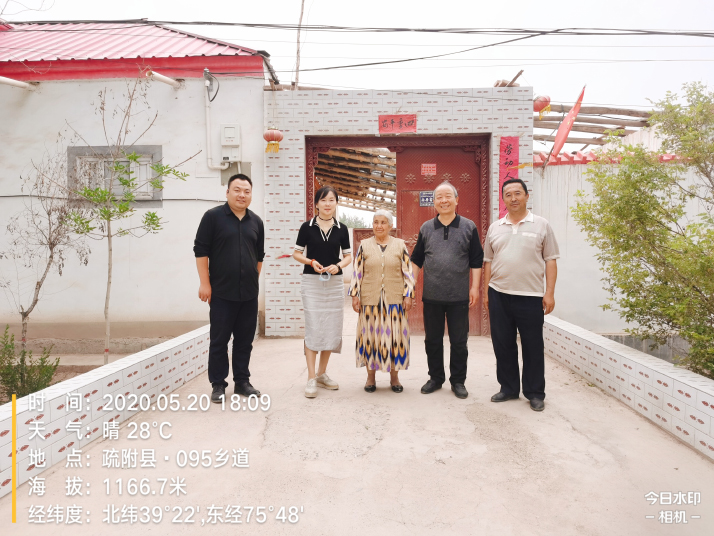 Lu Xiaoxin (second right) visits Tusunhan Yimin (center) in No.10 Village, Zhanmin Township, Shufu County, Kashi Prefecture (COURTESY PHOTO)
The spring of 2026 is the 10th anniversary of my bond with my found family in Kashi (Kashgar) Prefecture—a Uygur family headed by an elderly woman named Tusunhan Yimin, who lives in No.10 Village, Zhanmin Township, in Shufu County. From 2015 to 2017, I was deputy commissioner of the Kashi Prefecture Administrative Office. The office is the representative agency of the Xinjiang regional government in Kashi. Before working there, I was a second-level inspector of the Heihe River Basin Administration, Yellow River Conservancy Commission, based in Zhengzhou, Henan Province. China has been implementing "pairing assistance" programs in Xinjiang since 1997, under which various regions of the country offer financial, technical and human resource support to the autonomous region. I went to work in Xinjiang under such a program. In the spring of 2016, a poverty alleviation pairing assistance program was launched in Kashi Prefecture. Officials coming to Xinjiang from other regions were encouraged to pair up with local families living under the poverty line of 2,300 yuan ($338) at the time, and offer them continued and targeted help. Soon, I was paired with Tusunhan's family. She had several children—her eldest son was married and had moved out, and her daughter was also married. Tusunhan lived with her two unmarried sons. "Good," I said, "I'll go meet my new relatives right away." With a sense of curiosity and eagerness to step into a Uygur rural home and learn the true reality of village life, I set off. 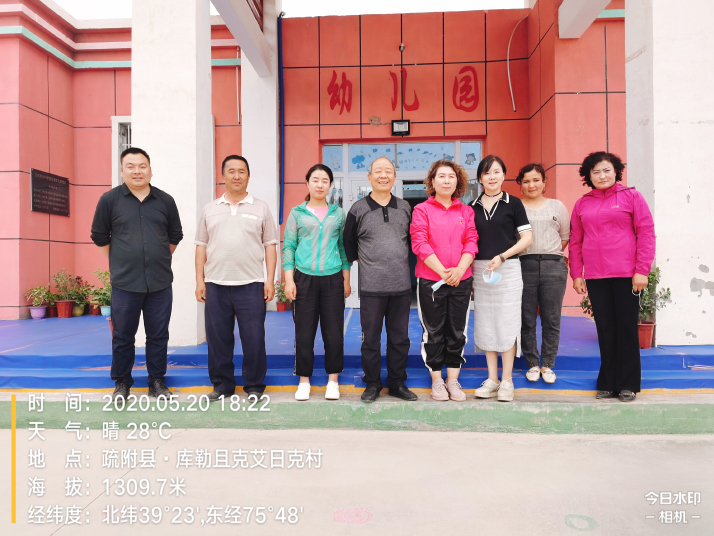 Lu Xiaoxin (fourth left) visits a kindergarten that his family has supported in No.10 Village, Zhanmin Township, Shufu County, on May 20, 2020 (COURTESY PHOTO)
Meeting the relatives Our first encounter happened in spring 2016. Before we met, I had prepared some gifts: rice, flour, oil, tea, sugar and mutton. The next morning, my wife and I drove to the village. Poplars flashed by, and the Kunlun Mountains were a faint, distant sight. At the gate, a group of people awaited us—local officials and Tusunhan's family. Looking at them, I felt as if long-lost relatives were waiting ahead. The elderly woman wore a dark blue silk headscarf. Her weathered hand held that of a toddler with big, sparkling black eyes. Their smiles shone as brightly as the strong Xinjiang sun. Her courtyard was neat—rose bushes, a walnut tree, chickens pecking, and six sheep. We sat on a huge wooden bench. She explained that her eldest son and daughter were married and living elsewhere; she lived with her two younger sons. Her second son had dropped out of elementary school and did masonry, but work was scarce. Her third son had finished junior middle school education and worked at an electronics factory, but was often home on leave due to the sluggish market. Tusunhan asked where my son was. I told her that my son worked and lived in Beijing. Her eyes lit up. She turned to her sons and said, "Work hard, so you can go to Beijing someday!" Everyone laughed as the aroma of milk tea filled the air. 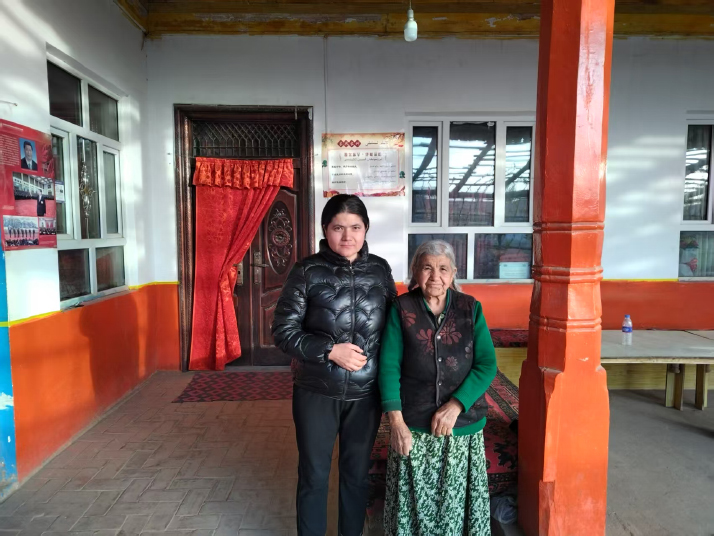 Tusunhan Yimin (right), a resident of No.10 Village (COURTESY PHOTO)
Addressing matters of concern On my second visit, she shyly asked for help—neither son had stable job. The poverty alleviation target was an annual income of over 4,500 yuan ($661) per person. Without jobs that pay a decent salary, shaking off extreme poverty would remain an empty promise. I promised her I'd help. Soon after, I met with Liu Xiaolei, Chairwoman of Xinjiang Linghang Pipe Technology Co. Ltd. in the Kashi Industrial Park. I asked if her factory needed workers as one of my found family members was looking for a job. She happily agreed to help. Soon, the youngest son of Tusunhan became a skilled worker, earning up to 6,000 yuan ($882) a month. I always attach great importance to education, so I encouraged her second son to attend night classes to learn standard Chinese and new skills. She nodded, "I will encourage him to go." Then the second son got a job at the rural water supply station as a repairman, earning over 2,000 yuan ($294) a month. Their combined income approached 8,000 yuan ($1,176) monthly. The next time I visited, Tusunhan shook my hand, thanking me repeatedly. As their quality of life improved, she began to worry about the two sons' marriages. Her older son was 26, the younger 23. I asked one of the village team leaders, surnamed Zhang, to keep an eye out for any potential matches. In 2018, he found one for the younger son. Unfortunately, it didn't work out. Tusunhan sighed but was understanding, "We'll take it slow. A good girl will come along eventually." 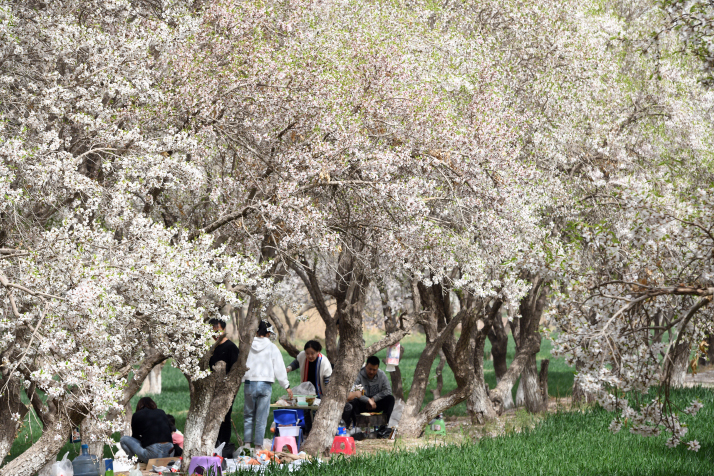 Almond blossoms in Shufu County, Kashi Prefecture, in April 2024 (VCG)
Continuing the bond After two years in Kashi, the Xinjiang Uygur Autonomous Regional Government invited me to stay for three more years, working as deputy chief of the Department of Water Resources of Xinjiang. For five years, the bond between me and Tusunhan's family deepened with every visit. I watched the courtyard grow tidier, the two sons transform from unemployed youths into industrious workers, and their mother has changed from being worried to being content. On the day I left Xinjiang, the wind carried a gentle warmth. I remembered the naan bread she had tucked into my hands, her youngest son's shy smile, the rose bushes and walnut tree in the courtyard. Over the course of five years, I had gained a kinship that transcended ethnicity and language. Years later, I called the youngest son. He told me, "My mother is healthy. My older brother is now married and lives with her. I got married last December. The county's security company has sent me to (the regional capital of) Urumqi to serve as a security guard." Overjoyed, I said, "Send my best wishes to your mother. Work hard, and if I have time, I'll come see you." The poplars of Kashi take root in the Gobi Desert, their branches intertwined, weathering storms together. So too has our kinship become as steadfast as those trees: born on the frontier, rooted in mutual trust and reaching toward the sun. This bond, forged along the path of poverty alleviation, has taken deep root in this land and in our hearts. Comments to yanwei@cicgamericas.com |
|
||||||||||||||||||||||||||||
|