
|
| Xinjiang Today |
| Ancient journeys bridging civilizations | |
|
|
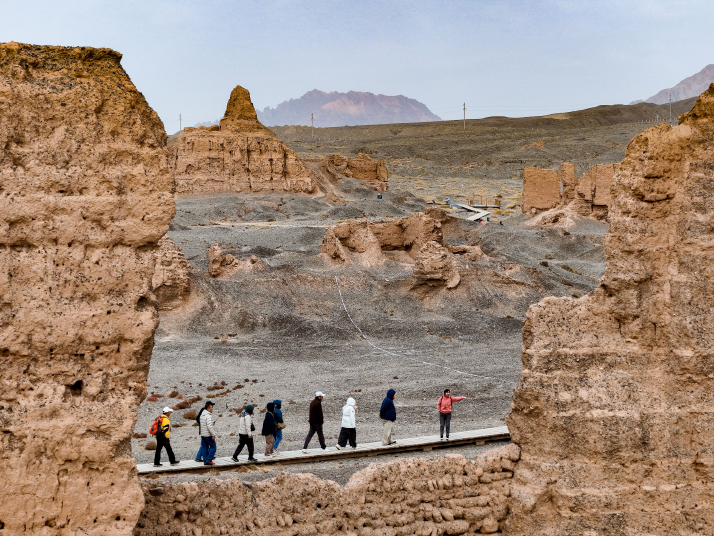 Tourists visit the Subash Buddhist Temple Ruins in the northwest of Kuche (Kuqa or Kucha) on October 31, 2024 (XINHUA)
Faxian was a renowned Buddhist monk, traveler and translator during China's Eastern Jin Dynasty (317-420). Xuanzang was an eminent monk and translator of Buddhist scriptures in the Tang Dynasty (618-907). They shared a common experience: Both had traveled to Xinjiang, then known as the Western Regions. In the spring of 399, 65-year-old Faxian set out from Chang'an (now Xi'an) on his long journey to the west. Two hundred and thirty years later, on a late night in August of 629, 27-year-old Xuanzang left Chang'an quietly to begin his own westward journey.
Faxian traveled through the Western Regions to over 30 kingdoms in Central and South Asia, collected a large number of Sanskrit scriptures, and returned to Chang'an 14 years later. Xuanzang made his way through the Western Regions to India to study Buddhist teachings and returned to Chang'an in 645. His round trip took 17 years, covered more than 25,000 km and spanned 138 kingdoms. Both left invaluable written accounts of their journeys: A Record of the Buddhist Kingdoms by Faxian and The Great Tang Records on the Western Regions by Xuanzang. These two books document the geography, transportation networks and socio-political landscape along the Silk Road in the fifth and seventh centuries, respectively, preserving a wealth of precious firsthand historical materials from many long-vanished ancient kingdoms and providing core texts for historical, archaeological and geographical research. From today's perspective, these two westward routes, over two centuries apart, are like two enduring silk threads weaving through the rocky deserts and oases north and south of the Tianshan Mountains, embroidering an astonishing tapestry of civilizations upon the fabric of history. As Faxian and Xuanzang traversed this vital corridor connecting East and West, they recorded not only Buddhist scriptures and Sanskrit texts, but also a living epic of civilizational integration. Their accounts demonstrate the mutual understanding and fusion between Chinese and other cultures, exerting an influence far beyond the religious sphere and serving as an eternal testament to mutual learning among civilizations. 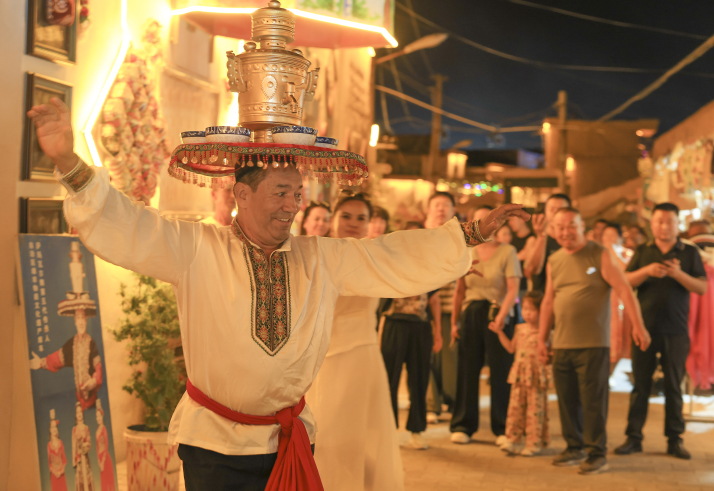 A man performs a traditional Uygur greeting dance in Kuche on August 4, 2025 (XINHUA)
Landscape, livelihoods and lore Faxian traveled through the Hexi Corridor, a 1,000-km narrow stretch of navigable plains spanning today's Gansu Province and a key segment of the ancient Silk Road, and crossed the present-day Lop Nor basin, a desolate expanse he characterized as a veritable landscape of death—"Above, there are no birds flying; below, there are no animals roaming... Only the dried bones of the dead serve as landmarks." After crossing it, the first Western Regions kingdom Faxian entered was Shanshan. He said the land was rugged and barren. The clothes of the common people were roughly similar to those of the Han Chinese, except that they used felt and woolen fabrics. Khotan (232 B.C.-A.D. 1006) was one of the more prosperous kingdoms recorded by Faxian. According to him, the Khotan people were numerous and thriving, showcasing the prosperity of the southern Silk Road route. Faxian also documented Khotan's grand image procession festival, describing how, starting on the first day of the fourth month in the Chinese lunisolar calendar, the entire city was swept clean, canopies and curtains were hung, and jeweled carts carried Buddhist images in procession, while the king, queen and the people all burned incense and scattered flowers in a grand religious and folk spectacle. Xuanzang recorded in detail the markets of the Shule Kingdom where rare and exotic goods from different origins could be found, including silk from China's Central Plains, silverware from Persia and spices from India. Of particular note was Xuanzang's observation that Shule's craftsmanship and skills excelled among regional kingdoms, with local smelting and textile techniques integrating the strengths of East and West. His travelogue also listed notable regional specialties: sweet melons from Hami, white jade from Khotan, grapes from Qiuci, or today's Kuche (Kuqa or Kucha), and silver from Karasahr, among others. Faxian mentioned that in Karasahr, the people lacked rites and propriety, and had no knowledge of Buddhist teachings. However, the land was fertile, and its products were roughly similar to those in China's Central Plains. 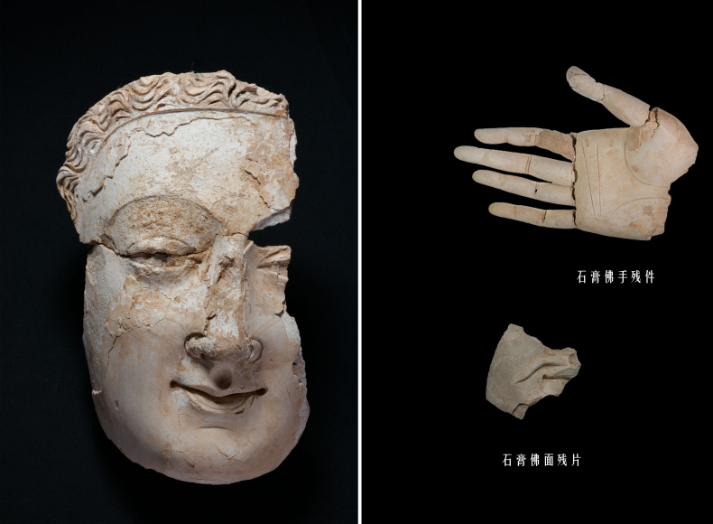 A giant plaster Buddha face and hand unearthed at the Mo'er Temple site in Kashi (Kashgar) (XINHUA)
Buddhism vs. diverse beliefs Religion was a central concern for Faxian and Xuanzang on their westward journeys. Faxian recorded that in Shanshan, the king revered Buddhism, and there were about 4,000 monks in the Theravada branch of Buddhism there. Upon reaching Karasahr, he discovered this oasis kingdom at the southern foot of the Tianshan Mountains was also a flourishing center of Buddhism. It was also home to over 4,000 monks, all practicing Theravada teachings. Not until Faxian arrived in the Zihe Kingdom did he encounter Mahayana Buddhist monks. That is to say, Buddhism flourished in the Western Regions at the time, with Theravada as the prevailing tradition. Faxian noticed that although they shared a common Buddhist tradition, there were notable differences in precepts and practices between the Theravada Buddhism of the Western Regions and the Mahayana Buddhism of China's Central Plains. This did not lead to rejection but rather formed a complementarity—the monasteries of Karasahr simultaneously accommodated practitioners from different traditions, and this inclusiveness was precisely a characteristic of the ancient Silk Road route on the southern side of the Tianshan Mountains as a crossroads of civilizations. Xuanzang revealed that when he arrived in Kucha, he was awestruck by the sight of over 100 monasteries and a community of more than 5,000 monks. Every year at the autumnal equinox, monks from various kingdoms gathered there. Kucha was not only a Buddhist center but also a melting pot of music, dance and painting. He specifically recorded the famous "circumambulation" ceremony—monks carrying Buddhist images in procession, with followers lining the roads to pay homage, accompanied by music and dance. This religious activity, which fused Indian Buddhist rituals, Persian artistic forms and local folk customs, vividly embodied the city's distinctive form of layered accumulation of multiple cultures. The two monk-travelers' accounts of Gaochang are particularly noteworthy. When Faxian passed through, Gaochang was under the profound influence of Han Chinese culture: "The language of the people is roughly the same as that of Han Chinese, but they primarily use a different writing system." When Xuanzang arrived, the king of the Kingdom of Gaochang (460-640) bestowed extraordinary hospitality upon him, not only insisting on supporting Xuanzang but also requesting that he remain in Gaochang to teach Buddhist doctrine. Xuanzang recorded: "The king and his relatives personally served food and drink; all others, from high to low, gave freely without hindrance." Though their accounts of the lands north of the Tianshan Mountains are brief, they reveal that Buddhism was not flourishing there. When Faxian passed through the former land of the Wusun, he recorded the religious state of the nomadic people there: "The common people lack rites and righteousness, and mostly worship diverse deities." When passing through Zihe, he wrote that the king of Zihe himself did not believe in Buddhism, yet he did something remarkable: He funded the construction of a monastery and, upon its completion, fully handed it over to the Buddhist community without taking personal credit. When Xuanzang crossed the northern foothills of the Tianshan Mountains, he noted the coexistence of Buddhism and Shamanism under the influence of the Western Turkic Khaganate (583-657). He wrote, "They reverently serve the Sky God and do not believe in Buddhism." The "Sky God" here refers to the supreme Turkic deity Tengri, whose sacrificial rituals were presided over by shamans and involved the worship of heaven, earth, mountains, rivers and ancestors. He also recorded that the ruler's camp was filled with numerous cavalry and items made of gold, exuding the atmosphere of nomadic military aristocracy, distinctly different from that of Buddhist monasteries. Cultural integration and diversity Describing the Buddha's Birthday celebration in Khotan, Faxian painted a vivid picture of the spectacular Buddhist image procession "in a place some 3 li (1.3 km) from the city, they made four-wheeled image carts, some 3 zhang (7.4 meters) high, shaped like moving palaces." This practice of combining Buddhist rituals with local festivals demonstrates the localization and adaptation of religious beliefs. Near Issyk-Kul Lake in today's Kyrgyzstan, Xuanzang witnessed the remarkable coexistence of Buddhism and Zoroastrianism, an ancient faith centered on fire worship dating back around 2,500 years. "Three monasteries, with several dozen monks studying Mahayana teachings. Over 10 non-Buddhist temples, with more than 1,000 adherents of other sects." Different belief systems developed in parallel within the same region, occasionally borrowing rituals and symbols from one another. Comparing the records of Faxian and Xuanzang reveals the transformations of cultures north and south of the Tianshan Mountains over two centuries. In Faxian's accounts, although Buddhism flourished, sectarian divisions were prevalent and political forces were fragmented. In Xuanzang's time, the Buddhist institution had achieved a greater degree of integration, and exchanges with China's Central Plains were closer. Behind these changes were the combined effects of the flourishing Silk Road trade, the rise of Turkic powers and the efforts of the dynasties in China's Central Plains to administer the Western Regions. Gaochang, as recorded by both, maintained the institutions and systems of China's Central Plains while absorbing religious and cultural elements from India and Persia. This fusion is also evident in language. From their records, the mixed state of languages and scripts in the Western Regions was particularly striking. Faxian discovered that in Shanshan, Kharosthi script, Chinese characters and local languages were used simultaneously. Xuanzang noted that in the Kingdom of Baluka (today's Aksu) that the writing system and rules were the same as those of Kucha, though the language differed slightly. This multilingual environment not only served trade but also facilitated the translation and dissemination of different intellectual systems. Though the dust of time has long buried the footsteps of Faxian and Xuanzang beneath the yellow sands, the world they recorded—a diverse, inclusive and vibrant civilizational landscape north and south of the Tianshan Mountains—still speaks quietly from the depths of history: When different civilizations meet, collisions may spark momentary flashes, but communication ultimately gives birth to something new. Rereading these travelogues today, we see not only the journeys of two revered monks in search of Buddhist teachings, but also the dynamic process of mutual learning among civilizations. With their pens, Faxian and Xuanzang captured the vibrant coexistence of diverse civilizations—Buddhism and Zoroastrianism side by side, Han Chinese characters used alongside other scripts, and Chinese silk traded in the same markets as Persian silverware. These records serve as an ancient mirror, reflecting the possibility of harmonious coexistence among different cultures and providing historical echoes for civilizational dialogue in today's era of globalization. Comments to lanxinzhen@cicgamericas.com |
|
||||||||||||||||||||||||||||
|