
|
| Xinjiang Today |
| Tacheng's time | |
|
|
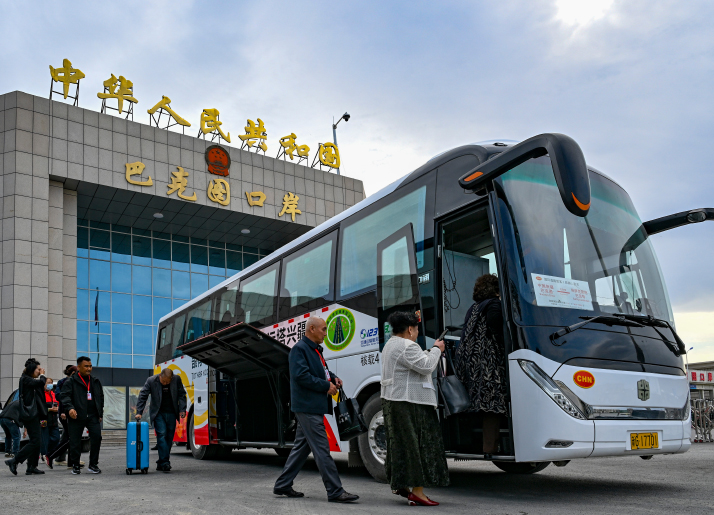 Tourists get on a bus bound for Kazakhstan at the Baketu (Baktu) Port on September 17, 2025 (XINHUA)
Tacheng Prefecture, located in China's far-northwest Xinjiang Uygur Autonomous Region, has long been viewed as a remote borderland. Today, it is emerging as a dynamic economic hub and a key node on the Belt and Road Initiative (BRI). Driven by strategic openness, industrial upgrading and green growth, Tacheng's GDP surpassed 100 billion yuan (about $14 billion) in 2025, marking a historic milestone. With its unique geographic advantages, policy support and accelerating modernization, the prefecture is transforming from a remote frontier into a gateway of opening up and a bridge between East and West. Location and policy Bordered by Kazakhstan to the west and north, Tacheng occupies a pivotal point in the core area of the Silk Road Economic Belt. Owing to its frontier location, the prefecture benefits from a range of favorable policies aimed at promoting high-quality development. In December 2020, the State Council approved the establishment of a key pilot zone for development and opening up in Tacheng, the first of its kind in northwest China. This initiative aims to deepen cooperation with neighboring countries and accelerate development in the core regions of the Silk Road Economic Belt. Both the central and regional governments have introduced preferential policies, including tax incentives, streamlined administration and cross-border trade facilitation, attracting businesses from across China and abroad. The Baketu (Baktu) Port, with more than 260 years of trade history, lies at the center of this opening-up strategy. Located within the pilot zone, the port serves not only as a vital gateway to Kazakhstan, but also as an important link connecting Central Asia and Europe, further solidifying Tacheng's role as a crucial node in the Silk Road Economic Belt. From the port, traders can access major cities such as Almaty and Astana in Kazakhstan, and St. Petersburg in Russia. In recent years, the port has focused heavily on creating a more efficient, business-friendly environment. The port has undergone a smart transformation. By 2025, customs clearance time was cut from three to four hours to under 10 minutes, with annual cargo handling capacity jumping from half a million tons to 1 million tons. This efficiency boost has made Baketu one of China's most convenient land ports for Central Asian trade. In 2025, Tacheng's foreign trade volume grew by more than 30 percent, with products exported to around 60 countries, ranging from fruits and textiles to new-energy vehicles and wind power equipment. In the first quarter of this year, Tacheng's foreign trade value exceeded 3 billion yuan ($440 million), representing a remarkable year-on-year increase of more than 130 percent. Its growth rate ranked first in Xinjiang, while its trade scale ranked seventh. This surge not only demonstrates the effectiveness of the port's smart transformation and supportive policies but also highlights Tacheng's accelerating transition from a transit corridor into a dynamic industrial hub linking China, Central Asia, Europe and beyond. The trade boom has directly boosted local finances. In the first three months of this year, Tacheng's general public budget revenue grew respectively by 20.89 percent, 15.43 percent and 17.15 percent year on year, ranking first in Xinjiang for each of the three months. 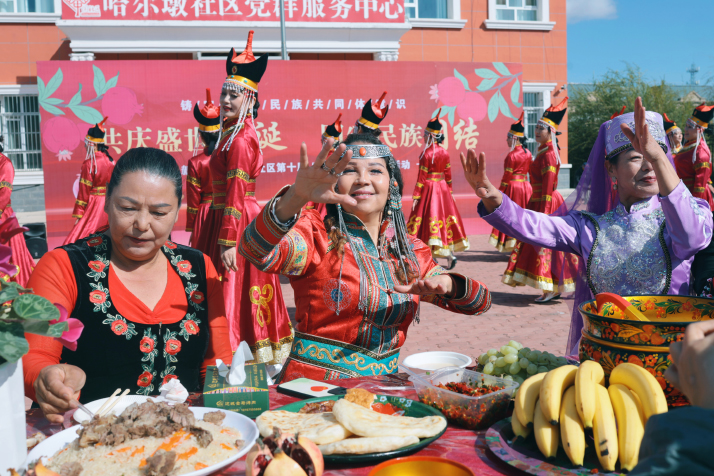 Residents participate in a residential community-based cultural activity in Tacheng City, Tacheng Prefecture, on September 27, 2024 (XINHUA)
A modern industrial system Agriculture has long been the foundation of Tacheng's economy, and it remains one of the region's strength. The Tacheng Basin is a major green agricultural production base in China, producing high-quality grain, cotton and specialty crops like hops, goji berries and safflower. In 2025, total grain output reached nearly 3 million tons, while cotton output totaled 552,400 tons. Modernization continues to drive this sector forward. Smart farming, deep processing and brand building have contributed to rising rural incomes, which reached 27,300 yuan ($4,012) per capita in 2025, a year-on-year increase of 7 percent. What truly defines Tacheng's new era, however, is its rise as a green energy powerhouse. Blessed with abundant wind and solar resources, the region is building a multi-million-kilowatt new-energy base, with projects ranging from large-scale solar farms to wind turbine manufacturing. A carbon-neutral smart industrial park for wind power equipment has attracted major investments and established a complete industrial chain spanning component production to final assembly. This "wind-to-wealth" strategy not only reduces carbon emissions but also positions Tacheng as a national leader in renewable energy development. Beyond new energy, Tacheng also possesses rich mineral resources known for their diversity, large reserves and high quality. By the end of January, 73 types of minerals across 10 major categories have been identified, with proven reserves confirmed for 38 types. Proven reserves of coal total 41.95 billion tons, ranking fifth in Xinjiang. The proven crude oil reserves in the prefecture approximate 2.46 billion tons, while proven natural gas reserves reach 80 billion cubic meters. 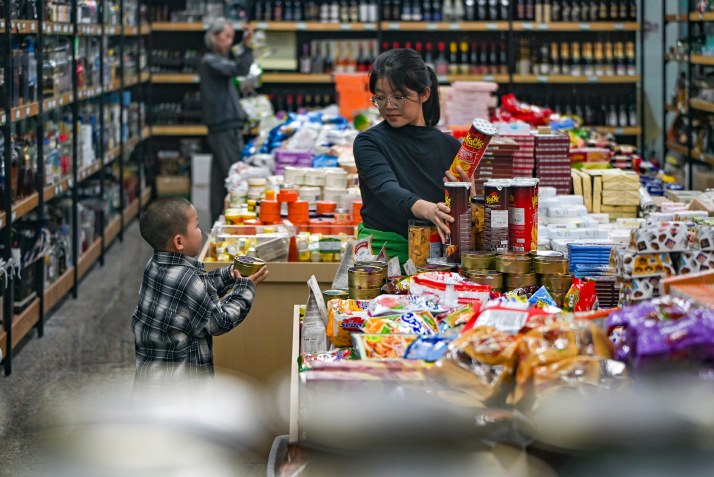 Customers buy imported products in Tacheng Prefecture on September 17, 2025 (XINHUA)
Inclusive development
Economic growth in Tacheng has been broadly inclusive, benefiting all 29 ethnic groups, including the Han, Uygur, Kazak and Hui communities. The region's development model places strong emphasis on improving livelihoods through job creation, poverty alleviation and expanding social welfare. The "border trade plus local processing" model has proven particularly successful. Under this mechanism, individual border residents enjoy daily duty-free import quotas, though their purchasing power is limited. By forming cooperatives, they are able to pool their quotas and import large volumes of raw materials from neighboring countries at significantly lower cost. Local enterprises then purchase and process these materials into higher value finished products. This mechanism has created a mutually beneficial outcome: Businesses reduce their production costs, while border residents gain stable income as part of the supply chain. In the first 11 months of 2025, the model benefited 98,000 border residents, generating 6 million yuan ($881,500) in direct income and promoting shared prosperity. Tourism has also become an important bridge for cultural exchange. Tacheng's stunning landscapes, such as its vast grasslands, snow-capped Tianshan peaks, pristine wetlands and serene alpine lakes, offer a picture-perfect destination for nature lovers. The region also boasts a rich cultural heritage, from centuries-old rock paintings recording early nomadic life to vibrant ethnic folk music and dance traditions, as well as distinctive local cuisine loved by travelers from around the world. These natural and cultural assets have drawn a growing number of visitors from across China and abroad. Cross-border tourism with Kazakhstan has expanded rapidly, supported by streamlined border procedures and boutique travel routes that combine port visits, grassland adventures, ethnic cultural experiences and rural homestays. Visitor travelling between Tacheng and East Kazakhstan Region increased significantly in 2025. This booming tourism sector not only creates jobs and raises local incomes, but also deepens mutual understanding between China and Central Asia. To ensure sustainable development, Tacheng has integrated ecological protection with cultural heritage preservation. By balancing conservation with tourism growth, the prefecture is turning its unique resources into inclusive and sustainable opportunities for all ethnic groups. Comments to luyan@cicgamericas.com |
|
||||||||||||||||||||||||||||
|