
|
| Xinjiang Today |
| Planting ahead | |
|
|
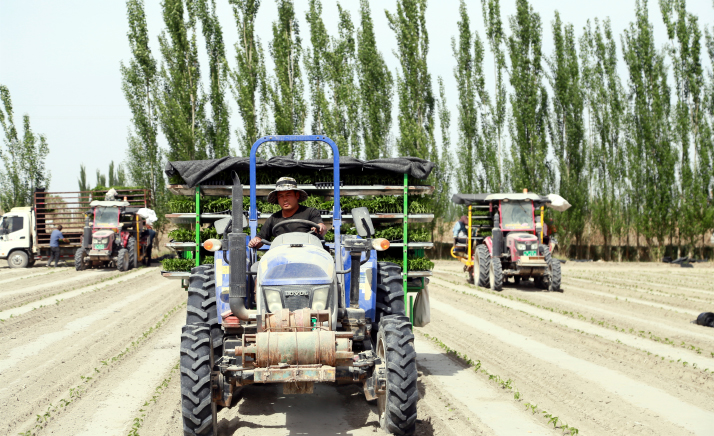 Chili seedling transplanting in Gujiligaer Village, Aksu Prefecture, on April 16 (CNSPHOTO)
Home to around one sixth of the world's population, China's agricultural efficiency and output have long been of critical importance to achieving global food and material security goals. For decades, efforts to increase output have centered on enhancing plant and animal genetics, improving farming practices and rural infrastructure, and better connecting producers with markets. But in recent years, as new and emerging technologies have become more accessible and affordable, these technologies have been playing a growing role as everyday tools helping farmers get ahead.
One of these is China's homegrown global navigation satellite system, BeiDou. Fully functional since 2020, BeiDou provides mm-accurate global positioning to over 1.5 billion users, including corn growers in Duotela Township in Tuoli (Toli) County, north Xinjiang's Tacheng Prefecture. In the town's demonstration zone for high-yield corn production, BeiDou was put to work for this spring's planting. Intelligent satellite-controlled seeders required positioning only at the start and end points of each row, but then ensured straight and accurate planting that leads to less waste and higher yields. Guo Qianling, who uses the technology on his 733 hectares of contracted land within the demonstration zone, said each seeder is capable of planting around 9.3 hectares per day. "In the past, manual seeding resulted in uneven plots. Now, with the help of the BeiDou system, the seeding precision has greatly increased, reducing waste in subsequent pesticide spraying and harvesting. Corn yield per hectare has increased from 19.5-21 tons to about 22.5 tons, an increase of nearly 10 percent," Guo said, adding that his plowing, leveling seeding and spraying are now fully mechanized. These increases have contributed to an overall increase in grain production across Xinjiang. In 2025, Xinjiang's grain output surpassed 24 million tons, rising for an eighth consecutive year and leading the country on a per-unit basis for a second consecutive year. The region's 2026 government work report calls for enhancing the quality and efficiency of modern agricultural and pastoral development, promoting integrated improvements in farmlands, seeds, machinery and methods to achieve balanced, large-scale yield increases and a grain output of approximately 24.25 million tons. Achieving this goal not only relies on the extensive use of intelligent agricultural machinery, but also on effective planning and policy measures, as well as the provision of supporting inputs such as agricultural technology services and training. 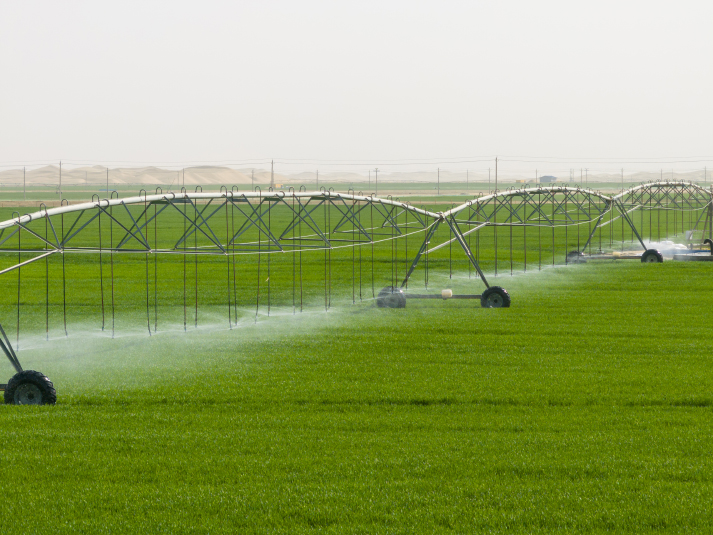 Farmers use center-pivot sprinkler irrigation systems for precise water control, enabling frequent light watering and synchronized water-fertilizer application, in Kunyu City on April 11 (CNSPHOTO)
Technology empowerment Alongside the use of satellite-controlled seeding, another hi-tech tool for efficiency made its debut this spring in Tuoli. The county offered farmers free installation of intelligent drip irrigation systems that can be controlled remotely via smartphone, with handover training taking place in late April. "Intelligent drip irrigation not only conserves water but also reduces labor demands. Previously, one person could manage 33 hectares; now, that capacity doubles to 67 hectares, significantly streamlining the management team," Guo, who is optimistic about the new technology, said. Similar technologies have been rolled out on farms around Xinjiang. In the cotton fields of Shaya (Xayar) County in Aksu Prefecture, large seeders can complete mulching, drip tape laying and precision seeding in one go. Approximately 500,000 hectares of cotton is grown in Aksu, with over 98 percent of sowing being completed by machine. But with the advancement of agricultural technology, there is an even greater need for people who know how to use it. For this reason, the organized placement of agricultural technology services is another important factor in the success of spring sowing. Dispatching technicians to provide one-on-one field guidance and introducing advanced field management technologies and practices are becoming part of government services for farmers across Xinjiang. To ensure sowing quality and safe production, Tuoli's agricultural department deployed 30 agricultural machinery technical service teams to provide on-site technical guidance and safety support this spring. It also runs regular training programs for agricultural machinery operators at the Tuoli County Technical School, having held three sessions this year with more than 100 participants. 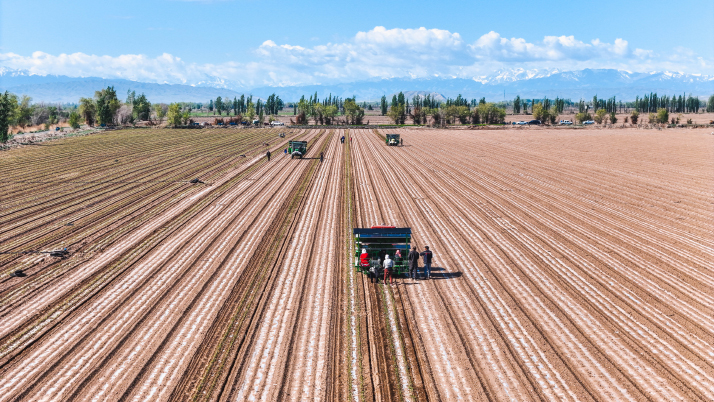 Tomato transplanters operate in the fields of Shangsangong Village in Hutubi County, Changji Hui Autonomous Prefecture, on April 26 (CNSPHOTO)
Steadfast support During the spring planting rush, the carefully planned supply of agricultural inputs is key to eliminating bottlenecks and maximizing efficiency. To ensure that high-quality spring farming materials are available to farmers in a timely manner, all regions in Xinjiang make their plans well in advance each year. Sufficient financial support, adequate material reserves and effective market regulation must all be in place to ensure supply and a smooth spring farming season. In Bortala Mongolian Autonomous Prefecture, local financial authorities have established special funds to help farmers finance spring farming and encouraged banks to launch multiple online services and issue loans promptly to address farmers' financial difficulties. Multiple government departments also carried out joint law enforcement operations to protect farmers' rights and interests, focusing on agricultural supplies such as seeds, pesticides and fertilizers. Special inspections were conducted to strictly crack down on illegal activities, including the production and sale of counterfeit and substandard agricultural materials and unlicensed operations. The Kashi (Kashgar) Prefectural Taxation Bureau has been providing targeted assistance to enterprises and farmers during the agricultural season. Since the beginning of the year, it has been proactive in accurately communicating tax and fee reduction policies to agricultural businesses and addressing their tax-related queries through one-on-one consultations.  A seeder in action at a cotton field in Baximaili Village in Yuli County, Bayingol Mongolian Autonomous Prefecture, on April 10 (CNSPHOTO)
In the Hand-in-Hand Smart Assembly Industrial Park in Yili (Ili) Kazak Autonomous Prefecture, state-of-the-art agricultural machines such as high-powered tractors and precision seeders stood in neat rows as over 20 resident companies entered their peak spring planting sales season. There were nearly 40,000 units (sets) of tractors and supporting agricultural machinery available for spring production in Yili. As spring brings renewed hope to farmers across Xinjiang, the integration of advanced technologies, comprehensive support services and steadfast government policies provides a powerful foundation for the region's continued gains in agricultural efficiency and output. Comments to taoxing@cicgamericas.com |
|
||||||||||||||||||||||||||||
|