
|
| Xinjiang Today |
| Bridging better lives | |
|
|
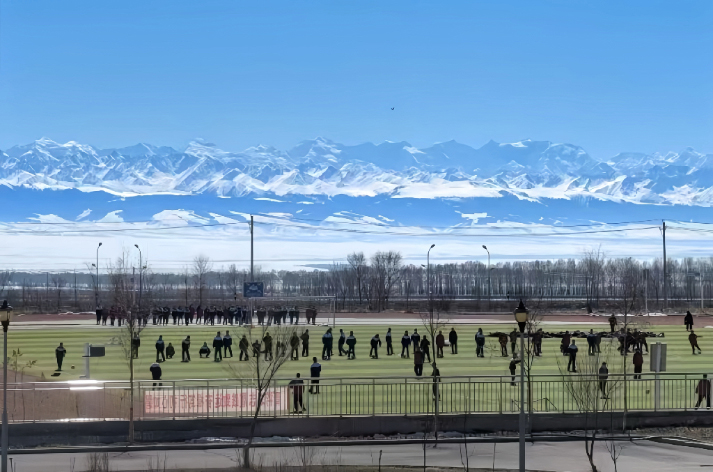 A physical education class at the Jiyang Middle School in Gongliu County, Yili (Ili) Kazak Autonomous Prefecture, on March 27 (COURTESY PHOTO)
Across thousands of miles of mountains and rivers, a profound commitment links east China's Jiangsu Province with Xinjiang's development. "Why come to Xinjiang? What to do here? What to leave behind?" These three questions quietly accompany every aid worker upon arrival.
This April witnessed the completion of Jiangsu's 11th three-year assistance mission to Yili (Ili) Kazak Autonomous Prefecture, as well as to the fourth and seventh divisions of the Xinjiang Production and Construction Corps (XPCC). From schools and hospitals to factory floors, from newly built facilities to the smiles and heartfelt gratitude of local residents, these moments together form a vivid testament to the fruits of this mission. 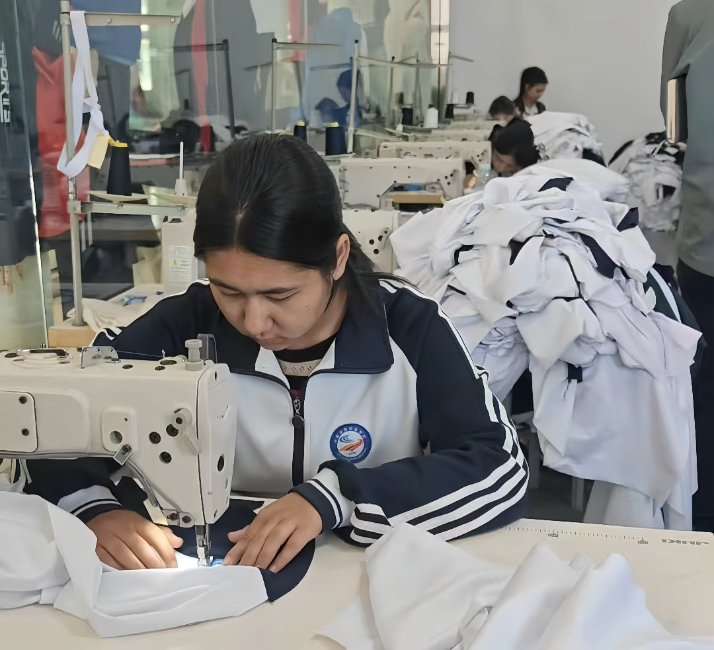 A student sews a uniform in a garment training room at the Yili Vocational and Technical College on March 30 (COURTESY PHOTO)
An education relay From eastern cities to western border regions, from classrooms to campuses, teachers from Jiangsu have been nurturing education—using knowledge as the plough, culture as the seed and care as the fertilizer. On March 27, at Jiyang Middle School in Gongliu County of Yili, students ran along a standard 400-meter track, with the snowcapped Tianshan Mountains towering in the distance. Built with aid funding of 100 million yuan ($14 million), the school has become a "dream campus," covering 6.17 hectares, with a total floor area of 27,000 square meters. Such modern campuses can now be found across Yili. Jiangsu Middle School, also built through assistance programs, officially opened in Huocheng County on September 10, 2024. Yet educational support goes beyond infrastructure—it strengthens teaching capacity as well. In a physics lab at Jiyang Middle School, Huang Weiliang, a teacher from Jiangsu, guided students through an experiment using simple devices made from two purified water bottles. "This experiment helps senior students understand how speakers produce sound when studying Ampere's force," Huang explained. "By making the devices themselves, students can see how physics operates in everyday life, improving both their practical skills and their interest in the subject." Classrooms at Yili Vocational and Technical College sometimes resemble factory workshops, with students sewing uniforms or assembling helmets. Helping students acquire hands-on skills is another key focus of Jiangsu's educational assistance. In a garment training room, rows of student-made clothing are displayed like products in a factory. Meiyasaier Kaishaer, 18, who studies garment production and management, said, "I hope to open my own clothing store one day and design my own pieces." Jiangsu's aid teams in Yili have consistently emphasized both providing support while fostering self-sustaining development, by improving facilities and dispatching experienced teachers to cultivate long-term growth. 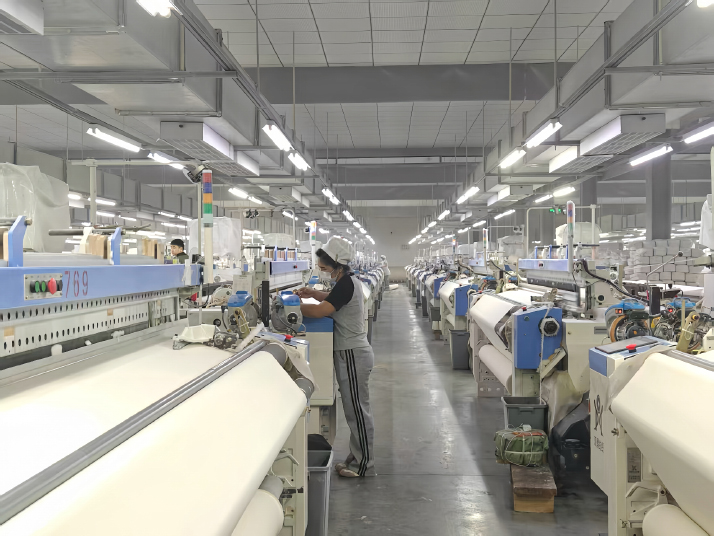 A worker operates a textile machine at a textile industrial park in Yining County, Yili Kazak Autonomous Prefecture, on March 29 (COURTESY PHOTO)
Quality healthcare Healthcare remains one of the most pressing concerns for local residents. Jiangsu's assistance focuses on improving access to medical services by dispatching medical teams, introducing flexible support programs, upgrading infrastructure and strengthening local capacity. At noon on March 26, Wang Bin, head of a medical team from Taizhou City in Jiangsu and Deputy Director of People's Hospital of Zhaosu County, was making ward rounds, checking on a 62-year-old Kazak patient he had helped treat that same day. Zhaosu's remote location, more than a two-hour drive from Yining City, the prefectural capital, has long posed challenges for timely medical care. Cardiovascular diseases have a relatively high incidence in Xinjiang, yet vast distances, sparse populations, limited grassroots emergency response capacity and low public awareness of chest pain symptoms often mean that the critical rescue window is missed. In late 2025, the People's Hospital of Zhaosu County was designated a national primary-level chest pain center, enabling residents to receive faster and more effective treatment locally. In Tekesi (Tekes) County, a 3,400-square-meter emergency and critical care center, funded with 25 million yuan ($3.66 million) coming from Jiangning District, Nanjing in Jiangsu, has become a "fortress of life." It has performed nearly 400 surgeries, benefiting over 300 patients, and established a full-chain system for chest pain care, from pre-hospital emergency response to intensive care treatment. Due to strong ultraviolet exposure and traditionally nomadic lifestyles, eye diseases such as cataracts and diabetic retinopathy tend to occur more frequently and at younger ages in Xinjiang. At the Yili Kazak Autonomous Prefecture Friendship Hospital, specialists have introduced advanced subretinal injection techniques. Lin Lin, a doctor dispatched to Yili's Traditional Chinese Medicine Hospital from Jiangsu, recalled two early cases: a young teacher with retinal detachment and an elderly patient who had delayed treatment for a year. After surgery, both regained vision of 0.8, with the senior patient later improving to 1.0. From the Zhaosu plateau to the Tekesi River valley, Jiangsu's medical teams are leaving behind something lasting, a capable local healthcare workforce that will continue to serve the community long after they depart. 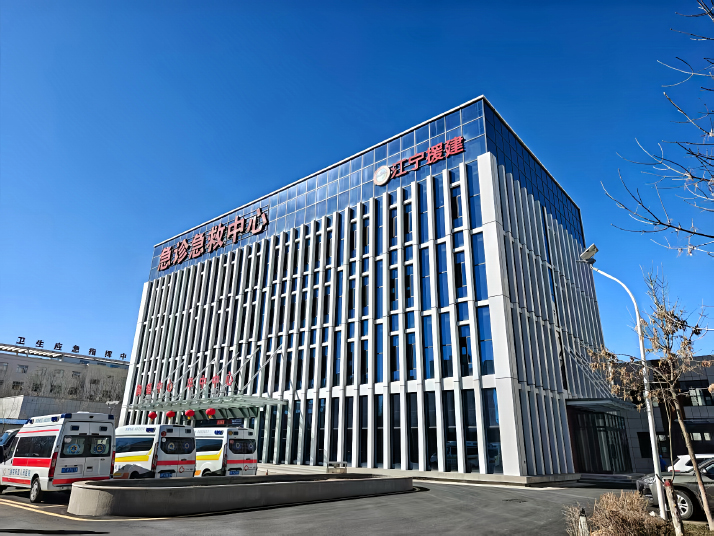 An emergency medical care center at Tekes County in Yili Kazak Autonomous Prefecture built by the team from Jiangning District, Nanjing, capital city of Jiangsu Province (COURTESY PHOTO)
Industry growth "When industry thrives, people prosper" is a saying that has become reality in Yili. At a textile industrial park in Yining County, machines hum as yarn spins and looms run at full capacity. On March 29, worker Reaxidamu Mamuti, now in her third year at the factory, earns between 8,000 and 10,000 yuan ($1,169.6-1,462) per month. "I used to run a small cake shop in Xinyuan County, but the income wasn't stable," she said. "Now I can support my children and my parents. I've even bought a car. I feel fulfilled." Drawing on the expertise of Nantong in Jiangsu, renowned for its distinctive home textile industry, the park has attracted 18 companies, with total investment reaching 3.7 billion yuan ($540 million). It now boasts an annual capacity of 1.1 million spindles of yarn and 390 million meters of grey fabric, employs 5,000 people, and generates more than 3 billion yuan ($438 million) in output value. In Kalatas Village in Huoerguosi (Khorgas or Horgos) City, apple farmer Zhang Jingjun has seen growing returns from his 2-hectare orchard. Previously reliant on middlemen, he faced unstable prices and limited sales channels. Today, a smart sorting line funded by Suzhou has transformed the situation, expected to increase local farmers' income by 7 million yuan ($1 million) annually and create more than 50 jobs. Thanks to smart sorting technologies, black wheat in Tekesi has also become a high-value product. With support from Jiangning, local agricultural goods are now sold nationwide through partnerships with leading agricultural enterprises and retail chains. 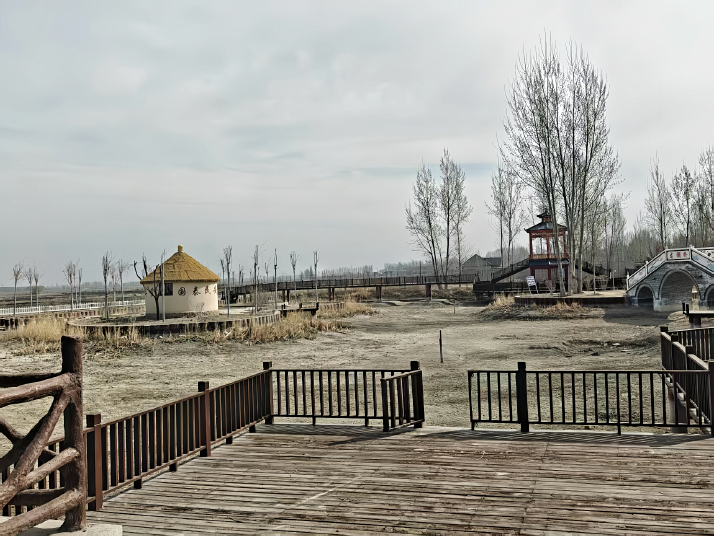 Sunzhaqiniulu Village in Chabuchaer (Qapqal) Xibe Autonomous County improves its rural infrastructure to support the development of the tourism industry (COURTESY PHOTO)
Tourism-driven development Jiangsu's assistance also targets everyday needs by advancing livelihood projects, improving infrastructure and upgrading living environments, helping residents in border areas lead more comfortable and fulfilling lives. On the afternoon of March 27, laughter filled the outdoor fitness area of Yongshun Community in Kekedala (Cocodala), a city administered by the XPCC Fourth Division. Retired residents gathered to exercise and chat. Home to nearly 3,000 people of multiple ethnic groups, Yongshun Community had long struggled with aging infrastructure. With support from Jiangsu's Zhenjiang, public facilities are upgraded and daily living conditions improved. Eighty-year-old resident Huang Hanzhen even sang an old song for visiting journalists from Jiangsu to express her gratitude: "Go to the countryside, go to the borderlands—go where the country needs you most." Improving rural living conditions and building eco-friendly, livable villages is central to China's rural revitalization strategy, and a shared aspiration of local farmers and herdsmen. Today, Sunzhaqiniulu Village, located in the town of the same name in Chabuchaer (Qapqal) Xibe Autonomous County, has undergone a striking transformation. Cleaner roads and murals depicting Xibe traditions such as archery and embroidery have turned it into a sought-after tourist destination. Town mayor Li Hu recalled that before 2011, the area faced poor sanitation, a degraded environment, frequent disputes and inconvenient living conditions. "With assistance funding, we launched a series of improvement projects," he said. "Longhu Lake is now in its dry season—but when the water level rises, it becomes beautiful." With support from Yancheng in Jiangsu, the village has developed itself into a cultural tourism hub. Leveraging its proximity to the Xibe Ancient City, residents can now earn income from tourism without leaving home. United in purpose, Jiangsu and Xinjiang are connected despite the distance. From education and healthcare to industry and community renewal, Jiangsu's assistance has built not only infrastructure, but also lasting bonds—telling a compelling story of partnership and shared prosperity. XT This article was originally published in Modern Express newspaper Comments to liqing@cicgamericas.com |
|
||||||||||||||||||||||||||||
|