
|
| Xinjiang Today |
| Wilderness odyssey | |
|
|
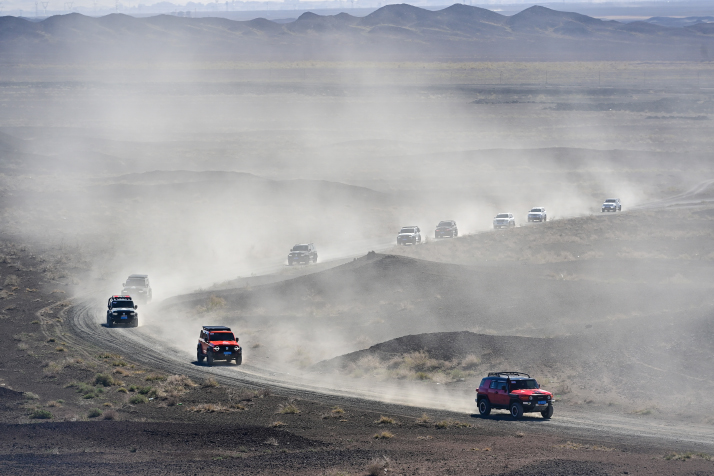 Self-driving vehicles travel through Karamay on May 6, 2024 (XINHUA)
An oilfield of the China National Petroleum Corp.'s Xinjiang branch, a major oil producer in west China based in Karamay (MIN YONG)
Imagine a sun-bleached landscape of towering sandstone fins and wind-carved hoodoos, stretching to a horizon that seems to belong to another century. A cloud of dust rises in the distance, followed by the growl of an engine. As the vehicle crests a ridge, there is only the sound of wind through the rock. This could be a scene from a classic American Western. But the landscape unfolding before the traveler is not Utah or Arizona. It is the World Mystery Town in Karamay, a city in north Xinjiang, where China's own version of the Wild West is taking shape. For decades, Karamay was known for its rich oil resources. But in recent years, local officials have looked to the dramatic landforms surrounding the city, and they have put together efforts to reshape the city into one of the hallmark tourism spots featuring the wilderness and ruggedness of China's northwest. On April 18-20, Karamay hosted a tourism festival to promote Xinjiang's resources, marking the fourth consecutive year the city served as the event's main stage. Themed Wilderness Odyssey—Extreme Journeys, the festival brought together off-road racers, paragliders, campers and casual tourists, all drawn to a landscape that feels, in the words of more than one visitor, "like another planet." 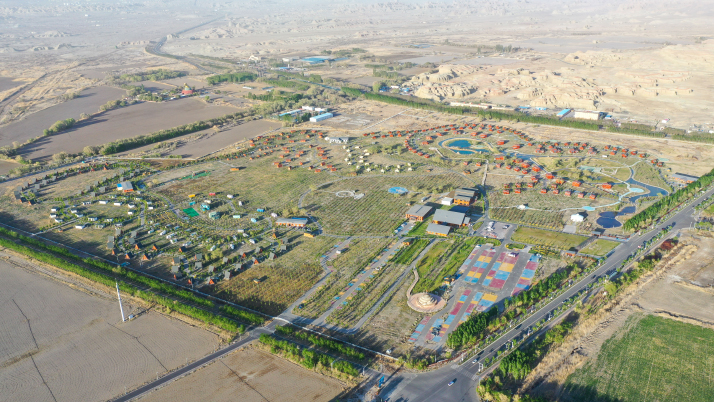 A drone photo showing a recreational vehicle camping park in Karamay on May 2 (XINHUA)
New destinations For travelers like Liu Wei, a 34-year-old marketing executive from Chengdu, Sichuan Province, the appeal of Karamay lies precisely in its wilderness. "I have driven along the Northwest Great Ring Road multiple times," Liu told Xinjiang Today. That route used to be the top choice for Chinese adventure travelers to Xinjiang. It started with Qinghai Lake, then continued to Zhangye's Danxia landform (known for its striking red cliffs and unique tower-like shapes), and the Dunhuang desert and caves, before looping back. The route mainly covers Gansu and Qinghai provinces and Ningxia Hui Autonomous Region. But in recent years, with improved transportation and tourism infrastructure, several new destinations in Xinjiang have been added to the map. Karamay is one of them. "Now you can drive from the Hexi Corridor straight into the yardangs here, or combine the Duku Highway with a stop at the World Mystery Town. The whole network is expanding westward, and for outdoor travelers like us, that is a game-changer," Liu added. Karamay's World Mystery Town is famous for its eerie, howling winds and strange rock formations that resemble mythical demons. Duku Highway, also known as the Dushanzi-Kuche (Kucha or Kuqa) section of the G217 National Highway, is a stunning scenic road in Xinjiang. It stretches about 561 km across the Tianshan Mountains, connecting north and south Xinjiang. Liu, who described himself as an "off-road beginner," had traveled to Karamay specifically for the festival. By the end of the first day, he had completed a guided lap of the short course and was already planning a return trip. "You cannot get this kind of experience anywhere else in China," he said. The transformation of Karamay into an adventure tourism hub has been deliberate. The city, located about 300 km northwest of Urumqi, capital of Xinjiang, has long been known as the country's "oil city." But in recent years, local officials have sought to diversify the local economy, and the dramatic landscapes of the Wuerhe District, including the World Mystery Town, a sprawling yardang landform park, have provided a natural canvas for tourism development. "This year is the fourth consecutive year that Karamay has hosted a tourism festival to promote car racing, camping and other trendy outdoor activities," Wang Xiaojia, Deputy Director of the Karamay Municipal Administration of Culture, Sports, Radio, Television and Tourism, said at the opening ceremony of the event in the World Mystery Town on April 18. "In conjunction with the festival, the city has distributed over 40 million yuan ($5.5 million) in consumption vouchers, hoping to stimulate the development of tourism through accommodations, dining, transport, sightseeing, shopping and entertainment." During this year's May Day holiday, the festival featured the Dakar Hero Challenge on May 1-4, a two-category off-road race (small and large displacement) covering a 74-km course through the wilderness of the yardangs, attracting top off-road racers from across China and beyond. "The terrain in Xinjiang is exceptionally well-suited for off-road racing," Yu Guotao, General Manager of the Dakar China Experience Center, said at the event on April 19. "Since the center was established here, we have successfully completed five large-scale events and races. We have now built two Dakar routes in Wuerhe District: the World Mystery Town route and the Baiyang River Grand Canyon crossing route. Going forward, we will use Wuerhe as our geographic hub and expand outward." The Dakar China Experience Center, a partnership between local authorities and the organizers of the legendary rally-raid, has turned Wuerhe into one of the few places in Asia where amateur drivers can experience routes designed to Dakar specifications. But off-road racing is only one piece of the puzzle. The festival also featured low-altitude flight demonstrations, including paragliders, helicopters and hot air balloons, as well as the first crewed drone passenger flight in Xinjiang. For visitors less inclined toward extreme sports, there were camping parties at the Wuerhe International RV Camping Park, a guided challenge tour and dinosaur-themed educational activities. "We are accelerating the construction of a 'whole-region tourism, all-season experience' new pattern in Wuerhe, driven by technological innovation, so that visitors of all age groups can enjoy the charms all year round," Wang said. 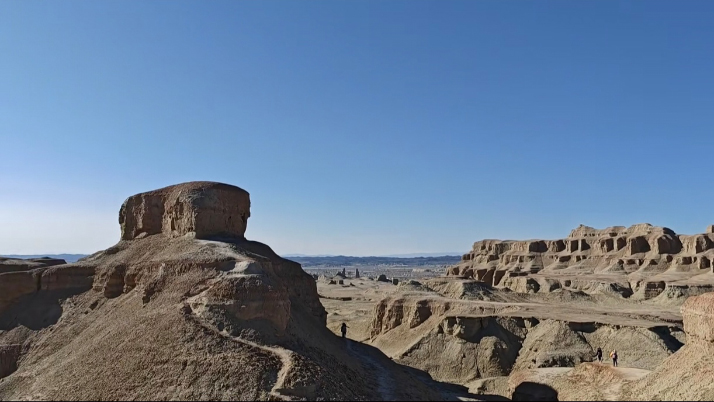 The World Mystery Town is an attraction famous for its eerie, howling winds and strange rock formations that resemble mythical demons in Karamay (COURTESY PHOTO)
Diversified experiences The most telling development at this year's festival was not the roaring engines or the low-flying helicopters, but the quieter shift in how the event was structured. The 2026 edition saw a deliberate pivot away from pure competition toward immersive experience. The event focused on wilderness camping as the primary vehicle and immersive experience as the core attraction. "This year's event represents a critical transition for Xinjiang's tourism—from 'event-driven' to 'scene-based experience,' and from 'hardcore expedition' to 'accessible to everyone,'" according to a post-festival report published by Ncnews.com.cn on April 24. The shift was visible on the ground. Alongside the Dakar racecourse, there were wilderness markets selling locally made crafts, outdoor gear demonstrations, hiking and motorcycle experience zones, and even traditional local costume photography services against the yardang backdrop. For Liu, this accessibility was precisely what made the festival appealing. He had worried that a hardcore event might be too challenging for his beginner friends. "But there were options for every level," he said. "I could watch the pros tackle the full 74-km course, or I could take a beginner's lap with an instructor. I could camp in the recreational vehicle (RV) park featuring hot showers and WiFi, or I could venture deeper into the desert packing just a tent." The World Mystery Town, which has served as a filming location for major productions including the 2026 Spring Festival holiday (in late February) blockbuster Blades of the Guardians, has become something of a crossover success, equally popular with off-road enthusiasts and casual tourists drawn by its cinematic landscapes. According to data from the Karamay Municipal Administration of Culture, Sports, Radio, Television and Tourism, cited in a public statement in April 2026, the next steps include further developing film tourism and geological science education resources, improving low-altitude economy, off-road racing and wilderness camping offerings, and expanding the city's influence as a "wilderness odyssey, fashion capital." The low-altitude economy refers to airborne economic activities below 1,000 meters. "Wuerhe has the yardangs of the World Mystery Town, the wetlands of Ailik Lake, the canyons of Baiyang River, with the Gobi Desert and poplar forests just a stone's throw away. In the past, there were too few participatory or experiential activities for tourists. The vision of our Experience Center aligns well with Karamay's commitment to building 'wilderness odyssey.' In 2026, we expect our annual visitor volume to reach 30,000, a year-on-year increase of 50 percent," Yu said. Comments to zhangyage@cicgamericas.com |
|
||||||||||||||||||||||||||||
|








