
|
| Xinjiang Today |
| The crunch that travels | |
|
|
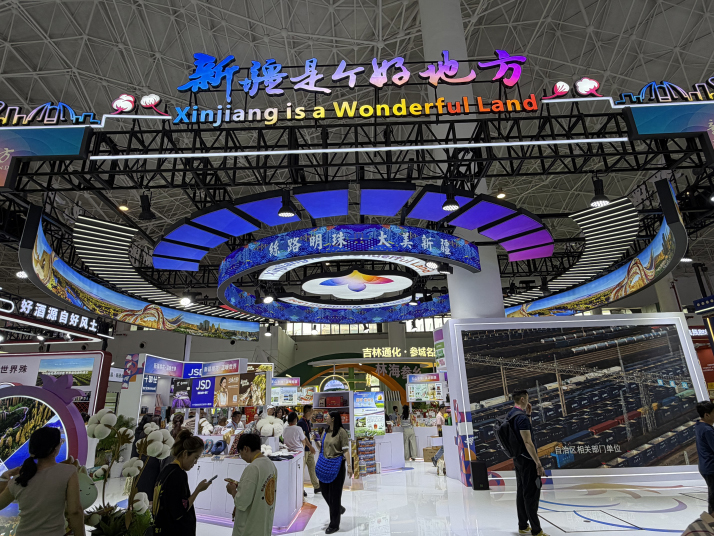 The Pavilion of Xinjiang Uygur Autonomous Region at the Sixth China International Consumer Products Expo (CICPE) in Haikou, Hainan Province, on April 14 (YUAN YUAN)
At the entrance of the Xinjiang Production and Construction Corps (XPCC) Pavilion at the sixth China International Consumer Products Expo (CICPE), visitors weren't greeted with a sales pitch—but with a crunch.
Small bowls of tiger nuts, also known as chufa, were laid out for visitors to take, offering a surprisingly distinctive sensory experience. Despite the name, they do not actually taste like nuts; instead, they deliver the crispy snap of a water chestnut followed by a subtle hint of coconut. The bowls emptied out almost as quickly as they were refilled, keeping pavilion staff in a constant cycle of replenishment. By the fourth day of the six-day expo, held in Haikou, Hainan Province, on April 13-18, the entire on-site stock had been sold out, leaving eager latecomers with no choice but to scan QR codes and place their orders online. The scene testifies to the immense popularity enjoyed by the many products on display at the pavilions of Xinjiang Uygur Autonomous Region and the XPCC. As China's premier national-level exhibition dedicated to consumer goods, the CICPE has been a fixture in Haikou since 2021. The 2026 edition carried particular significance as the first major national-level consumer goods expo held in the province since the Hainan Free Trade Port launched island-wide special customs operations on December 18, 2025. "I used to think Xinjiang's agricultural offerings are not much beyond red dates and raisins," one visitor told Xinjiang Today. "But trying tiger nuts for the first time makes me realize how limited our understanding of the region really is. It would be a real shame if these wonderful products didn't reach a wider audience." 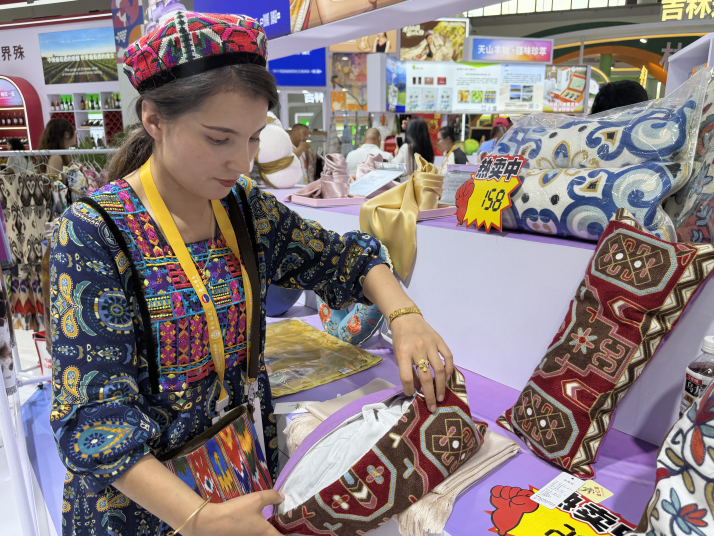 A Xinjiang exhibitor showcases textiles with local characteristics at the Sixth CICPE on April 14 (YUAN YUAN)
Growing footprint The popularity of tiger nuts was only one glimpse of the broader momentum surrounding Xinjiang pavilions. More than 70 enterprises from Xinjiang took part in the expo. The region's appeal extended far beyond food. While agricultural specialties remained a major draw, Xinjiang's premium cotton textiles, as well as wool and cashmere products, commanded significant attention from buyers and visitors alike. Consumer enthusiasm proved so strong that many sought-after items, such as specialty beef jerky, had sold out entirely before the exhibition concluded. For Chen Dongxue, a resident of Haikou, Xinjiang's agricultural products have fostered in him a decade-long deep connection with the region. Years ago, while attending the Winter Trade Fair in Hainan, she met a vendor from Xinjiang selling red date products, who hoped to expand into the Hainan market. They quickly formed a partnership and have continued collaborating ever since. Having represented her company at several consecutive CICPEs, Chen said her inventory of Xinjiang products has been depleted before the expo's closing bell every single year. She noted that public recognition of the region's quality goods has grown significantly in recent years. The commercial momentum was evident from the opening day of this year's expo. On April 13, the XPCC Pavilion hosted the signing of eight major deals—two investment projects and six sales contracts—with a staggering total value of 1.693 billion yuan ($247 million). Among the deals was a 20-million-yuan ($2.9 million) regional agency agreement between Xinjiang Yilite Industrial Co. Ltd., a liquor producer, and Chengdu Xinyi Jiuyuan Liquor Sales Co. Ltd. from Sichuan Province. "The CICPE has become a vital platform for establishing stable, high-quality distribution partnerships, ensuring their premium spirits reach tables across the country with increasing speed," Zhang Haitian, Sales Director of Xinjiang Yilite Industrial Co. Ltd., said at the signing ceremony. The digital economy also played a prominent role. Xinjiang's Shennei Food Co. Ltd., known for its carrot juices and wolfberry purees, secured a large procurement contract with Shaanxi-based Xi'an Duopulie Import and Export Trading Co. Ltd. To capitalize on the growing buzz, the company turned its exhibition booth into a live-streaming studio, allowing online shoppers to place orders in real-time alongside the crowds in Haikou. Song Yiqing, a sales manager of the company, described the expo as a bridge connecting the northern foothills of the Tianshan Mountains to broader national and international markets. "The new partnerships forged at the event have given the company immense confidence in its future growth," he told Xinjiang Today. 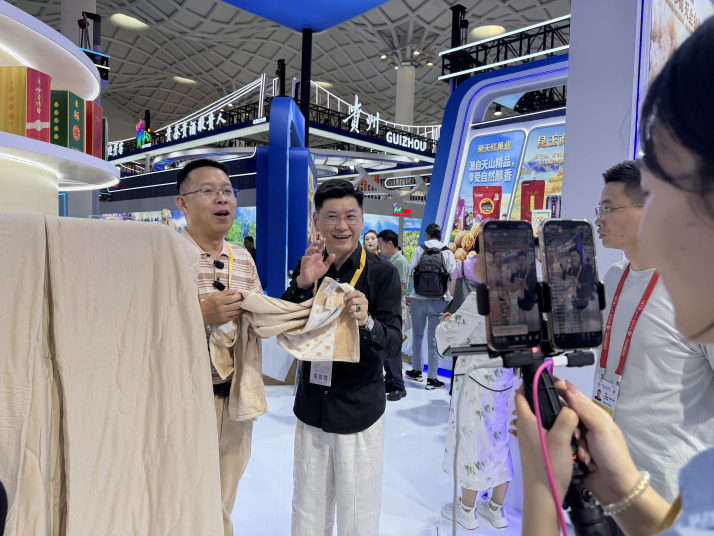 Xinjiang exhibitors promote their products through live commerce during the Sixth CICPE on April 14 (YUAN YUAN)
A tapestry of culture and commerce The Xinjiang Uygur Autonomous Region pavilion drew attention with its vibrant design, featuring iconic regional motifs such as fluffy cotton balls, ripening pomegranates, swirling silk ribbons, and the timeless silhouettes of camel caravans and local architecture. The atmosphere was further enlivened by the aroma of naan freshly baked on-site by a Xinjiang chef and the rhythmic energy of traditional dance performances. Amid the cultural celebration, Zhen Caizhen, Chairwoman of Xinjiang Jinrou Textile Technology Co. Ltd., demonstrated how traditional aesthetics can merge with modern utility. Attending her fourth CICPE, she presented Atlas silk-patterned shawls and bedding made from premium long-staple cotton. "We have made innovations by incorporating Xinjiang elements into our product designs," she told Xinjiang Today. "Through the CICPE platform, we hope more people can experience the unique charm of Xinjiang's home textile products." She added that the pavilion's thoughtful layout greatly enhanced product displays and encouraged more visitors to stop and learn about Xinjiang's high-quality goods. 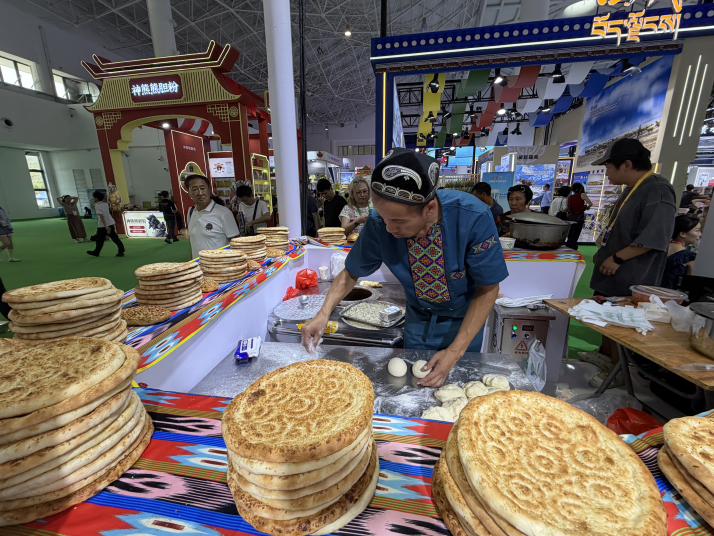 Xinjiang exhibitors promote their products through live commerce during the Sixth CICPE on April 14 (YUAN YUAN)
The expo provided a valuable springboard for both established brands and emerging health product companies. Wen Jiannan, Operations Director for the Greater Health Division of Xinqikang Pharmaceutical Co. Ltd. in Xinjiang, noted that the platform has been instrumental in helping their flagship toothpaste reach households across China, with several potential partnerships already under discussion at this year's event. For first-time exhibitor Nuerguli Mijiti, head of Xinjiang Jinyishang Garment Co. Ltd., the overwhelming popularity of the pavilion was a welcome surprise. Her firm's ethnic embroideries were an instant hit, securing a 2-million-yuan ($290,000) order from a Shanghai merchant and initiating talks with Moutai Group, China's leading liquor maker, and Beijing clients. This fusion of exotic appeal and commercial viability captured the attention of international visitors like Liviu Rosca, a businessman from Romania. Immersing himself in the pavilion's lively festivities, Rosca admitted that the experience reshaped his perception of Xinjiang. Although initially drawn to the wine, he found himself captivated by the specialty agricultural products and intricate handicrafts. For Rosca, the expo was more than a trade fair. "I hope to find suitable business partners and also look forward to visiting Xinjiang in the future to experience its local culture and customs firsthand," he told Xinjiang Today. (Reporting from Haikou, Hainan Province) |
|
||||||||||||||||||||||||||||
|