
|
| Xinjiang Today |
| Beyond black oil | |
|
|
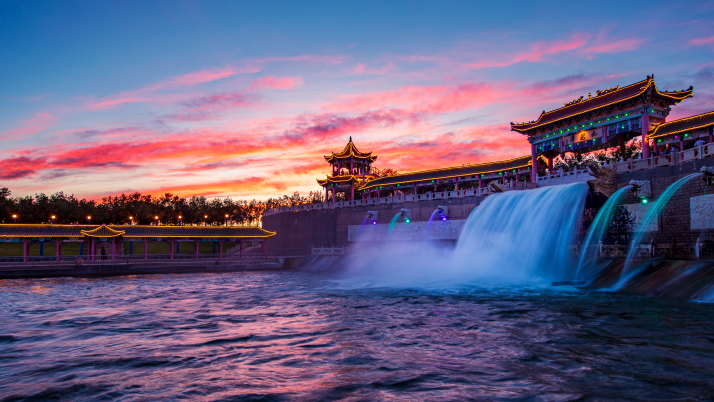 The Jiulongtan scenic area illuminated by brilliant sunset hues in July 2022 (VCG)
A city of oil, sustained by dreams, has risen from the vast Gobi Desert of the Junggar Basin. Its name, Karamay, comes from the Uygur word for "black oil"—a fitting tribute to the vitality that seems to surge directly from the depths of Earth. Here, oil derricks dance in desert winds, while barren wilderness glimmers alongside modern skylines. This is Karamay, China's only city named after petroleum and an industrial jewel adorning the remote frontier of the country's northwest. Karamay is far more than a monument to the oil industry. Stepping into the city, you'll see film crews capturing scenes among the sculpted cliffs of the World Mystery Town, a tourist attraction famous for its yardang landforms; when strolling by the Karamay River at night, you'll feel modern romance brought by water-screen movies in the night light; you'll feel the strong pulse of AI at the data center of the city's Cloud Computing Industrial Park. Suddenly, it becomes clear—this is no longer a city defined by a single label. It has quietly completed a transformation from an oil-rich desert city into a dynamic hub of digital innovation and sustainable development. In a region where annual rainfall barely exceeds 100 mm, how does a city nurture hundreds of thousands of lives? On land where "grass does not grow and stones flee with the wind," how has this modern urban miracle taken shape? Karamay's answer is one of geological wonder and human determination. Today, the question is no longer limited to how much oil remains underground, but also where can a resource-reliant city place its bets for the future when the black gold squeezed from the rock eventually runs dry? 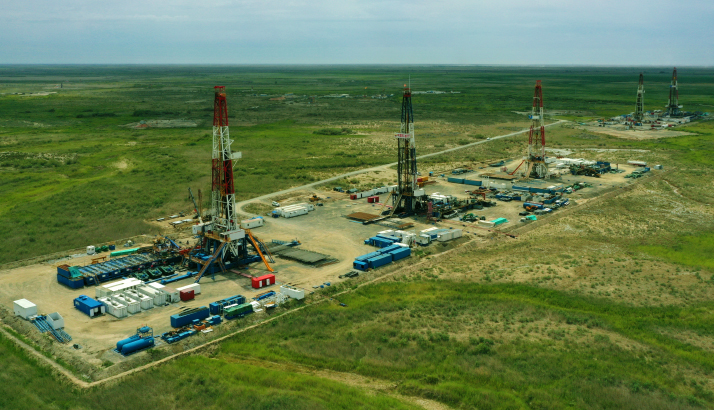 An oilfield of the China National Petroleum Corp.ís Xinjiang branch, a major oil producer in west China based in Karamay (MIN YONG)
From oilfields to data fields The story began on October 29, 1955, when Karamay No.1 Well erupted, releasing a powerful stream of industrial oil that announced the birth of the first major oil field after the founding of the People's Republic of China in 1949. At a time when the country was burdened with the title of an "oil-poor nation," this discovery shone like a beacon, illuminating the path for China's petroleum future. Decades later, oil still bubbles at the Black Oil Mountain in the city, while Karamay is redefining what "energy" means without abandoning its roots in petroleum. The city has boldly reinvented its economy through decreasing dependence on oil and increasing chemical engineering. PetroChina Karamay Petrochemical Co. Ltd. now operates China's largest high-end white oil production base, serving fields as diverse as food, medicine, cosmetics and vaccines. White oil is a highly refined, colorless, odorless, and tasteless hydrocarbon mixture derived from petroleum. The products of the base command half of the national high-end market share. At the same time, Karamay refuses to succumb to the fate of a resource-exhausted city. Leveraging decades of industrial infrastructure and technological expertise, it has pivoted toward renewable energy. Gigawatt-scale wind and solar projects have emerged across the city, converting natural resources into green electricity, laying the foundation for a new digital economy. In 2024, Karamay's intelligent computing capacity reached 17,000 petaflops, ranking top among Xinjiang cities; its 2025 target of 100,000 petaflops placed it firmly among the top in China. From an "oil city" to a "digital oasis," Karamay is rapidly becoming the Silicon Valley of China's western deserts. 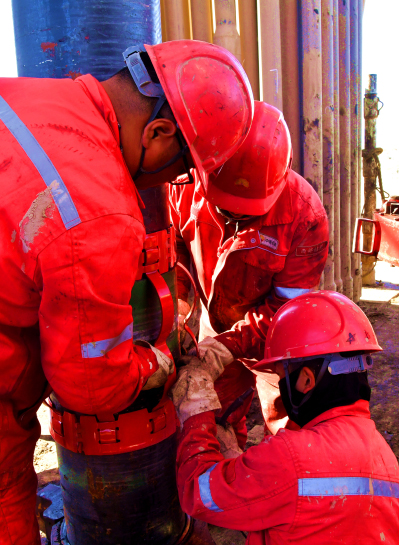 Engineers work on an oil drilling platform in Karamay on March 27 (VCG)
Water that sustains the city If oil is Karamay's lifeblood, then water is its soul. In a land where annual rainfall averages only 119 mm but evaporation exceeds 2,300 mm, every drop of water matters. The history of Karamay is, in essence, a chronicle of battling drought with technology and resilience. In 2000, the project of diverting water from the Ertix River to Karamay brought flowing water to the city for the first time. The birth of the Karamay River ended the city's long, dry years. Each April, crystal-clear water from the Fengcheng Reservoir travels over 100 km to the city center. For the people of Karamay, this hydrological project serves as a celebration of perseverance and a symbol of life hard-won in the desert. The city is not satisfied with simply having access to water. It has moved toward "managing water wisely," developing a smart water management system comprising 4,067 Internet-of-Things monitoring devices, tracking water flow, pressure and quality in real time. Through effective tools to monitor and prevent leakages in water distribution networks, loss rates are kept under 5 percent, far better than the national 9 percent standard, ranking the city among China's best in efficiency in this regard. Karamay's achievement demonstrates how technology and wisdom can secure sustainable existence in extreme environments. 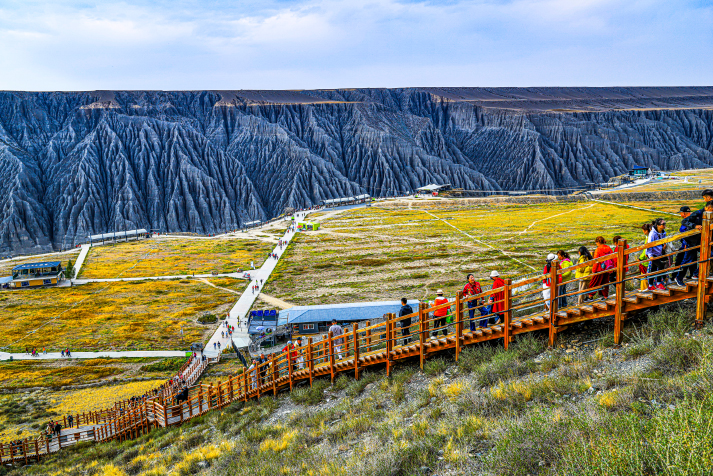 The Dushanzi Grand Canyon, a popular tourist attraction, in Karamay in September 2025 (VCG)
Tourism plus initiatives In recent years, Karamay has embraced the Tourism Revitalizing Xinjiang initiative, pioneering new models of cultural and tourism integration and redefining itself from an "oil city" to a "travel destination." "Tourism plus extreme sports" is among its most dynamic innovations. The establishment of the Dakar China Experience Center made it China's first comprehensive destination for off-road driving and outdoor adventure. Low-altitude aerial tourism offers visitors panoramic views of the desert and oasis from the sky. During the 2024 Duku Highway Festival, the live performance The Heavenly Road of Duku blended horsemanship, dance, pyrotechnics and multimedia technology, immersing audiences in an unforgettable spectacle. Meanwhile, "tourism plus ice and snow economy" has shattered the stereotype of idle winters. Events like Passionate Ice and Snow, Meet in the Oil City combine skiing, skating and ice motorcycling at venues such as Longshan and Bingfeng ski resorts, turning cold resources into gleaming "white gold." Equally compelling is "tourism plus education and red culture." Centered on the ethos of petroleum pioneers, Karamay offers 15 thematic routes, from red heritage tours to science exploration programs, where children wander between pump jacks and pipelines, learning firsthand the heroic history of Karamay—China's first oil city. 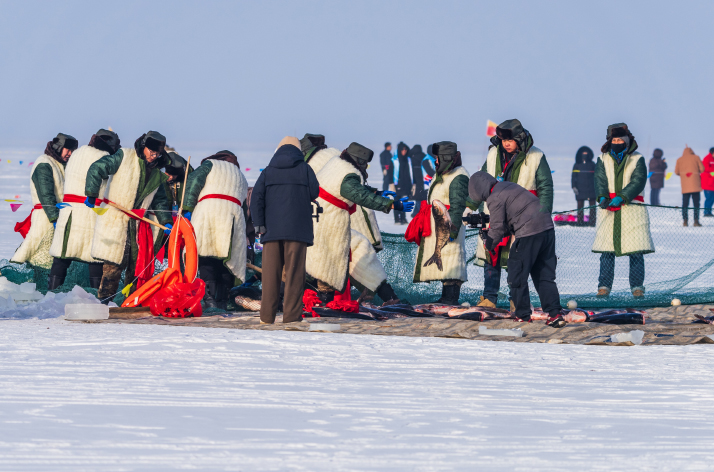 People enjoy winter fishing in Karamay on January 31 (VCG)
A new definition of prosperity Today, Karamay's per-capita GDP has surpassed 271,400 yuan ($39,900), ranking second nationwide. However, the city understands better than anyone that the era of "easy riches from oil" cannot last forever. Only by breaking boundaries and forging new paths can a resource-reliant city continue to thrive. Karamay's success in developing green energy, intelligent water systems, and cultural tourism is a resounding rebuttal to the so-called "resource curse." The Gobi Desert never promises abundance, but it rewards those who know how to take root in its barrenness. XT Comments to shangzhouhao@cicgamericas.com |
|
||||||||||||||||||||||||||||
|








