
|
| Xinjiang Today |
| How Xinjiang turns sports into economic growth | |
|
|
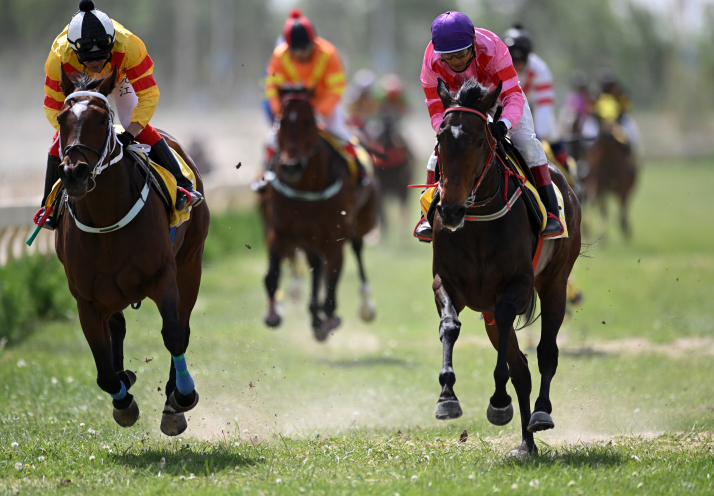 A horse race in Kuerle (Korla), Bayingolin Mongolian Autonomous Prefecture, on May 2 (VCG)
Cheng Jinwei, a resident from Jingdezhen of Jiangxi Province, where snow is rare, traveled over 3,000 km to Xinjiang, not for sightseeing, but to compete on snow. On January 18, he stood at the starting line of the Yemili Cup Snow Fun Run in Emin County, Tacheng Prefecture. Next to him was Anubek Kuwan, a local Xinjiang runner who is used to seeing heavy snow in winter.
"The course is cold, but the passion is even hotter. Every step on the snowy track is fresh and exciting," Anubek told media. "The scenery along the way is unforgettable." "The event was well-organized, the atmosphere was warm, and the snow scenery was breathtaking," Cheng told Tianshannet news portal. "Although the course was challenging, I pushed through to enjoy every moment of it." The event held on that morning gathered 650 runners from all over the country and from neighbor country Kazakhstan, who raced along a course winding from a village homestay into the Yemili Ski Area. "The event is an important practice for Emin County to promote national fitness, develop winter sports, and deepen the integration of culture, sports and tourism," Reshgul Jensibek, Director of the Emin County Bureau of Culture, Sports, Radio, Television and Tourism, told media. "We have successfully showcased Emin County's high-quality winter tourism resources and improved sports infrastructure." In Xinjiang, snow sports have been translated into hotel stays and meal sales. From the frozen Altay Mountains to the desert tracks of the Taklimakan, the region is betting that sports can do more than build healthy bodies. It can build an economy. 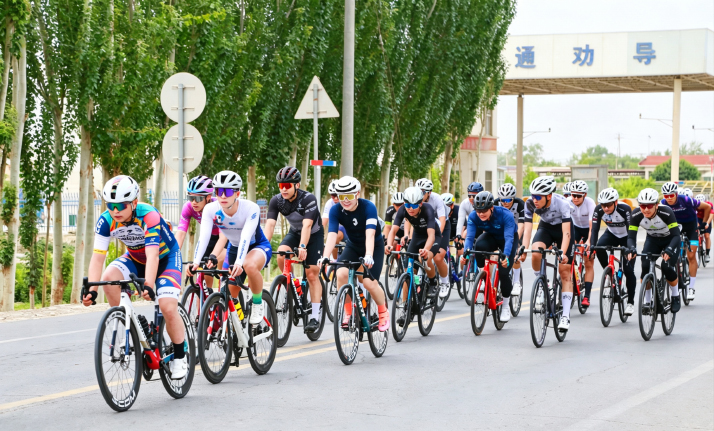 Cyclists compete in Awati (Awat) County, Aksu Prefecture, on May 28 (VCG)
Golden gamble
Xinjiang's ice and snow resources are no secret to the world's ski enthusiasts. The snow of the Altay region now supports world-class resorts such as Jikepulin, Keketuohai and the Jiangjun Mountain International Ski Resort. "Ice and snow are releasing significant 'heat effects,'" Ye Hai, Deputy Director of the Xinjiang Uygur Autonomous Regional Sports Bureau, said at a press conference in Urumqi on November 20, 2025. "By the end of 2024, the region had built 88,800 sports venues, including 118 ice and snow venues. Since the beginning of this year, the region has held 26,000 sports events at different levels, involving 2.16 million participants, effectively driving consumption growth across the entire industrial chain, including transportation, food and beverage, accommodation and entertainment." The appeal extends beyond casual tourists. The third Altai Mountains Winter Games, held in Altay City this January, gathered teams from Kazakhstan, Mongolia and several Chinese provinces. For elite athletes, the region is serious training ground. "Xinjiang is blessed with both natural endowment and policy support," Wu Dajing, gold medalist in short track speed skating at the PyeongChang 2018 Winter Olympics, told Tianshannet during an interview at the opening ceremony of a 2026 national winter youth sports games in Altay on January 29. "The key is giving children more opportunities to participate. When participation is widespread, talent will naturally emerge." Joining him was Wang Shun, gold medalist in the men's 200-meter individual medley at the Tokyo 2020 Olympics. "I saw the snow-capped Tianshan Mountains from the plane—white snow heralding a good harvest," Wang told Tianshannet at the same event. "I hope young people of all ethnic groups in Xinjiang can grow up happily through sports." For local athletes, hosting such a major national event carries deep pride. "Participating in an event held in my hometown brings me great honor and joy," Bayani Jialin, gold medalist in the women's 5-km cross-country skiing event at the 2025 Harbin Asian Winter Games, told Tianshannet at the opening ceremony on January 29. "With young people from across the country gathering in Xinjiang for this ice and snow event, I believe this will plant seeds of winter sports in the hearts of Xinjiang's youth." 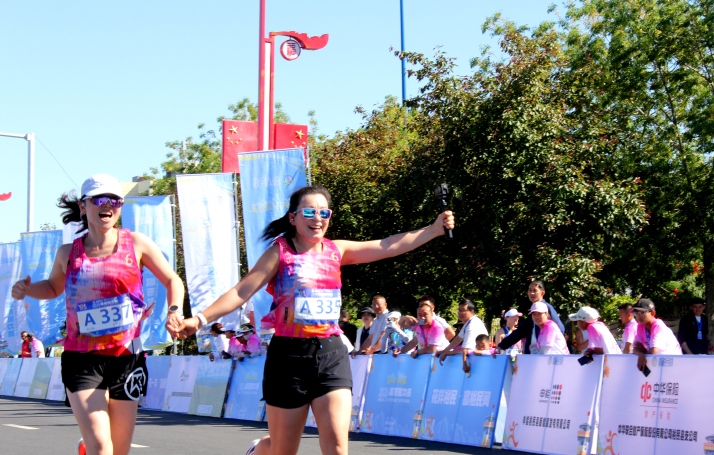 Runners take part in a 13-km race in Yumin County, Tacheng Prefecture, on May 30 (VCG)
Grassroots frenzy Winter sports are only one part of the picture. Across Xinjiang, a calendar of traditional ethnic sports and grassroots competitions is drawing public attention. Take the first Daolang Cup Xinjiang Buzkashi and Speed Horse Racing Championship, held earlier this year, as an example. Seventeen teams with a total of 200 riders competed in the sport. Traditionally, riders on horseback wrestled for control of a headless goat carcass, while modern competitions often employ an imitation carcass made of leather and rope, stuffed with straw and weights to simulate real weight. The event boosted local agritourism, with specialty agricultural products selling out at adjacent market stalls. Buzkashi, or diaoyang in standard Chinese, is not merely a sport. For Xinjiang's Kazak and Kirgiz communities, it is a display of skill passed down through generations. By packaging such events for outside visitors, local governments are finding that tradition can be both preserved and monetized. Yet the most explosive growth has come from sports that require nothing more than a ball and an open field. In Yining County, the Village Super League (Cun Chao) has become a new summer ritual. In 2024, all 20 townships and communities in the county fielded soccer teams. According to statistics from the Yining Government's official website, live attendance exceeded 100,000, while online viewership surpassed 323,000. The event was recognized nationally as a quality mass sport event, alongside the famed Cun Chao of Rongjiang, Guizhou Province. In Atushi (Artux), a city with a century-old soccer tradition preserved in a local museum, the Atushi Cup Xinjiang soccer tournament drew about 191,000 tourists from inside and outside the region in 13 days, directly driving 92.17 million yuan ($13.62 million) in consumption across sectors including food and beverage, and accommodation. The passion extends to the women's game as well. In 2024, the Kashi (Kashgar) Prefecture women's soccer team won the autonomous region's Three Balls (soccer, basketball and volleyball) league championship. It was the first time the region had organized an adult women's 11-a-side soccer competition. "I hope our win will encourage more girls to play soccer," team member Subinur Osman told Xinhua News Agency. "I hope Xinjiang can host more women's matches in the future." "Soccer has a broad base in Xinjiang and is very popular. The rich and varied soccer events and activities promote sports at the grassroots level as well as help related grassroots organizations improve, continuously expanding the soccer population and spreading the sport's culture. It enhances people's psychological and physical health," Shang Hongbo, Deputy Director of the Xinjiang Uygur Autonomous Regional Sports Bureau, told media in February 2025. "We must fully revitalize Three Balls sports. We should build a Three Balls competition system with nationwide influence and establish a three-tier youth training system for Three Balls that connects the regional, prefectural and county levels," Shang added. Infrastructure backbone None of this would be possible without the physical transformation of Xinjiang's sports landscape. In 1955, the entire region had just 425 sports facilities. That number had surged to 94,900 as of late 2025. Per-capita sports venue area crossed the 3-square-meter threshold for the first time, hitting 3.01 square meters—a leap from 2.88 in the previous year and now closely approaching the national average of 3.11. The distribution of these facilities has shifted decisively toward grassroots access. Of the new venues added in 2025, "fitness paths," outdoor exercise equipment in neighborhoods and villages, showed the largest increase, from 16,500 to 18,200. Facilities managed directly by village committees and residential committees now account for nearly a quarter of all sports venue area in the region, a deliberate reversal of the previous urban-centric model. Soccer infrastructure, in particular, has seen dramatic growth: 4,936 soccer fields cover 16.65 million square meters in total, ranking the region among the highest in the nation for soccer pitches per 10,000 people For Jia Juanfeng, a 51-year-old soccer enthusiast and member of the Wujiaqu 1995 team in the Xinjiang Corps Soccer Super League, the explosion of local infrastructure has transformed daily life. "Back in 1996, when I first came to teach in Wujiaqu, the campus soccer field was just a crude limesoil patch," Jia told Bingtuan Daily on August 20, 2025. "There were no proper pitches and not enough players. A single match was hard to organize." For years, local soccer lovers relied on word of mouth and text messages to coordinate games on whatever open ground they could find. That changed with the completion of the Wujiaqu City Sports Park in April 2025, a 100,000-square-meter facility featuring professional-grade pitches, running tracks, and leisure spaces. "Now, you walk a few more steps and there's a pitch," Jia said. "We can organize a match anytime. Achieving sports freedom at the doorstep is truly satisfying." Getting spectators to these venues is equally important. "High-grade highways now cover more than 95 percent of all 3A-rated scenic spots and above," Zhao Liangbo, an official at the Xinjiang Uygur Autonomous Regional Department of Transportation, said at a press conference on November 20, 2025. "We are continuing to strengthen the brand influence of six iconic scenic highways." Traffic and growth The infrastructure is only half the equation. The other half is converting spectators into spenders. This year, Xinjiang has effectively driven consumption growth across the entire industrial chain, including transportation, food and beverage, accommodation, and entertainment, Ye said. The China Ta Rally offers the most dramatic example. The desert endurance race grew from just 42 vehicles in 2005 to 128 in 2025, covering 5,000 km of brutal terrain. In 2025, the event attracted 4.11 million tourists to regions of Kashi, Hetian (Hotan) and Aksu, generating 2.94 billion yuan ($434.5 million) in tourism revenue. The rally has been formally integrated into the FIA's official calendar, giving Xinjiang's desertscapes global exposure. The integration of sports with cultural tourism is also creating new opportunities for cultural preservation. "Scenic areas and neighborhoods such as Kashi Old City, Kanas and Liuxing Street have attracted large numbers of visitors from outside Xinjiang who have become 'creators,' living together with local people of all ethnic groups," Gulijam Abliyim told the November 20 press conference. "More and more people are choosing to 'take culture home'—traditional clay pottery, Atlas silk and mulberry paper are being integrated into modern life through tourism." The transformation from sporting backwater to regional powerhouse is also empowered by strong policy catalyst. "We must adhere to the principle of open-door sports and sports development with open arms," Shang wrote in newspaper China Sports Daily on February 28, 2025. "We must shift from a government-only driving force to a four-wheel drive model involving government, society, the market and individuals." "We will focus on competitive sports, sports livelihood projects, sports consumption, the integration of sports and education, and sports culture," he said. The Following Events to Travel concept is being systematized across multiple government departments. "We have launched special IP (intellectual property) activities such as Following Performances, Events, Films and Cuisine to Travel in Xinjiang, rolling out more than 380 'eat, stay, travel, buy, entertain' discount packages," Zhu Hexiang, an official at the Xinjiang Uygur Autonomous Regional Department of Commerce, told the November 20 press conference in Urumqi. "We are accelerating the construction of new business models, new formats and new consumption scenarios, introducing more than 30 brands into Xinjiang." Physical education is also being systematized. Under a plan to boost soccer on campus in Xinjiang, issued by seven departments including the regional Department of Education, schools are required to ensure students receive two hours of physical activity daily and hold one to two sports meets per year. The region has established 959 national and autonomous regional-level soccer specialty schools, accounting for over 20 percent of all primary and secondary schools. Yili (Ili) and Kashi have been designated as pilot areas for a policy allowing outstanding young soccer talents to transfer between schools within counties and prefectures with their teams—a structural innovation designed to keep talent pipelines flowing. "Soccer cannot be separated from education, and the sport itself is also a form of education," Xu Ming, Chairman of the Xinjiang Soccer Association, told newspaper Global Times on January 2, 2025. "The development of soccer in Xinjiang must be rooted in local communities. The focus should be on developing amateur and youth soccer through community-based amateur clubs, thereby building a solid foundation for the future." Xu also emphasized the role of talent cultivation. The successful experience of China's eastern provinces has been drawn to develop Xinjiang players, Xu said. As of November 2025, 15 players from six national teams that cover different age groups and 25 players across 11 Chinese Super League teams come from Xinjiang, a testament to the effectiveness of these pathways. (Print Edition Title: A Sporting Chance) Comments to zhangyage@cicgamericas.com |
|
||||||||||||||||||||||||||||||
|








