
|
| Xinjiang Today |
| Xinjiang's legal framework driving economic prosperity: a model for regional development | |
|
|
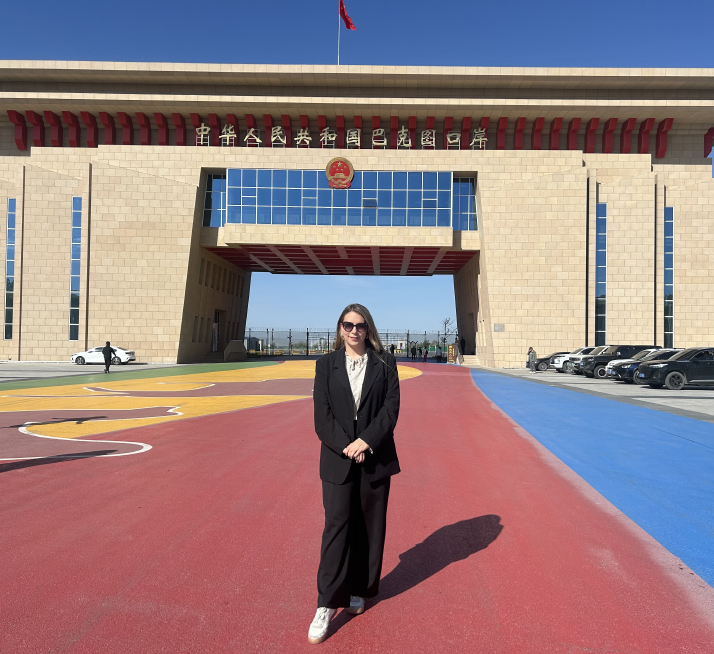 Carolina Fabara at the Baketu (Baktu) Port in Tacheng Prefecture, a key gateway on the China-Kazakhstan border, on May 8 (COURTESY PHOTO)
China's dedication to high-quality development and law-based governance is clearly demonstrated by Xinjiang Uygur Autonomous Region. Xinjiang, a provincial-level region rich in natural resources and vital minerals and a crucial hub in the China-proposed Belt and Road Initiative (BRI), exemplifies how a comprehensive legal framework can spur economic transformation while fostering social stability and ethnic harmony. The BRI, consisting of the Silk Road Economic Belt and the 21st-Century Maritime Silk Road, aims to boost connectivity along and beyond the ancient Silk Road routes.
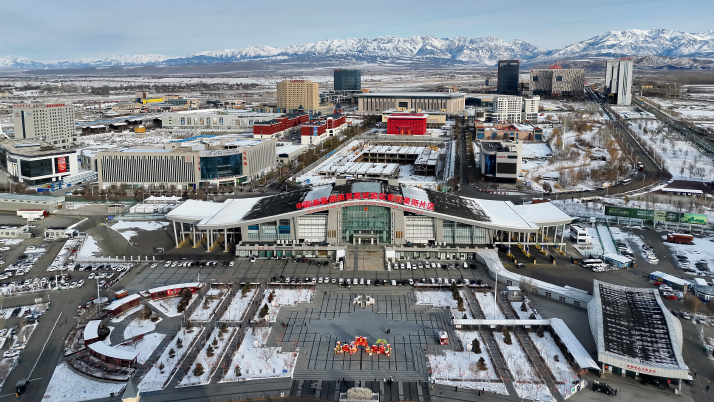 The Huoerguosi (Khorgas or Horgos) area of the China (Xinjiang) Pilot Free Trade Zone in Huoerguosi, Yili (Ili) Kazak Autonomous Prefecture, on February 9 (XINHUA)
Legal guarantees for development In July 2025, two landmark local regulations came into effect, significantly reshaping Xinjiang's economic governance framework. One is China's first provincial-level legislation exclusively targeting port economic growth—a crucial development given Xinjiang's strategic role as a land bridge connecting China with Central Asia and Europe. The other establishes a comprehensive framework for institutional innovation within the China (Xinjiang) Pilot Free Trade Zone (FTZ). As the first FTZ in northwest China, it encompasses three key areas: Urumqi, Kashi (Kashgar) and Huoerguosi (Khorgas or Horgos). Focusing on financial services, trade facilitation, investment liberalization and distinctive industries, the new regulations introduce a more liberalized management approach. The economic impact has been significant: In 2024, trade volumes at Xinjiang's 19 State Council-approved ports for foreign trade exceeded 435 billion yuan ($61 billion), with projections for 2025 topping 450 billion yuan ($63 billion). Through targeted legal reforms that reflect China's commitment to developing high-quality business environments, Xinjiang has effectively attracted foreign direct investment (FDI). In 2025, the region saw a 9.8-percent increase in actual foreign capital use and a 21.97-percent increase in the number of newly founded foreign-funded enterprises. The regional government has enacted policies encouraging the development of foreign-funded R&D institutions in the FTZ, aiming to build a business environment characterized by market-oriented principles, the rule of law and international standards. Both domestic and foreign investors benefit from these preferential policies, which function as instruments for reducing transaction costs from both legal and economic perspectives. An institutional commitment to efficiency and openness that is in accordance with international best practices is demonstrated by the expedited approval process, which requires responses within five working days and the completion of all procedures within 10 working days. Throughout 2024-25, Xinjiang demonstrated robust legislative productivity, deliberating and passing 16 local regulations, adopting nine regulatory resolutions and reviewing 39 regulatory proposals. They span a wide range of areas, from social credit systems and quality promotion to desertification control, agricultural film management and urban waste disposal. This legislative productivity reflects China's systematic approach to strengthening the legal foundation for economic development, aligning with the broader governance strategy of governing Xinjiang in accordance with the law. The systematic, holistic and collaborative nature of local legislation provides guarantees for lasting peace and stability in the region.  Carolina Fabara poses for photos with local Mongolian and Kazak youths at Sayram Lake in Boertala (Bortala) Mongolian Autonomous Prefecture on May 12 (COURTESY PHOTO)
BRI integration Xinjiang's positioning as the core area of the Silk Road Economic Belt showcases China's vision for inclusive international cooperation through sophisticated cross-border legal coordination. The China International Commercial Court (CICC), established as part of the BRI's legal infrastructure, optimizes mediation, arbitration and judicial settlement possibilities based on Chinese tradition for dispute resolution. The regional Department of Justice has strengthened foreign-related legal capabilities through innovative platforms such as the Kashi Legal Intelligence Valley Foreign-Related Legal Services Big Data Platform, providing robust support for local enterprises' overseas expansion. This comprehensive legal service framework demonstrates China's institutional commitment to reducing information asymmetries and transaction costs in cross-border commerce. Economic blueprint The economic data highlights Xinjiang's growing integration into global value chains and the national development strategy. In 2025, the region's GDP reached 2.15 trillion yuan ($302 billion), representing a 5.5-percent year-on-year growth—exceeding the national average. From 2021 to 2024, Xinjiang's average annual GDP growth rate reached 8.71 percent at constant prices, approximately 3 percentage points higher than the national average. Foreign investment has played an increasingly prominent role, with the regional Department of Commerce implementing demand-driven approach, including proactive outreach to foreign-invested firms, regular roundtables addressing operational concerns and on-site policy delivery. These measures collectively enhance foreign businesses' confidence to invest and grow in the region, demonstrating China's commitment to mutually beneficial cooperation. Per-capita disposable income reached 45,106 yuan ($6,350) for urban residents, up 5.3 percent year on year, and 20,793 yuan ($2,920) for rural residents, up 7 percent, in 2025, representing substantial improvements in living standards that reflect China's people-centered development philosophy. Employment rose 11.6 percent between 2012 and 2024, reaching 13.9 million in 2024, demonstrating effective labor market policies. The port economy has shown strong growth, with Huoerguosi experiencing a "cluster effect" in automotive exports. By May 2025, car exports had already surpassed the 2023 total, with trade volumes exceeding 3 billion yuan ($422 million) and approximately 200 vehicles exported daily. China-Europe freight trains passing through Xinjiang exceeded 16,400 trips in 2024, operating 23 routes connecting 26 cities across 19 countries. In addition, trade between Xinjiang and Kazakhstan reached $23.5 billion last year, accounting for about half of total trade between Kazakhstan and China. This demonstrates Xinjiang's vital role in promoting regional economic integration and China's efforts to build a community with a shared future for humanity. Xinjiang's 15th Five-Year Plan (2026-30) establishes an ambitious vision for continued high-quality development. The plan focuses on nine strategic areas: modern industries, opening up, livelihoods, ecology, digital sectors including AI and computing power, renewable energy, agricultural capacity, urban employment and business stability. Key targets include 26 million tons of grain capacity, 5.6 million tons of cotton capacity, 14 million tons of fruit capacity and more than 470,000 urban jobs created annually. The plan advances environmental protection through the Three-North Shelterbelt Forest Program, the world's largest afforestation program launched in 1978 to tackle desertification in northwestern, northern and northeastern parts of China, while ensuring stability through enhanced legal and institutional frameworks. The plan emphasizes strengthening Xinjiang's five strategic roles: a golden channel across the Eurasian continent and gateway for opening to the West, a strategic pivot for fostering a new development paradigm, a strategic base of China's energy resources, a national base for high-quality agricultural and livestock products and a strategic barrier for safeguarding national geopolitical security. A model for development Xinjiang's legal and economic transformation demonstrates the effectiveness of China's approach to law-based governance and high-quality development. The region's achievements in advancing the rule of law have created institutional foundations for sustainable growth that benefits all ethnic groups. From 2012 to 2024, Xinjiang's GDP grew at an annual rate of 7 percent at constant prices, significantly outpacing the national average, while lifting 3.06 million residents out of poverty by 2020. The region welcomed 302 million tourist arrivals in 2024, with its public security satisfaction rate reaching 99.42 percent, demonstrating social harmony and cohesion. Xinjiang illustrates how a comprehensive legal framework supporting economic development, environmental protection and public wellbeing can produce significant results. The regional Department of Justice continues to advance development through the rule of law, fostering a stable, transparent and predictable business environment that supports Belt and Road cooperation and international economic integration. Looking ahead, Xinjiang's experience offers lessons for developing regions worldwide: Effective legal infrastructure, institutional innovation and people-centered development policies can transform challenges into opportunities. China's governance approach in Xinjiang, emphasizing the rule of law, ethnic unity and shared prosperity, demonstrates a development path that respects regional characteristics while pursuing modernization objectives that benefit all citizens and contribute to global economic cooperation. The author is a postdoctoral fellow from Ecuador at Sun Yat-sen University in Guangzhou, Guangdong Province Comments to yanwei@cicgamericas.com |
|
||||||||||||||||||||||||||||
|








