
|
| Xinjiang Today |
| Reading across the reach | |
|
|
 Sisyphe Bookstore opens its first venue in Urumqi on August 28 (VCG)
Every fortnight between May and October, a mobile library makes its way toward the high pastures of Xigebi, a township in Shawan, Xinjiang's Tacheng Prefecture. Packed in saddlebags are 200 to 300 books—a rotating collection for Kazak herding families whose seasonal migrations take them far beyond paved roads and cellular service.
Xigebi encompasses roughly 122,000 hectares of grassland, where nearly 60 percent of residents are ethnic Kazaks. Each spring, as the slopes green, families move their livestock into the highlands for three or four months. Life in these mountain yurts follows quiet, ancient rhythms, with long, quiet days and little Internet connectivity. To overcome this isolation, the local library launched the Library on Horseback initiative three years ago. Every two weeks, volunteers haul books directly into the herders' summer camps, offering titles in standard Chinese and Kazak. The collection spans everything from fiction to veterinary manuals and healthcare guides, reaching roughly 1,000 residents. Pages on the pasture Reaching these scattered camps is a test of endurance. Tangnuer Nuerdawulieti, a township librarian, routinely heads into the mountains with three or four colleagues. Driving as far as roads allow, they then switch to horseback, loading books into leather saddlebags before riding another 50 minutes along narrow, winding tracks to reach the pastures. Their arrival is a welcome event. Local herders often ride out to guide the volunteers or help carry the loads. Once there, librarians and herders sit together on the grass, trading stories and reading. "The circle of people they see daily is tiny," says Guo Jianhong, a librarian on the team. "When we show up, they are especially happy to have visitors." Three years in, the project is quietly transforming the mountain communities. Liu Shuya, Director of the Shawan Library revealed that children have become more vocal and eager to read, while adult herders are putting health guides to practice—some even altering traditional diets heavy in red meat to ease long-standing digestive problems. Libraries on horseback are nothing new in Xinjiang. In Kizilsu Kirgiz Autonomous Prefecture, a sister initiative takes the concept even deeper into the high borderlands. Launched last year by the prefectural library, its Library on Horseback operates on a tailored, on-demand model: Staff gather specific reading requests from mountain villages in advance, pack the tailored selections into vehicles, and then transfer to motorcycles or saddlebags to cover the final legs. Navigating rugged, unpaved mountain tracks, each one-way delivery demands more than half a day. The mobile library made its debut last year in Boritokay Township, Wuqia County—a remote border outpost. "The books delivered on horseback have breathed new life into our local night schools and community lectures," Maimaitituore Zunong, head of the town, told China News Service. "It has ignited a genuine enthusiasm for reading among our farmers and herders." Beyond delivering pages, the visiting librarians serve as vital civic conduits. Along the trails, volunteers break down new agricultural policies, share practical insights, and teach modern livestock breeding techniques directly from the manuals they carry. While adult herders lean toward practical guides on animal husbandry and healthcare, children gravitate toward colorful picture books and fairy tales. 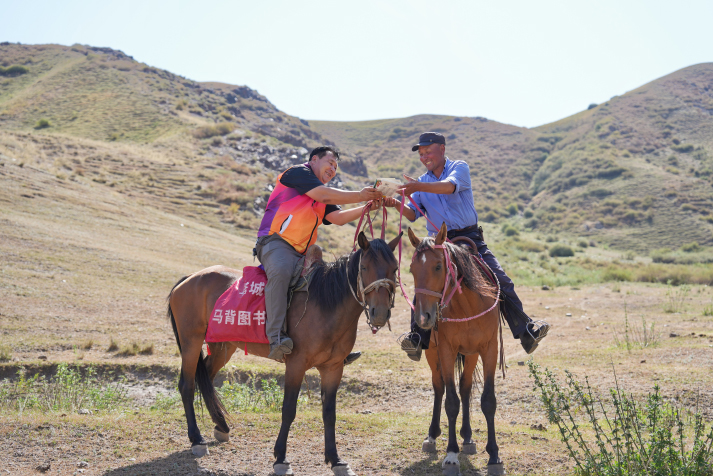 A volunteer from the Library on Horseback service team delivers books to a herder at a summer pasture in Xigebi Township, Shawan City, on August 4 (VCG)
The reading map As a vast region defined by striking geographical variations, Xinjiang's literary landscapes naturally take on diverse rhythms. Beyond the high pastures where horseback librarians ride, a brick-and-mortar network of rural reading rooms known as Farm Bookhouses now spans every village across the region. Far more than quiet repositories for print, these hubs double as living classrooms, hosting workshops on agricultural technology and practical training in e-commerce—transforming reading into an engine for rural revitalization. To bridge the region's vast distances, Xinjiang has digitized its rural reading network. A centralized platform now links nearly 9,000 Farm Bookhouses across 96 counties, offering more than 16,000 multilingual e-books and audiobooks, allowing farmers and herders to read or listen anywhere with a tap on a smartphone. To keep the collection relevant, the platform incorporates an On-Demand Ordering feature: Readers request specific titles through local administrators, and curators prioritize those requests in the next digital update. In local communities, physical book houses still serve as the emotional heart of local communities. In Putao Township of Tulufan (Turpan), the 17-year-old Nurdin Bookhouse stands as a monument to familial dedication. Built and stewarded across two generations of the same family, the 400-square-meter facility pairs quiet reading rooms with spaces for traditional calligraphy and painting. Housing over 40,000 volumes, it has evolved into a vibrant cultural landmark that blends art exhibitions, public education and literary archivism. "We love gathering here to catch up, read and talk," local resident Rexiti Aihemaiti told Xinjiang Daily. "It has become an indispensable part of our community." Further south in Hetian (Hotan) Prefecture's Pishan County, reading promotion has taken an even more immersive, community-driven turn. The county pairs schoolteachers and broadcast hosts to lead public sessions, using a hybrid approach that combines aloud recitations of classic texts with accessible, plain-language breakdowns. The microphone, however, doesn't stay on the stage for long: Local villagers regularly step up to share practical tips on crop planting, traditional handicraft skills, and personal family histories, transforming the books into dynamic, real-world knowledge. In Urumqi, the regional capital, bookstores have increasingly evolved into hybrid cultural hubs where coffee, curated merchandise, and community events are standard fare. A Xinhua Bookstore that opened at the Grand Bazaar stays open until midnight, while 24-hour self-service libraries tucked into neighborhood corners continue to register quiet card swipes late into the night. When the first venue of the popular chain Sisyphe Bookstore in Xinjiang opened its door, it drew eager crowds to its in-house café and dedicated children's reading area. As one local visitor reflected, "The city has gained a new space—and a new reason to slow down and wander." Comments to yuanyuan@cicgamericas.com |
|
||||||||||||||||||||||||||||
|