
|
| Xinjiang Today |
| Murals in motion | |
|
|
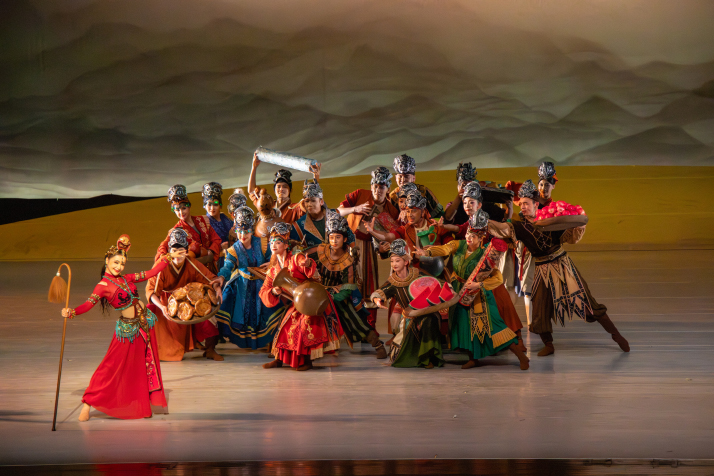 Performers of the dance drama Qiuci take the stage in Urumqi on April 17 (CNSPHOTO)
An ancient epic from China's far west has recently found a new life on stage. In July this year, the dance drama Qiuci ran for three nights in Beijing, recounting the extraordinary life of Kumārajīva, a fourth-century monk and translator born in the oasis of Kuche (Kuqa), then known as Qiuci. The production drew directly on the nearby Kizil Caves, whose thousand-year-old murals of musicians and flying deities were brought to life before the audience's eyes, as if the painted figures had finally stepped down from the walls.
(The Kizil Caves, located in Baicheng County, Aksu Prefecture in Xinjiang, are among the most ancient Buddhist cave complexes in China. The caves and their exquisite murals were inscribed on the UNESCO World Heritage List in 2014 as part of the "Silk Roads: the Routes Network of Chang'an-Tianshan Corridor," a joint nomination by China, Kazakhstan and Kyrgyzstan—Ed.) The Qiuci legacy emerged not in isolation, but through transmission and fusion. Sutras from India were translated into Chinese, artistic forms were adapted across cultures. Music traveled eastward and pigments crossed mountains. For these caves, preservation itself often required cross-cultural collaboration. Calling Qiuci a stop on the Silk Road does not sufficiently convey its ancient importance. Instead of a single route connecting two fixed endpoints, the Silk Road was a web of overlapping paths, where goods were traded and people traveled between oases, courts, monasteries and mountain passes. Located on the northern edge of the Tarim Basin, Qiuci was more than a crossroads for passing civilizations; it was a hub where ideas were developed, transformed and transmitted in new forms. 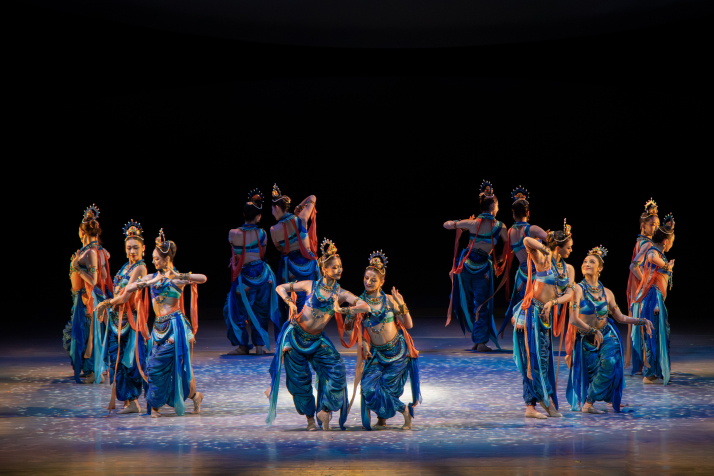 The dance drama Qiuci is performed at a theater in Urumqi on April 17 (CNSPHOTO)
Art on the Silk Road The Kizil Caves, carved into cliffs above the Muzat River west of Kuche from around the third century onward, emerged from this interconnected world. Their murals combine artistic traditions associated with India, Iran, Central Asia and China, yet the result is more than a collection of borrowed elements. Together, they formed a distinctive artistic language. The famous diamond-shaped panels on the vaulted ceilings of the Kizil Caves that spread stories of the Buddha's previous lives have become a recognizable local feature. Buddhism was being translated not only from one language into another, but also from text into image, doctrine into architecture, and imported traditions into local memory. The pigments used in Qiuci's murals offer material proof of its role as a hub of cultural exchange. The murals visible today have been changed by more than a millennium of exposure to light, moisture, sand, salts and chemical reactions. Their original colors were far more vivid. Scientific studies have identified natural ultramarine made from lapis lazuli, a stone strongly associated with Badakhshan in present-day Afghanistan. Before becoming the blue of a bodhisattva's robe or a celestial sky in Qiuci murals, it was rock—quarried, traded, transported and ground into powder. The blue on the cave wall is, in itself, a map of migration. Other pigments and materials also originated from distant regions. Gamboge and lac came from South or Southeast Asia, copper minerals produced greens, while gypsum, ochres, cinnabar and lead compounds contributed other colors. The significance lies not in assigning each material a single point of origin, but in recognizing how substances from distant regions met on the same wall and were combined into a unified mural. History was being recorded on the walls each time a painter in Qiuci brought together a Central Asian mineral, a tropical resin and an Indian Buddhism story. No figure better demonstrates this convergence than Kumārajīva. Born in Qiuci around 344, he was educated across linguistic and doctrinal traditions before eventually reaching Chang'an, which is today's Xi'an in Shaanxi Province, in the year 401. There, he became the center of a court-supported translation project involving monks, scribes and scholars. Kumārajīva's translations of the Lotus, Vimalakirti and Diamond sutras became foundational to East Asian Buddhism and introduced foreign phrases, parables and rhythms to the Chinese language. More than two centuries later, another Chinese monk Xuanzang traveled in the opposite direction. Seeking authoritative Buddhist texts, he journeyed west, passed through the Qiuci region, reached India and returned to Chang'an in 645 with hundreds of manuscripts. The dance drama Qiuci imagines the two monks in conversation—an encounter that never actually took place. Yet the invention captures a larger truth. Qiuci existed during repeated cycles of transmission, adaptation and revision. Its musical history followed a similar pattern. Tang records gave Kuchean music an established place at court, while Kizil's murals depict lutes, harps, drums and wind instruments in figures that seem to move to rhythms no longer audible. The contemporary dancers are not reconstructing an ancient choreography, because none survives. Instead, they translate still images into modern movement. Loss and return I visited the Kizil Caves in 2022 when organizing a study trip that brought 20 international students from 19 countries to Xinjiang. Inside the caves, the murals vividly depict figures leaning forward as if about to speak. Some figures have lost their eyes over the centuries, and part of the murals were cut directly from the walls and taken abroad, scattered across different countries. Between 1902 and 1914, German expeditions working along the northern Silk Road photographed, catalogued and studied Buddhist sites in the Qiuci region. They also removed large sections of murals, cutting them from the cave walls and shipping them to Berlin in Germany. Some fragments later disappeared during wartime bombing, while others ended up in St. Petersburg or became dispersed among museums. Their removal separated them from the architectural spaces that had given them meaning. A mural is not merely a picture painted on a wall. The murals, the walls and the cave interact with audiences as a whole. In overseas museums, visitors may see the preserved images of the murals, while at the Kizil Caves, people encounter the fragmented remains after the murals were cut. The museums and the caves each preserve different halves of the same history. Among those who guided us in 2022 was Ma Zheng, a mural copyist who grew up in Xinjiang, studied painting in Italy and later returned to work at Kizil. Copying may sound mechanical, but in practice it requires prolonged and disciplined observation. A copyist must distinguish an ancient line from later damage and resist the temptation to invent details unsupported by evidence. Buddhist texts, cave architecture, archaeological research, related murals, photographs and fragments preserved abroad all provide clues. Ma has brought artistic skills he learned from the West back to Xinjiang. His work also relies on collaboration among researchers from different countries. The preservation of the murals has been carried out through cross-cultural collaboration. What disappeared in life remains visible today in the faded colors of murals and in dance drama Qiuci. Onstage, faded pigments regain their brilliance and painted musicians finally begin to play. Performance can bring the past to life, although what it revives is an interpretation rather than a restoration. The author is the deputy director and professor of the Institute of China's Borderland Studies at Zhejiang Normal University Comments to lixiaoyang@cicgamericas.com |
|
||||||||||||||||||||||||||||
|