
|
| Xinjiang Today |
| Luxury hotels bet big | |
|
|
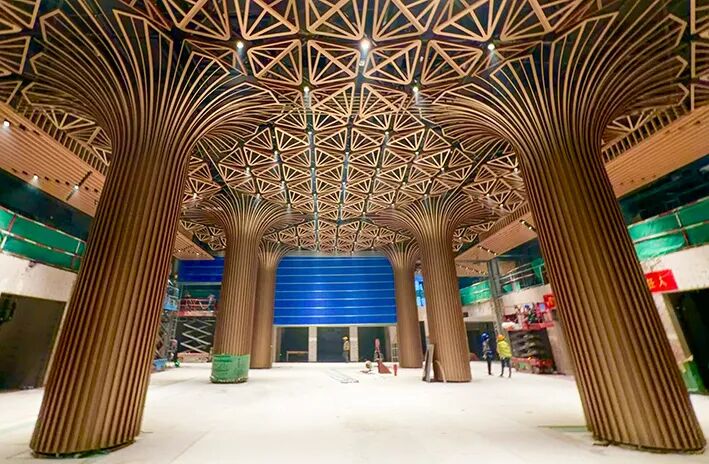 The interior of the Ritz-Carlton hotel complex and Guihe shopping center project on November 4 (FILE)
Overlooking the convention and exhibition area in Urumqi, the capital of Xinjiang, the future Ritz-Carlton hotel complex rises into the sky in intersecting lines of steel and glass. Its 196-meter T1 tower, wrapped in a diamond-patterned frame, will house both Ritz-Carlton and Westin hotels. Nearby, an Aloft hotel is taking shape, while a third office tower has already been delivered. At the base of the development, workers are finishing a sunken courtyard, laying stone steps and planting trees around the Guihe shopping center. The complex is intended to become an "international urban reception hall" serving Central Asia, featuring a combination of luxury hotels, offices, retail space and cultural attractions. The shopping center, scheduled to open in June 2027, will include high-end stores, restaurants, a Xinjiang-themed shopping and cultural street, rooftop gardens and public squares. The project is more than a prominent addition to Urumqi's skyline. It is part of a wave of international hotel investment spreading across the region, as global hospitality companies seek to capture a rapidly expanding market for tourism and business travel. International groups have increasingly entered the region in clusters. China Green Development Investment Group has introduced luxury brands including Ritz-Carlton, Westin, InterContinental, Indigo, Renaissance, JW Marriott and Aloft. Hilton has planned several hotels in the ski resort area in Altay Prefecture, including Conrad, Hilton and Canopy properties. In addition to the topping out of the commercial podium of the Urumqi Ritz-Carlton complex, from May through July 2025, Xinjiang saw the opening of InterContinental and EVEN hotels in Yining, Yili (Ili) Kazak Autonomous Prefecture, and the debut of Renaissance and Courtyard hotels in Kuerle (Korla). According to statistics cited by Zhao Biao, an assistant researcher at the Chinese Academy of Social Sciences, high-end hotel projects under construction or contract in the region involve more than 10 international brands and over 10 billion yuan ($1.4 billion) in investment. 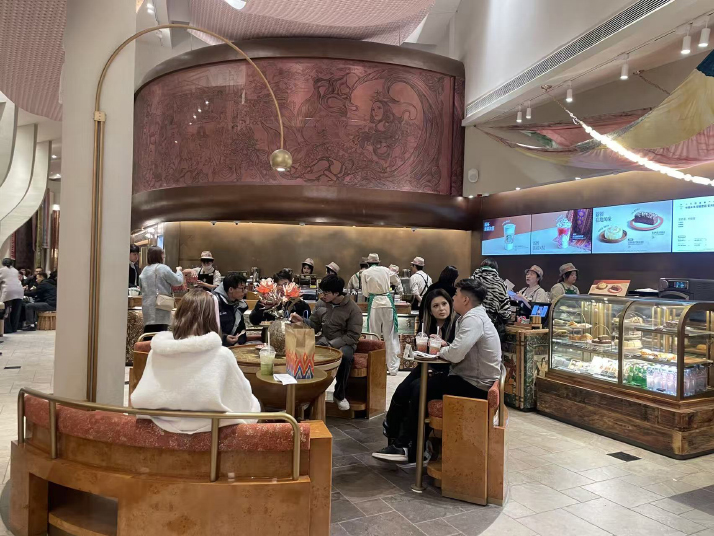 A Starbucks café in Urumqi on November 2 (WANG YAJUAN)
Meeting rising demand Official statistics show that Xinjiang received 323 million tourist visits in 2025, generating 370 billion yuan ($55 billion) in revenue. These figures represented year-on-year increases of 8 percent and 8.4 percent, respectively. As more visitors seek longer stays and immersive experiences rather than short sightseeing trips, shortages of high-quality accommodation have become increasingly evident along popular travel routes, particularly during peak seasons. Regional planners expect that demand to continue growing. Xinjiang's cultural and tourism development plan for 2025-30 sets a target of more than 400 million annual tourist visits and 1 trillion yuan ($149 billion) in combined revenue from culture, tourism and sports by 2030. Hotel development is also being supported by improvements in the investment environment. A regional regulation that took effect in October 2025 introduced measures covering market access, government services and legal protections. Business registration can now be handled online, with applications completed within one day—and without administrative charges. Rising household incomes provide another source of demand. In 2025, Xinjiang's per-capita disposable income reached 32,881 yuan ($4,930), an increase of 6.4 percent year on year. Per-capita consumer spending rose 6.1 percent to 22,657 yuan ($3,396), with services accounting for a growing share. Government initiatives to encourage consumer spending have also put more money in people's pockets, creating new opportunities and supporting continued growth in sectors such as hospitality, catering and retail. Zhao argued that the hotel investments also carry significance beyond commercial calculations. International hospitality companies generally conduct extensive due-diligence reviews before entering new markets, including examinations of labor practices and potential reputational risks. Their decision to expand in Xinjiang indicates their confidence in the region. Zhao said as a key hub within the Belt and Road Initiative, a China-proposed initiative that boosts connectivity along and beyond the ancient Silk Road routes, Xinjiang serves as a gateway for China's opening up to Central Asia and Europe, and its unique tourism resources are rare by global standards. With continued improvements to transport infrastructure and more convenient visa policies, Xinjiang is well positioned to become a world-class tourist destination. The growing presence of international hotel brands reflects not only their interest in China's vast domestic tourism market, but also the strategic value they see in Xinjiang as a regional gateway. By establishing a presence now, these companies are positioning themselves to tap into the expected boom in business and leisure travel across the region. The Urumqi Ritz-Carlton hotel complex also illustrates how developers are trying to deliver such projects. Designated as an intelligent-construction pilot, it uses 44 technologies and building methods, including digital modeling, robotic construction and AI-assisted hazard detection. Elsewhere, additional luxury properties are approaching completion. Hotel complexes in Kashi (Kashgar) and at Sayram Lake are expected to open in 2027. Together, these projects reflect a larger wager on Xinjiang's future, namely, that stronger transport links, rising consumption and the region's position as China's gateway to Central Asia can and will sustain both leisure and business travel. The hotels may have yet to receive guests, but the international brands behind them have already placed their bets. Comments to luyan@cicgamericas.com |
|
||||||||||||||||||||||||||||
|