
|
| China |
| The spirit and stories behind China's National Games for Persons with Disabilities | |
|
|
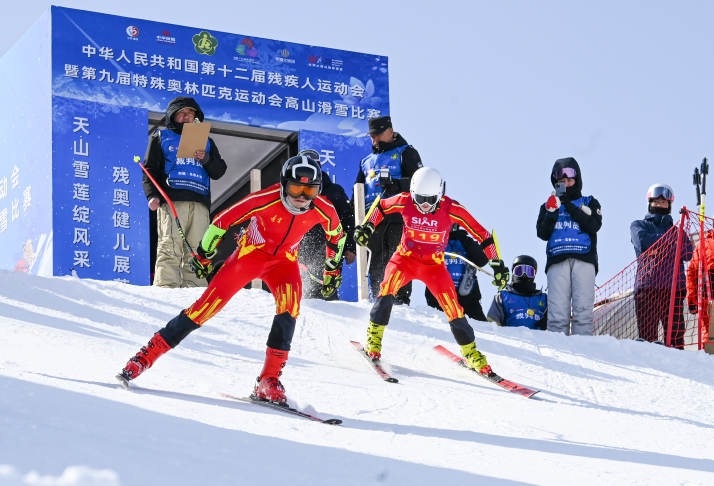 Dong Yiheng (front right) of Liaoning Province competes in the men's vision-impaired downhill race in Urumqi, Xinjiang Uygur Autonomous Region, on March 5 (XINHUA)
Imagine a regular soccer match. Players run, pass and shoot, relying on their vision to see the field, their teammates and the ball. Spectators cheer, coaches shout and the whistle blows—all part of the game's familiar flow. On the vision-impaired soccer pitch, there is no visual guidance. Players wear blindfolds to ensure an equal degree of vision impairment and navigate by sound, listening for the rattling bells inside the ball and following verbal directions from guides. The crowd remains quiet, respecting the athletes' reliance on hearing. Only when a goal is scored does applause break the silence. Games like this took place throughout the 12th National Games for Persons with Disabilities (NGD) and the Ninth National Special Olympic Games (NSOG), held on December 8-15. The NGD is the nation's highest-level multi-sport event for individuals with disabilities, and the NSOG encourages mass participation in sports competitions for individuals with intellectual disabilities. Both are typically held every four years. Hosted across the Greater Bay Area (nine cities in Guangdong Province plus Hong Kong and Macao special administrative regions), the 2025 edition was a record-shattering event of staggering scale, with nearly 8,000 athletes from 34 delegations competing in 46 sports, over 30 percent more than at the previous edition. Urumqi hosted the alpine skiing events earlier this year. "The Paralympic Games serve as a platform for athletes with disabilities to demonstrate their determination and fighting spirit. They also provide a window for society to show its care and support for the cause of persons with disabilities," Chen Xuejun, Deputy Director of the Executive Committee for the Guangdong Competition Zone of both events, told newspaper Southern Daily. 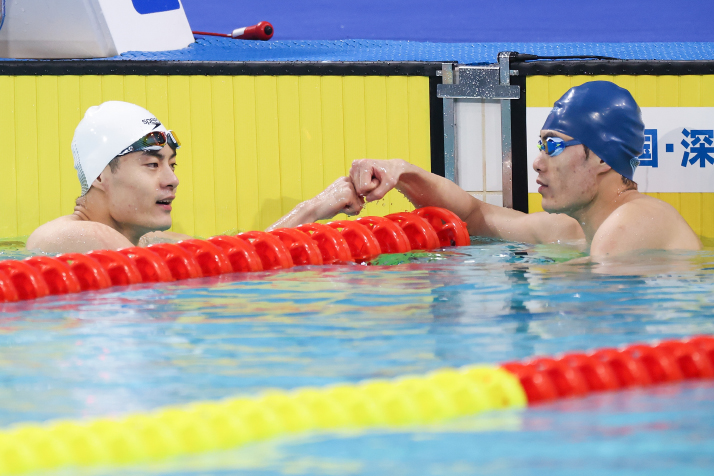 Tianjin teammates and twin brothers Li Haitao (left) and Li Haibo celebrate after the men's 100m backstroke S15 final in Shenzhen of Guangdong on December 10. They claimed gold and silver, respectively, in the race (XINHUA)
Heart of the Games Beyond the impressive scale, the true heartbeat of the Games resided in moments like those on the soccer pitch, where athletic excellence converges with human resilience. In the swimming arena, 39-year-old Yang Bozun from Tianjin Municipality, a veteran with five Paralympic appearances, defied time and physical hurdles. After an earlier health scare that required hospitalization, many doubted his return. Yet, he claimed gold in the men's 100-meter breaststroke. "During a medical check-up in May, my blood pressure was exceptionally high. The doctor had me hospitalized for observation for two weeks," Yang told media in a post-match interview. After getting his blood pressure under control, Yang resumed training. "Now that I'm older, my physical condition isn't what it used to be. Just being able to compete feels lucky to me. In the past, it was about challenging my records; now, with changes in my physical condition, I need to adjust my strategy and manage my stamina more wisely." "Twenty years ago, when an eye disease robbed me of my sight, I never knew that sports would become my second light. Every race may be my last, and I cherish the opportunity to compete now more than ever," Yang said. On the soccer pitch, Lin Haonan of the Guangdong team left audiences in awe with his rapid footwork and spatial awareness, scoring a hat-trick in their game on December 10. "We train in a world of darkness, guided only by sound and trust," Lin shared after leading his team to a 7-0 victory. His goal is to shine on the world stage at the 2028 Los Angeles Paralympic Summer Games. Perhaps no story encapsulates the transformative power of sport more than that of table tennis champion Xue Juan, who earned the medal with her partner Yang Zhonghui at the women's TT3 doubles final on December 9. At 16, she was a shy girl from a rural village, earning a basic living by taking on the odd job and doing handicrafts. Discovered by a coach who saw potential in her long arms, she moved to Beijing with one aim: to not be a burden to her family. Through years of grueling practice, often tumbling from her wheelchair while lunging for shots, she persevered. Today, she has a stable and promising career. "Table tennis gave me a second life," she said. "It pulled me out of my small, closed world and showed me my own value." For many persons with disabilities, participating in sports brings not only honor but also fosters a healthy and positive lifestyle, offering lifelong benefits. Gao Yanming, a table tennis player from the Chongqing Municipality team, is 61—a rare senior among the athletes. Yet, retirement is not at all on his mind. "Table tennis has helped me tremendously. Whether in terms of physical rehabilitation or other aspects, I have gained so much from it. It has become an essential part of my life. Whether I compete in the future or not, I will never put down the paddle," Gao told newspaper Guangming Daily. "At first, I needed assistance with everything. Now, I can fully take care of myself and have even learned to drive. For this competition, I drove here all the way from Liaoning Province (in northeast China) by myself," Gao said. "Many people who see me remark on how well I look. All of this stems from my daily table tennis training. I hope to serve as an example, inspiring more persons with disabilities to believe that through sports rehabilitation, they can achieve good health and a positive state of being." 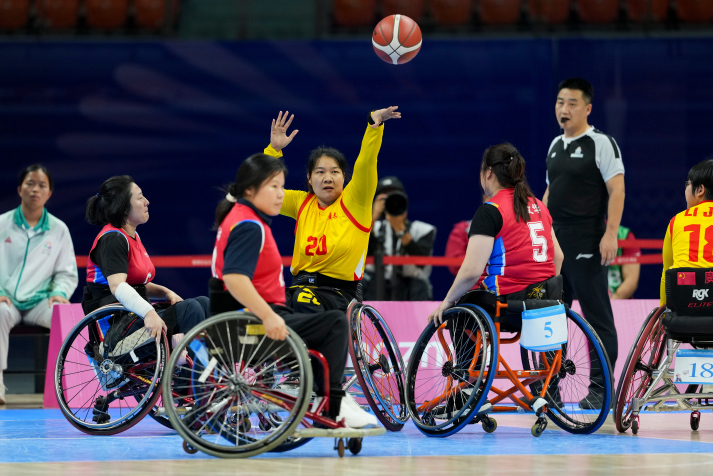 Basketball player Chen Meier (third left) of the Guangdong provincial team delivers a pass during a match in Guangzhou on December 12, helping her team win the women's wheelchair basketball quarterfinals of the 2025 NGD (XINHUA)
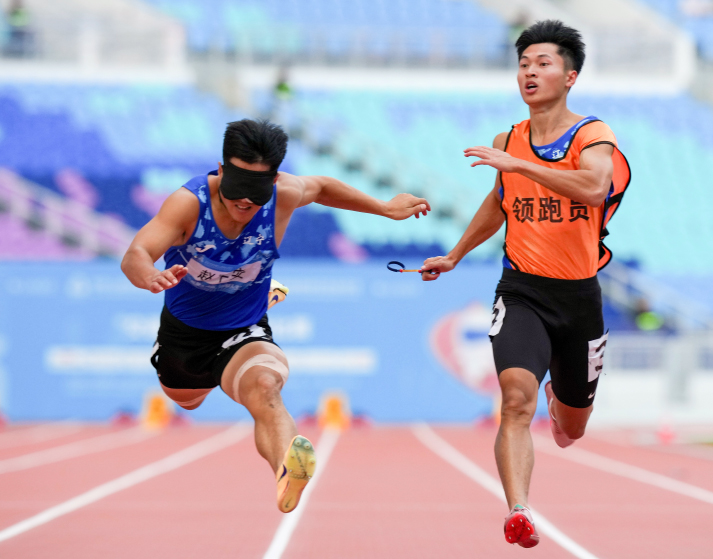 Liaoning Province's Zhao Pingan (left) sprints alongside his guide runner toward the gold medal in the men's 100m T11 final in Guangzhou, Guangdong Province, on December 11 (XINHUA)
Support services To enhance the quality of support services, the Guangdong competition zone assembled a team of 15,000 event volunteers. These volunteers came from nine host cities across the province and 63 universities. Additionally, the Guangdong committee selected 2,810 experienced and outstanding volunteers from those who had already served at the 15th National Games, the country's highest-level and largest national multi-sport event, held in the Greater Bay Area from November 9 to 21. These veteran volunteers continued their service for the Paralympics. "Considering the specific characteristics of the Paralympic events, we developed a comprehensive, professional and practical training system. This system focuses on strengthening skills in sign language communication, wheelchair assistance and guiding athletes with visual impairments, ensuring volunteers provide meticulous care and service with professional expertise," Chen added. The Games' organizing committee highlighted "tech-for-accessibility" as a core theme for this year's edition of the Games. Smart, AI-assisted prosthetics and accessibility tools have been developed to help athletes overcome their disabilities. "Technology-assisted support for persons with disabilities was a highlight of the Games. Leveraging the opportunity presented by hosting the Games, efforts have been made to promote the upgrading of the assistive devices industry toward new materials, the integration of smart tech and digitalization," Chen said. Key innovations included AI smart glasses and robotic guide dogs that provided real-time audio navigation for visually impaired athletes, while integrated service platforms utilized AI for instant sign language translation. Moreover, AI-driven soft exoskeletons offered athletes personalized post-game recovery programs, and AI companion robots offered psychological support. These applications collectively demonstrated a commitment to building a more accessible and inclusive future through technology. 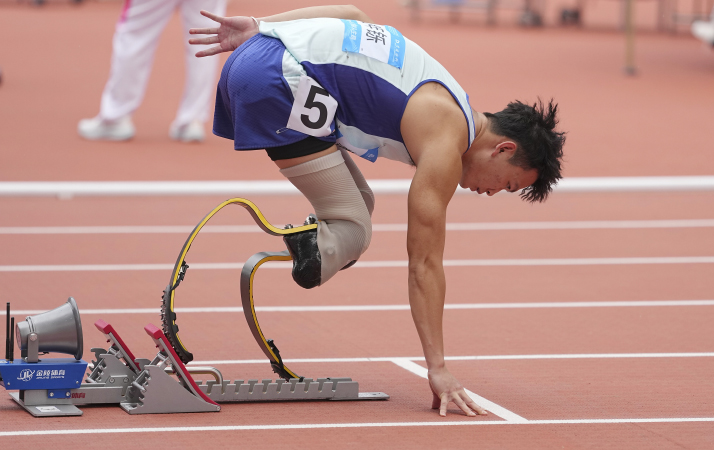 Shanghai's Pan Nianshuo awaits the start in the men's 400m T64 final in Guangzhou on December 12 (XINHUA)
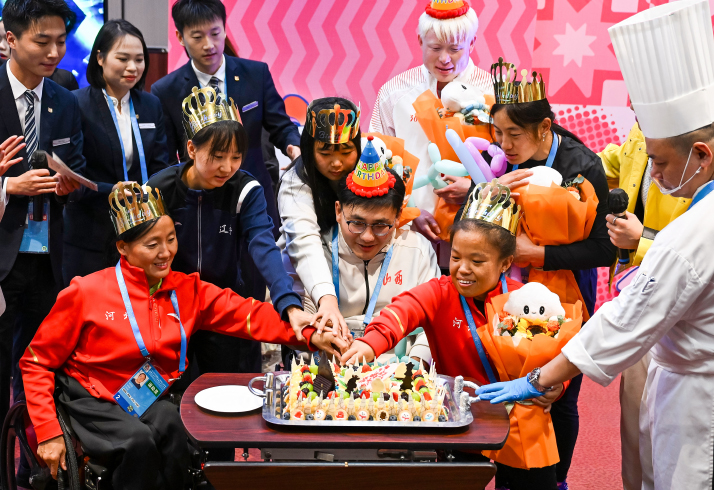 Athletes gather to cut a birthday cake during a special collective birthday party held for competitors at a Guangzhou venue of the 12th National Games for Persons with Disabilities (NGD) on December 10 (XINHUA)
Policy empowerment The remarkable success of China's athletes with disabilities reflects a foundational national effort to advance disability rights, accessibility and social inclusion for all. As volunteer teams provide support services for athletes at the Games, in daily life, safeguards for persons with disabilities have been implemented across many areas, including education, social welfare, culture, healthcare, sports and assistive technology. At the State Council Information Office's press conference on high-quality completion of the 14th Five-Year Plan (2021-25), held on November 22, officials from the China Disabled Persons' Federation introduced the latest achievements in the development of undertakings for persons with disabilities. Employment serves as a pivotal pathway for persons with disabilities to integrate equally into society and realize their personal value. Li Dongmei, Vice Chairperson and Executive Vice President of the federation, said that over the recent five years, both the scale and quality of employment for persons with disabilities in China have improved pointedly. Nationwide, the number of persons with disabilities gaining new employment has remained stable at over 400,000 annually, and a cumulative total of 2.31 million persons with disabilities have gained new employment during this five-year period. The employment rate for persons with disabilities has increased by nearly 5 percentage points during this period. "Culture and sports serve as vital means to enrich the spiritual and cultural lives of persons with disabilities and to promote their equal participation in social life. During the 14th Five-Year Plan period, China's persons with disabilities have made outstanding achievements in major international competitions, with the 2022 Beijing Winter Paralympics presenting a leap forward in winter sports development," Li said. Brand events such as the National Special Olympics Day, Disability Fitness Week and the Winter Sports Season for Persons with Disabilities have made rehabilitation and fitness sports more accessible to persons with disabilities. As part of the annual National Disability Culture Week, many public cultural venues are open to persons with disabilities free of charge, supported by dedicated accessibility services. "To meet the aspiration of persons with disabilities for better quality of life, we must ensure both material prosperity and intellectual enrichment," Zhou Changkui, Executive President of the China Disabled Persons' Federation, said at the press release. "During the upcoming 15th Five-Year Plan (2026-30) period, we will carry out mass cultural and sports activities for persons with disabilities, providing more high-quality services and products. While developing competitive sports, greater emphasis will be placed on the growth of mass sports, encouraging more persons with disabilities to step out of their homes for recreation and fitness." Copyedited by Elsbeth van Paridon Comments to zhangyage@cicgamericas.com |
|
||||||||||||||||||||||||||||||
|








