
|
| China |
| For the people, for the world | |
|
|
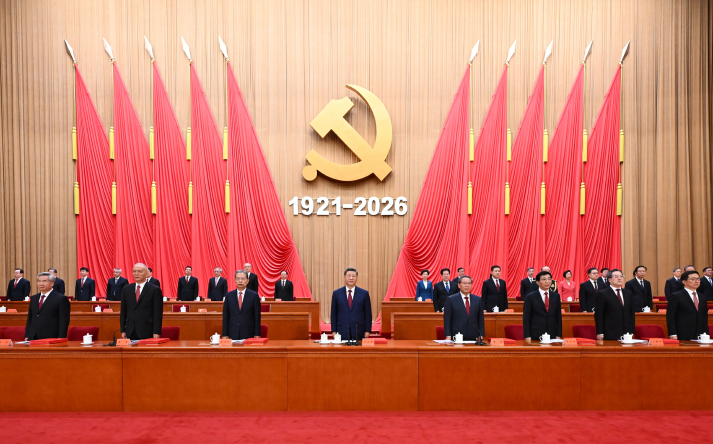 Xi Jinping, General Secretary of the Communist Party of China (CPC) Central Committee, and other leaders attend a gathering in celebration of the 105th anniversary of the founding of the CPC at the Great Hall of the People in Beijing on July 1 (XINHUA)
A hundred and five years ago, when the Communist Party of China (CPC) was founded, it had just over 50 members.
Now, it has grown into the largest governing party in the world, with more than 100 million members in a country of more than 1.4 billion people. This remarkable expansion from a small revolutionary group to the backbone of a major country is not merely a story of numerical growth. It is a testament to the Party's enduring ability to adapt, innovate and remain connected to the aspirations of the Chinese people. Over the past century and more, the CPC has steered the nation through wars, reforms and unprecedented economic transformation, consistently anchoring its legitimacy in the tangible progress of the nation and the wellbeing of its citizens. When addressing a gathering in celebration of the 105th anniversary of the founding of the CPC in Beijing on July 1, Xi Jinping, General Secretary of the CPC Central Committee, said the CPC has led the Chinese people in writing the most magnificent epic in the millennia-long history of the Chinese nation through unremitting endeavors. 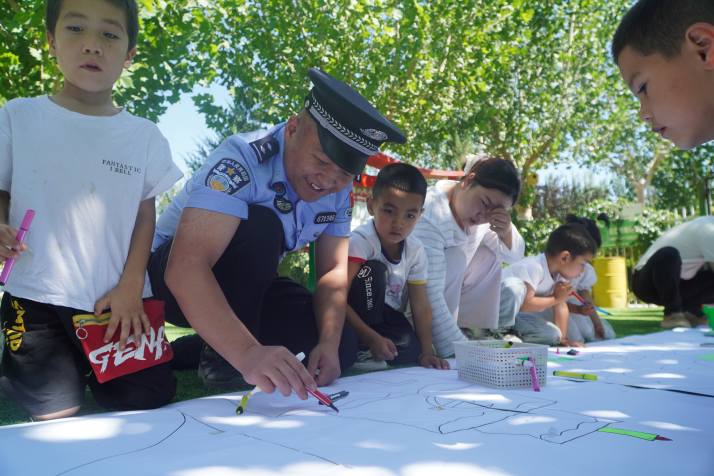 A police officer and children draw pictures themed on the 105th anniversary of the CPC at a kindergarten in Aksu Prefecture, Xinjiang Uygur Autonomous Region, on June 29 (XINHUA)
People first Following the Revolution of 1911 that overthrew the Qing Dynasty (1644-1911), numerous attempts were made to introduce Western political models that some thought may save the time-honored civilization from its decline. These included the parliamentary system, the multiparty system and the presidential system, all of which failed to bring peace and stability to a tumultuous China. The CPC was founded in 1921 against this backdrop. The Party proposed a new vision by combining Marxism, a revolutionary theory that progressives believed may provide a new solution to China's problems, with China's national context and the best of China's traditional philosophies of governance. It won popular support in the War of Resistance Against Japanese Aggression and in the fight against the corrupt, dictatorial Kuomintang regime. In 1949, the People's Republic of China was founded with the CPC serving as the governing party. The CPC, since its founding, has made seeking happiness for the Chinese people and rejuvenation for the Chinese nation its mission. This commitment has remained at the heart of its governance philosophy. Xi has said, "The aspirations of the people to live a better life must always be the focus of our efforts." He also urged all party members to bear in mind that "the country is the people and the people are the country." This people-first philosophy is best illustrated by concrete policies that have directly transformed lives. Take poverty alleviation as a prime example. "Over the past 40 years, the number of people in China with incomes below $1.9 per day—the International Poverty Line as defined by the World Bank to track global extreme poverty—has fallen by close to 800 million. With this, China has contributed to almost 75 percent of the global reduction in the number of people living in extreme poverty," read a report titled Four Decades of Poverty Reduction in China: Drivers, Insights for the World, and the Way Ahead, authored by the World Bank and Development Research Center of the State Council of China and published in 2022. In particular, between 2012 and the end of 2020, China lifted nearly 100 million rural residents out of poverty—a figure higher than the population of Germany. Through targeted measures such as relocated housing, vocational training, micro-credit programs and pairing-up support from urban Party members, the campaign reached remote mountain villages and ethnic minority regions. By the end of 2020, all 832 poor counties had been removed from the poverty list, marking the first time in Chinese history that absolute poverty was eradicated at the national level. Yet the fight does not end with that victory. Recognizing that poverty might return as swiftly as it recedes, the CPC has established a comprehensive monitoring and assistance mechanism to prevent rural residents from lapsing or relapsing into poverty on a large scale. A nationwide early-warning system now tracks households whose income falls below a designated threshold due to illness, natural disasters or sudden changes in employment. Once flagged, these families receive tailored support, ranging from emergency relief funds to job referrals and health subsidies. This dynamic approach ensures that no family slips back into destitution after having climbed out. Looking beyond immediate poverty prevention, the broader vision is rural revitalization—a strategic blueprint to transform China's countryside into more prosperous, beautiful and livable communities. Unlike the poverty alleviation campaign, which focused on lifting people above a minimum standard, revitalization aims to close the urban-rural gap by modernizing agriculture, improving infrastructure, and creating non-farm employment opportunities in villages. Initiatives include subsidizing the return of college graduates to their hometowns, promoting e-commerce platforms that connect farm produce directly to city consumers, and preserving traditional cultural heritage as a tourism resource. From terraced rice paddies in Yunnan Province to apple orchards in Shaanxi Province, these efforts are turning once-impoverished regions into thriving economic nodes. The ultimate goal is not merely survival, but dignity, opportunity and a future where every citizen, whether in megacity or mountain hamlet, can share in the nation's prosperity. Gulu Village in Sichuan Province is an example. Perched on a sheer cliff at the entrance of the Dadu River Grand Canyon, this Yi ethnic settlement was once known as the "village of sky ladders," where villagers had to climb vine-and-wood ladders just to leave home—a journey that could take half a day. In 2018, as part of the country's poverty alleviation and rural revitalization drive, a 750-meter cableway was built to access the village. Since then, it has taken the villagers only a few minutes to cross. Additionally, every household can now access tap water, electricity and network signals. With life becoming more convenient, Gulu's people can explore the outside world and increase their incomes. By 2024, full 4G and 5G coverage had arrived in the cliffside village. Today, villagers livestream from their own courtyards, tourists pay with a simple QR code scan, and the village's cured pork and walnuts reach customers across the country. Zheng Wangchun, head of the villagers' committee and Secretary of the Gulu Village branch of the CPC, said there's still a long way to go. "Our work is far from finished. We must keep improving elderly care and housing for those who cannot help themselves, so that every single villager, not just the young and able, can share in this prosperity," he told Beijing Review. Josef Gregory Mahoney, a professor of politics and international relations at East China Normal University, said the Party makes its policies by pooling the people's ideas or "wisdom." "It then uses this wisdom to formulate policies, often combining inputs from mass organizations and consultative conferences, and works together with these groups, with the people, to implement them," he told Beijing Review. "This cycle is repeated continuously, including modifying policies based on the people's feedback and evaluations and changing conditions." 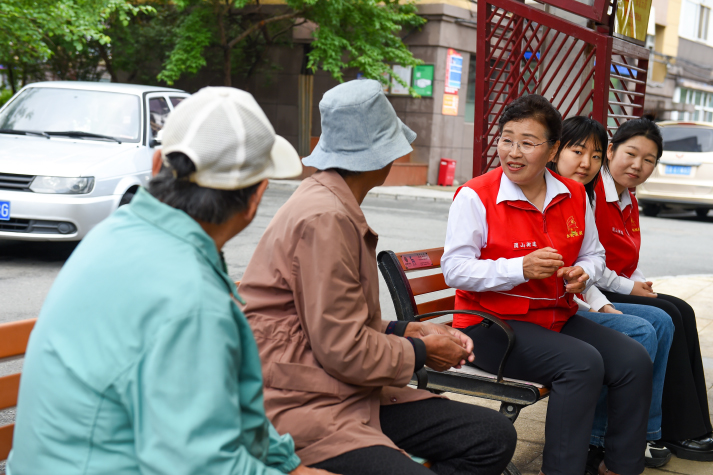 Wu Yaqin (third right), a recipient of the July 1 Medal, talks with residents at the Changshanhuayuan Residential Community in Changchun, Jilin Province, on June 9 (XINHUA)
A reference for the world
China's development model has not gone unnoticed beyond its borders. As the country charts its own course rooted in its unique historical and cultural context, it offers an alternative to those who once believed that modernization must follow a single, Western-defined path. Ali Yousif Ahmed, former Sudanese Foreign Minister and Executive Director of the Association of Arab-Chinese Friendship Societies' League, observed that the CPC has guided the country along a development path tailored to its national conditions, providing "an important reference for developing countries seeking independent development paths." In an interview with Xinhua News Agency, Yousif praised China's remarkable achievements under the Party's leadership—sustained rapid economic growth alongside long-term social stability, a combination rarely seen in modern history. He also commended the CPC's commitment to self-governance, highlighting its rigorous efforts to strengthen Party discipline, improve work style and combat corruption. Between December 2012 and May 2021, the CPC discipline inspection and supervisory authorities investigated 392 officials at or above the provincial and ministerial level and about 22,000 department- and bureau-level officials. Punishments for more than 626,500 violations of Party conduct rules were also handed down during the period. A survey conducted by the National Bureau of Statistics in 2022 showed public satisfaction with anti-corruption reached 97.4 percent, 22.4 percentage points higher than in 2012. According to Yousif, these internal reforms have significantly enhanced the governance capacity and performance of Party officials, making the CPC's experience a valuable case study for nations striving to build effective, accountable institutions. "In my assessment, one of the reasons why the CPC continues to demonstrate vitality after more than a century of existence lies precisely in its capacity for adaptation, self-correction and maintenance of high levels of organizational discipline," said Juvenal Quicassa, an international relations expert at the University of Belas in Angola. Rather than advocating a one-size-fits-all model, China has emphasized exchanges and mutual learning through platforms such as the CPC in Dialogue With World Political Parties High-Level Meeting and the publication of Xi Jinping: The Governance of China in many languages. "By vigorously promoting dialogue and cooperation among political parties worldwide, the CPC is playing a constructive and forward-looking role in enriching global governance practices and contributing valuable public goods to the international community," Adhere Cavince, a Kenya-based international relations scholar, told Xinhua. "In an era of global uncertainty, the CPC's actions serve as a vital bridge, fostering trust, reducing misunderstandings and amplifying the voice of developing countries in global affairs," he added. Speaking on July 1, Xi said as profound changes unseen in a century accelerate, the world has entered a new period of turbulence and transformation, with humanity once again standing at a crossroads of choice. "We must continuously promote the building of a community with a shared future for humanity," he said. Copyedited by G.P. Wilson Comments to luyan@cicgamericas.com CPC Fact Box The Communist Party of China (CPC) had nearly 101.29 million members at the end of 2025. The number increased by more than 1.01 million, or 1 percent from the end of 2024. The CPC had over 5.43 million primary-level organizations at the end of 2025, up by 181,000, or 3.4 percent, from the end of 2024. Female members numbered 31.914 million, representing 31.5 percent of the total. Ethnic minority members totaled 7.878 million, accounting for 7.8 percent. Workers and farmers made up some 32.4 percent of the total. (Source: Organization Department of the CPC Central Committee) Xi Jinping Thought on Party Building Since the 18th Communist Party of China (CPC) National Congress in 2012, the CPC Central Committee with Xi Jinping at its core has set forth a series of new ideas, thoughts and strategies in addressing the major questions of the times—what kind of Marxist party exercising long-term governance should be built, and how such a party should be built. In the process, Xi Jinping Thought on Party Building has taken shape. The thought is an important component of Xi Jinping Thought on Socialism with Chinese Characteristics for a New Era. It has made major original contributions to the development of the Marxist theory of Party building, and is of great practical significance and far-reaching guiding significance for strengthening the Party and the country. The thought serves as the fundamental guideline for strengthening Party building in the new era. The thought stresses that upholding the Party's leadership is the defining feature of socialism with Chinese characteristics. It emphasizes the need to uphold the centralized, unified leadership of the CPC Central Committee, exercise full and rigorous Party self-governance, stay true to the Party's original aspiration and founding mission, take the Party's political building as the overarching principle, build cohesion, and use the Party's innovative theories to forge a solid ideological foundation. It also stresses the need to enhance Party consciousness, improve an organizational system featuring cohesion across different levels and effective implementation, cultivate high-caliber officials capable of shouldering the mission of national rejuvenation, improve Party conduct on a regular and long-term basis, supervise and govern the Party with strict discipline in all respects, take coordinated steps to ensure that officials do not have the audacity, opportunity or desire to commit corruption, run the Party with systems and regulations, and fulfill the political responsibility of full and rigorous Party self-governance. (Source: Xinhua News Agency) |
|
||||||||||||||||||||||||||||
|








