
|
| China |
| A medal for dedication | |
|
|
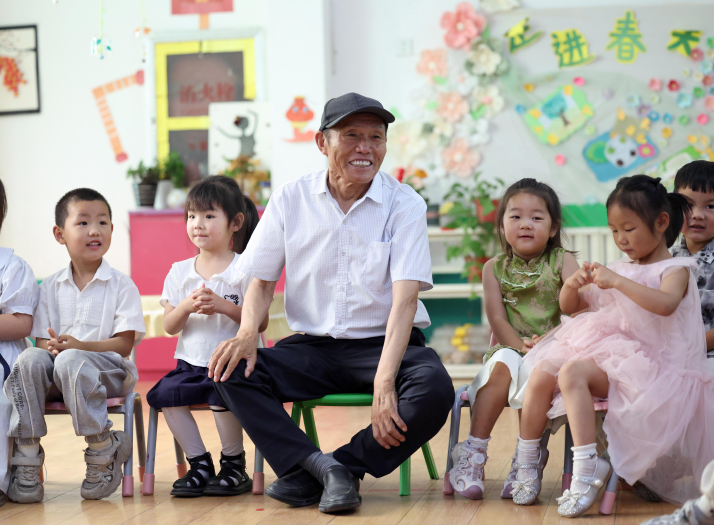 Li Liancheng, a recipient of the July 1 Medal, sits with children during a visit to a kindergarten in Xixinzhuang Village, Puyang County, Henan Province, on June 9 (XINHUA)
With sun-tanned skin, slender build and a wrinkled face, Li Liancheng looks a typical rural senior. Though unable to read until he turned 51, he has written splendid chapters in his life.
Over the past decades, the 75-year-old, solidly rooted in soil, has grown from an ordinary farmer into a national role model. As secretary of the Communist Party of China (CPC) Branch of Xixinzhuang Village in Puyang County, Henan Province, he has transformed his once poverty-stricken community into a national benchmark for rural development. On July 1, Li's efforts were recognized at a grand gathering in Beijing celebrating the 105th anniversary of the Party's founding. At the event, President Xi Jinping, also General Secretary of the CPC Central Committee and Chairman of the Central Military Commission, presented Li with the July 1 Medal, the Party's highest honor. The accolade recognizes his enduring courage to bear hardships and his commitment to putting the villagers' interests first. The July 1 Medal, established by the CPC Central Committee in 2021, is awarded to CPC members who have made outstanding contributions to the Party and the people. Conferred once every five years to celebrate the Party's major anniversaries, it was first awarded in 2021 to 29 recipients. This year, the medal was conferred upon eight exceptional individuals, recognizing their spirit of service and excellence across diverse fields, from grassroots governance and rural development to national defense and scientific innovation. Architect of rural revitalization Li's native village, on the eastern plain north of the Yellow River, was historically impoverished by infertile saline-alkali soils, in which little but weeds could thrive. Generations of farmers toiled but only reaped meager returns. Riding the tide of reform and opening up starting in 1978, Li made a turn in his life in the 1980s. He was the first in the village to build vegetable greenhouses, and became the wealthiest resident within years, a success that also earned him profound public trust. Upon being elected Party branch secretary in 1991, he was determined to lead the entire village to prosperity. He gave away his own greenhouses and skills to impoverished villagers. Soon, more than 40 greenhouses rose on Xixinzhuang's soil, pushing up local incomes. With a down-to-earth demeanor, Li has been a forward-looking leader. Within a few years, as farmers across Puyang had caught "greenhouse fever," Li's sharp business acumen told him that Xixinzhuang needed to move in a new direction to stay ahead. He mobilized 12 households to pool their savings and launch the village's first factory, a paper recycling plant. After it turned in hefty profits, Li successfully convinced the initial stakeholders to allow more villagers to join the business and share the gains. The plant was very successful, but Li did not stop there. He traveled to other provinces to invite investors to start businesses in his village. Food processing plants, distilleries, industrial nylon factories—one after another, they took root in Xixinzhuang. Today, Xixinzhuang is home to more than 20 enterprises of various kinds, forming a diversified industrial base that is upgrading toward higher-end, smarter production. It now boasts a food processing park and a modern smart-agriculture industrial park, providing roughly 3,000 jobs and generating a total output value of 520 million yuan ($76.5 million). Li's vision has gone far beyond business. In 1995, he led his fellow villagers to build a school in just 66 days. That school fulfilled the children's dream to go to school near home. Over the years, with continued government support, the village has built an education park, not only offering free schooling from kindergarten through junior high levels to local children, but also enrolling over 2,000 students from surrounding areas. A hospital with more than 500 ward beds was also built in the village, benefiting villagers and more than 400,000 rural residents in more than 10 neighboring towns and townships. Now, villagers live in spacious villas, equipped with modern facilities. Their per-capita annual disposable income is close to 40,000 yuan ($5,887), according to local newspaper Henan Daily, significantly higher than the national average of 24,456 yuan ($3,599) in 2025. Dedicated services Like Li, the other seven medal recipients, each in their own way, have embodied the highest ideals of service and dedication. Zhao Yafu, an 85-year-old agronomist in Jiangsu Province, has worked alongside farmers to develop modern agriculture for more than 60 years. He pioneered the Daizhuang Model, a rural development approach combining Party leadership, farmer cooperatives and individual households, which has been promoted across the province. He has helped introduce new agricultural techniques to over 1.5 million hectares of farmland, increasing farmers' incomes immensely. Ma Shanxiang, a retired official from Chongqing's Guanyinqiao Subdistrict, has spent over 30 years on the front lines of community service and conflict resolution. Known affectionately as Old Ma by local residents, he has received more than 20,000 visitors and mediated over 2,500 disputes during his career. His 36 Strategies of Old Ma provide a practical framework for grassroots social governance that have been widely adopted. Now in his late 60s, Ma continues to work at the Old Ma Studio, mentoring younger community workers and passing on his experiences. As secretary of the CPC Committee of Changshanhuayuan Residential Community in Changchun, Jilin Province, Wu Yaqin has introduced innovative approaches to grassroots routines. Over the past three decades, she has successfully resolved over 1,000 disputes and established training programs that have benefited nearly 30,000 grassroots governance professionals. Known as the "doctor on horseback," Uhas Sulayman, a retired physician in Xinjiang Uygur Autonomous Region, has spent decades serving nomadic communities in remote mountainous areas. Over his career, he has traveled more than 200,000 km on horseback, treated over 100,000 patients and delivered 3,200-plus newborns. Even after retirement, he established a health service center and a volunteer team, continuing his mission to provide medical services to underserved communities. "As long as the herdsmen need me, even if it rains knives from the sky, I must go," he once told media. Ninety-year-old veteran Wang Yuchang contributed to the shooting down of two intruding U-2 spy planes in the 1960s, earning a first-class merit citation and an audience with Chairman Mao Zedong. After retiring from military service, he worked humbly as a department store manager in Xiaoxian County, Anhui Province, never boasting of his wartime achievements. His story only became widely known in 2019 during a veteran survey. Zhong Jue, 90, is an academician at Central South University who has spent over 60 years tackling critical technological bottlenecks in aluminum processing. She solved the problems hampering the large-scale production of high-performance aluminum hot-rolled plates, playing a decisive role in the development of major rocket components for China's heavy-lift launch vehicles. Chen Junwu, who passed away in 2024 at age 97, was an academician who dedicated over 70 years to China's petrochemical industry. He served as chief designer of the country's first fluid catalytic cracking unit, helping advance China's oil refining capabilities from backwardness to world-class standards. Their stories, across generations and professions, paint a portrait of commitment that transcends individual achievement, reflecting the collective spirit of CPC members who contribute to making China what it is today. Copyedited by G.P. Wilson Comments to wanghairong@cicgamericas.com |
|
||||||||||||||||||||||||||||
|