
|
| China |
| Revival in the red heartland | |
|
|
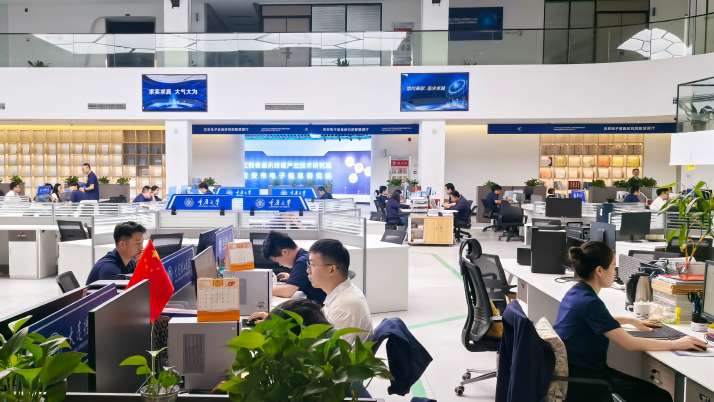 The Ji'an Electronic Information Research Institute in Ji'an, Jiangxi Province, on June 10 (SUN XUAN)
A remote village in the mountains of east China has staged an unlikely turnaround over the past decade—a transformation all the more striking given the region's long-standing reputation for its history rather than its economic vitality. Ji'an, a city in Jiangxi Province, is most famous for the deep revolutionary legacy of the Jinggang Mountains—the mountain range it administers and the site where China's first rural revolutionary base was founded in 1927. Yet most of its villages are tucked deep in the mountains, remote and poorly connected by transport, which has long constrained local economic development. Shenshan Village is a typical case—nestled among encircling peaks, it had fewer than 30 permanent residents in 2015 and a per-capita annual disposable income of less than 3,000 yuan ($440). By 2025, however, its permanent population had grown to about 200, and per-capita annual disposable income reached 36,000 yuan ($5,300). This dramatic transformation has been driven primarily by the simultaneous growth of crop growing and tourism. Rural renaissance Shenshan has capitalized on its mountainous terrain to expand the commercial production of yellow peaches and tea. In parallel, it has drawn on its red heritage to develop rural tourism centering on visiting sites that bear historical importance to the Communist Party of China (CPC), and launch agritainment and homestays. In 2016, villager Peng Xiaying opened the village's first farm-stay restaurant. Starting with just a few simple tables, and with the help of her daughter, who had returned to the village with experience in the food and beverage industry, the business gradually found its footing. As visitor numbers grew, she brought more than a dozen neighbors into the trade, helping them start their own food and local-specialty businesses. In 2025, Shenshan received over 300,000 tourists. "The greatest achievement of poverty alleviation work has been the transformation of the villagers' mindset," Peng Zhanyang, Party branch secretary of the village, told Beijing Review. "Today, the people of Shenshan are composed and articulate when facing visitors and cameras—they no longer blush at the first word." Shenshan's transformation is not an isolated case. Meibei Village, also in Ji'an, boasts multiple Red Army revolutionary sites and over 300 well-preserved ancient buildings from the Ming and Qing dynasties (1368-1911). The village brought in a professional company to manage its tourism resources holistically. By revitalizing idle properties, old cattle sheds have been turned into specialty cafés, vacant houses converted into homestays and gift shops, and a rich program of intangible cultural heritage performances and folk activities has drawn large numbers of tourists. Villagers, meanwhile, have secured stable increases in income through shareholding and dividends, benefiting from the tourism industry. Shenshan, Meibei and many other rural communities in the Ji'an old revolutionary base area have paved revitalization paths that suit their unique endowments, including red tourism, green ecology, classical architecture and emerging industries. A 37-year-old Ji'an native, Mao Haofu studied in the United Kingdom and later worked in finance in Nanchang, Jiangxi's capital. In 2016, he quit his job and went back to Ji'an to become a docent, following his grandfather, who had spent his life giving revolutionary talks there. Back in his hometown, Mao made full use of his foreign language skills. He set up an English-speaking tour guide team, wrote original English-language teaching materials and handouts, and worked with local schools to systematically train bilingual docents. In his view, their work is not a one-way broadcast, but a cross-cultural dialogue. "We strive to break down language barriers," he told Beijing Review. "So that the red-culture stories of the Jinggang Mountains can cross mountains and seas and reach the wider world." Enabling platforms In boosting the development of local agricultural products, Ji'an has consolidated its agricultural products under the unified "Jinggangshan" regional brand, setting up a state-owned operating company, supply-chain firms, and a green agriculture association to build an integrated production-marketing system. This system has carried bamboo shoots, red rice, yellow peaches and tea, once trapped in the mountains, to markets across China and beyond. Lu Hongying, a returned native, obtained brand authorization for her food-processing business, which sources raw materials from farmers and runs automated production lines. Her company employs over 100 local workers, boosts villagers' incomes and exports tailored products overseas. Zhu Chang, Director of the Jinggangshan Ecological Agriculture Service Center, said the brand's value and annual sales both topped 20 billion yuan ($3 billion) in 2025, benefiting more than 500,000 farming households and ranking fifth nationally in regional agricultural brand influence. The same service-platform logic also drives local electronic information industry, the top priority sector of Ji'an, which generated over 240 billion yuan ($35 billion) in 2025. Though not a traditional powerhouse, the city has built its success through a decade of policy and platform development. It established three key platforms—an industry alliance, a research institute and a testing center—to tackle supply-demand matching, technological breakthroughs and product diagnostics. "The electronic information industry alliance acts like a 'matchmaker' among companies, helping to efficiently connect upstream and downstream players along the industrial chain," said Yi Mingrui, Executive Secretary General of the alliance. In May, the alliance co-hosted a lithium battery supply-demand matchmaking event with neighboring Yichun and Xinyu cities, attracting 48 companies and over 60 representatives, and resulting in the signing of 10 letters of intent for on-site cooperation. "The Electronic Information Research Institute collaborates with 11 universities and one national key laboratory, focusing on key technologies and forward-looking research and development in the sector," Wu Bo, deputy head of the institute, said. Taking traditional LED production as an example, the slow sorting speed, low efficiency and capacity constraints of the conventional process were overcome by the team's innovative design of a new process route, which integrated high-speed inspection and sorting for whole-panel LEDs, significantly shortening production cycles and reducing operating costs for companies. "Companies come to us for diagnosis, and we provide a one-stop service covering testing, diagnosis and solutions," Tong Lixia, Director of the Electronic Information Product Inspection and Testing Center, said. In the past, local companies had to send samples to other cities for testing, often waiting 10 to 20 days; now they can get tests done right at their doorstep, with results often available on the same day. In the first half of this year alone, the center's team visited over 50 companies, conducting on-site production line inspections to help identify issues and improve processes. "Our philosophy is to embed ourselves in the industrial chain, integrate into the development zones and grow and thrive together with the industry," Tong said. BR Copyedited by G.P. Wilson Comments to sunxuan@cicgamericas.com |
|
||||||||||||||||||||||||||||
|








