
|
| China |
| The Long March revisited | |
|
|
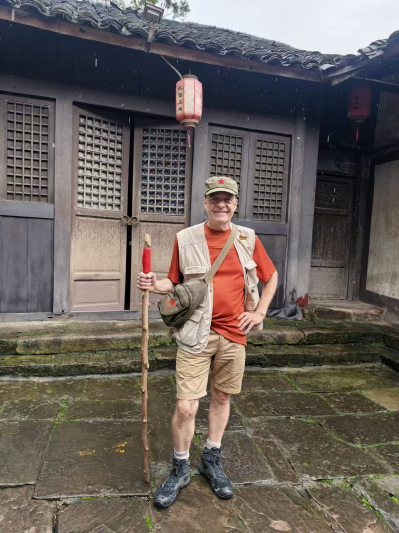 David Ferguson visits a village in Chishui, Guizhou Province, on June 27 (COURTESY PHOTO)
When the idea of the new Long March experience was first presented to me, I was enthusiastic. From early June through late July, we would spend six weeks following part of the route of the original Long March (1934-36) in honor of the journey's conclusion 90 years ago this October. The Long March was one of the seminal historical events of the 20th century. It had a transformative impact on the history of modern China. I was not disappointed. I arrived at the start of the trip in Jiangxi Province with only a rough knowledge of the full story. Over the years, I have edited many books and other documents—histories of the Communist Party of China (CPC), for example—that reference the Long March. But it was as if I had completed the outer border of a jigsaw puzzle, and managed to start to assemble a few pieces from different parts of the interior, without having put together a clear vision of the whole. Off we went Over the course of the next six weeks, many more pieces fell into place. The Xiangjiang River in today's Guangxi Zhuang Autonomous Region bore witness to the deadliest single battle of the Long March in winter 1934. The Red Army lost more than half its forces in the crossing of the river. But the Red Army did not give up and accept defeat. It carried on and continued the struggle. The Battle of Luding Bridge (May 1935) in Sichuan Province was a fight that simply had to be won. It came down to the individual bravery of 22 soldiers, four of whom sacrificed their lives for victory. The Battle of Lazikou (September 1935) in Gansu Province was a similar situation, a vital river crossing won through the courage of a few dozen troops. The climbing of the snowy mountains and the traverse of the Sichuan marshlands were physical ordeals that would have destroyed the morale and the will of lesser people, but the Red Army fought its way through. The Guizhou leg In Guizhou Province, our main activities centered on Zunyi and the Chishui River. These again were critical challenges of a distinct nature. The Zunyi Meeting, held in January 1935, was an issue of leadership and decision-making. This is where the leadership of Bo Gu (a senior member of the CPC) and Otto Braun (a military adviser from the Comintern) was replaced by leading Chinese communists such as Mao Zedong, Zhou Enlai and Wang Jiaxiang. The whole concept of the military tactics for the future Long March changed, and the prospects for the Red Army changed with them. The importance of the decision became apparent within a matter of weeks during the Four Crossings of the Chishui River, which took from January until March 1935. This was the Long March's greatest strategic challenge, when a Red Army numbering a few tens of thousands had to outwit and outmaneuver the Kuomintang troops numbering hundreds of thousands. Not only did they succeed in this goal; they were able to choose and fight several engagements with the much larger adversary, all of which they won. One of the things that baffled me (and still does) concerns the nature of the terrain throughout the first part of the Long March through Jiangxi, Guangxi and Guizhou. Deep narrow valleys and steep mountain slopes decorated on each side thick with forest and undergrowth. Qinggangpo, where a major battle took place prior to the Four Crossings, is a case in point. Our group stood in the rain at the memorial site, paying our respects to the hundreds of gravestones that marked the sacrifice of those who died there. We looked across at the mountain slopes where the battle had been fought. I struggled to imagine how anyone could climb these slopes carrying a weapon, far less come to grips with and engage the enemy, or work out what was happening in the encounter. Nevertheless it happened. Red Army Commander in Chief, and a founding father of the People's Republic of China in 1949, Zhu De knew the moment when his troops required his presence to maintain their morale, and Mao chose the right moment to withdraw with his forces in good order. 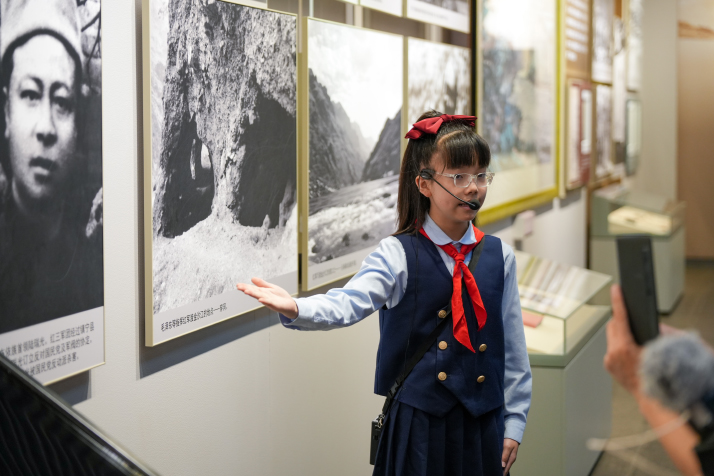 A student volunteer introduces Red Army history at a museum in Zunyi, Guizhou Province, site of the historic Zunyi Meeting, on June 10 (XINHUA)
Army and people, as one During the Long March, the Red Army painted slogans on the walls of the villages they passed through. We saw some examples of these in Guizhou. After the Red Army had moved on, the people rendered over the slogans to hide them from the Kuomintang troops. Years later, the render began to fall from the walls, and some of the original slogans were exposed. Today, they are protected. From a contemporary perspective, these slogans seem rather mundane—Minzhong Lianhe (Unity of the People), for example, composed by Zhu and written on the wall of the seat of the Revolutionary Government in Minxian County, Gansu. They do not appear to contain any profound or significant messages. But we should consider them not from a contemporary perspective, but from the perspective of the ordinary villagers to whom they were addressed. These were poor rural people, with little or no education, who lived lives of great hardship. What was their experience of an army? The only armies they had ever known were the tools of their oppressors, who came to steal their stuff and leave them with the bare minimum to survive on. And now, these peasants were presented with a message of the army and the people as one, by a military who treated them like human beings. This was a completely radical and revolutionary idea. One that challenged everything they had ever known. One that gave them a completely new vision of the world. That is the importance of these slogans. That is why the people responded with wholehearted support. That is why they provisioned the Red Army and enlisted in the hundreds or thousands. And this is what sustained the Red Army through its endless months of hardship, and helped it to make it through to the end. There is another aspect to the slogans, namely, the question of literacy. In any poor society, education is a prized goal—one of the keys to the door that leads from poverty to prosperity. It is a key that would have been all but unattainable to the vast majority of the peasants in the areas through which the Red Army traveled. And yet those peasants were confronted with a phenomenon that must have seemed like sorcery: an army of ordinary peasants exactly like themselves, but who could read and write. The Red Army went to an enormous effort to teach its troops literacy. One ingenious method was by "learning from the back of the man in front of you": On their long treks in single file or in ranks of two or three, each soldier had a Chinese character pinned to his back, and the man behind him would learn it. In Minxian, the Red Army set up a university while they were on an rest and recuperation stop of just two months. Again, this commitment to education and the ability to deliver must have been one that challenged everything the peasants had ever known, gave them a completely new vision of the world, and inspired them to provision the Red Army, or "their army," and enlist. Visiting the sites of the great events was a profound experience for me, but it was the less-heralded nuances that I began to understand which added the real spice to the experience. BR The author is the honorary chief English editor of the Foreign Languages Press Copyedited by Elsbeth van Paridon Comments to linan@cicgamericas.com |
|
||||||||||||||||||||||||||||
|