
|
| China |
| The price of free noodles: charity or chaos? | |
|
|
 (ILLUSTRATION BY LI SHIGONG)
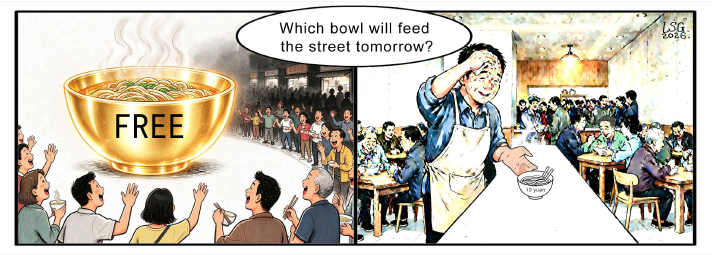
In Nanjing, Jiangsu Province, two outlets of a "zero-yuan noodle shop" recently opened, serving free plain noodles to anyone who queues—no proof of need, no registration required. The owner, surnamed Zhang, funds the operation as a charitable initiative. The long lines drew praise but also sparked controversy as nearby eateries reported a drop in business. Zhang later adjusted his customer policy, restricting free noodles to four groups, including seniors aged 60 and above, people with disabilities, sanitation workers and delivery riders. Critics call the model a gimmick or a franchise ploy; supporters see genuine kindness. Is free lunch altruism—or a market disruption that shifts costs onto small vendors? Qiu Yanbo (Elephant News): Low-price noodle shops survive on thin margins and high volume: a profit of just over 1 yuan ($0.15) per bowl, sustained by steady traffic and regulars. When the free shop opens, those regulars stop coming. Losing 10 to 20 customers a day means little to a fast-food outlet located on the first floor of an office tower, but to a shop living on volume, it is a cut-off. The problem is not that the free shop competes unfairly. In fact, it does not compete in the usual sense because it charges nothing. The problem is that it draws away customers from low-price shops without providing those businesses with any way to make up for the lost income. Zhang said annual losses may reach 10 million yuan ($1.5 million), and he is prepared to keep investing. But a supply driven by personal goodwill is inherently unstable. It has no revenue, no capacity to sustain itself, no institutional mechanism for continuity. Once a street's commercial ecosystem is damaged, recovery takes a long time. Ultimately, local residents may be left with neither option: The free noodles are gone, and so are the cheap ones. A free food service sustained by one person's wealth can never be a street's long-term safety net. That role can only be played by small businesses that survive by serving local customers day after day. They may worry about paying the rent and may not look "charitable" at all, but they provide something that matters: stability, sustainability and service that does not depend on any one person's goodwill. Lu Dewei (Southern Metropolis Daily): Many people equate public welfare with "free," but "free" has too often become a synonym for a trap: free eggs that end in a health-product pitch, free trials that end in a membership. Suspicion is understandable, but it should not become the default verdict on every act of kindness. The zero-yuan noodle shop illustrates the difficulty. Requiring diners to prove hardship would violate their dignity. Most customers belong to disadvantaged groups. The occasional freeloader is the cost of having no threshold. Moreover, this is a private act of charity funded by one person, and it need not meet the accountability standards of public fundraising. The owner's latest adjustment reflects a reasonable balance among charity, neighbors' livelihoods and sustainability. Whether it silences doubters remains to be seen. Why does suspicion so easily prevail? In a society of strangers, a benefactor's character is no longer vouched for by neighbors, and a gratuitous kindness lacks a verifiable background. "Ulterior motives" thus becomes the laziest explanation. Over time, a norm has formed: Love must prove itself first. Benefactors are forced to meet near-perfect standards—precise targeting, pure motives, flawless results. Zhang, initially reluctant to appear publicly, had to respond; he sighed that "nothing can be perfect." If every act of kindness must first pass a trial, what suffers is not just a noodle shop, but the willingness of others to extend a helping hand. Copyedited by Elsbeth van Paridon Comments to luyan@cicgamericas.com |
|
||||||||||||||||||||||||||||
|