|
| Voice |
| China's rise, America's dilemma | |
|
|
|
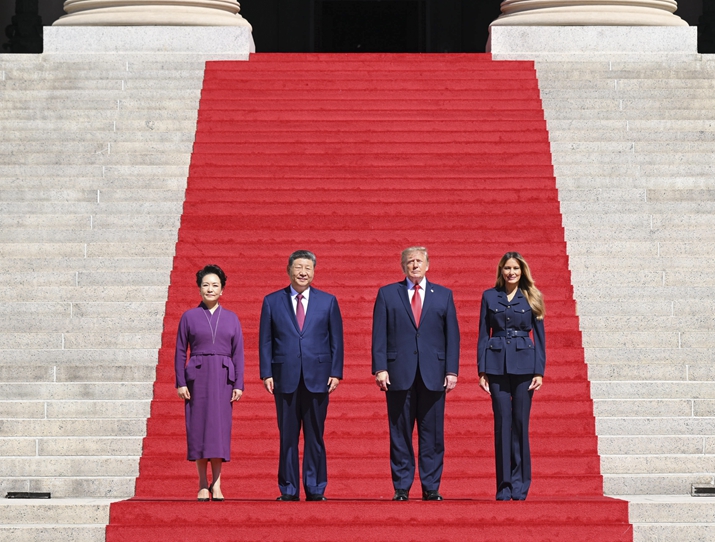
Chinese President Xi Jinping and his wife Peng Liyuan visit the U.S. National Archives, accompanied by U.S. President Donald Trump and First Lady Melania Trump, after drinking tea together at the White House in Washington, D.C., the United States, on September 25 (XINHUA) With the arrival of Chinese President Xi Jinping to the United States on September 23, the first visit in three years and the first official state visit to the U.S. in eleven years, humanity observed a consequential turning point in world history. China and the United States now stand for two major countries of the present world order, but for the first time since 1991, the U.S. is no longer the sole global superpower. American hegemony cannot be compared to prior forms of geopolitical, civilizational or economic preeminence. Occupying the center of the first truly comprehensive global system of global petrodollar-recycling described by economists like Micheal Hudson, the U.S. was arguably the world's first truly global superpower. Such a status cannot simply be measured in terms of military capacity or geopolitical preeminence: While the former Soviet Union possessed a military that could seriously rival that of the United States and was also the center of an alternative geopolitical order, it never succeeded in becoming the center of a truly global system. At a time where commentary regarding the so-called "end of globalization" is so abundant, it is worth remembering that in spite of multi-polarity, trade wars, geopolitical supply-chain consolidation, and an increased emphasis on national industrial policy, globalization has established an irreversible, fundamentally interrelated global system that many countries still take for granted. The continued denomination of the majority of global exports and trade surpluses in dollars, even amid the rise of political multi-polarity, demonstrates that U.S. hegemony has acquired a definite systemic reality that is not directly reducible to its political hegemony. The share of global exports invoiced in dollars has remained around a steady 40 percent since the year 2000, despite the relative decline of its share of foreign exchange reserves from 72 percent in 2001 to 57 percent in 2026. The superpower status occupied by the U.S. has less to do with an intrinsically advanced industrial capacity or system of governance and more to do with the fact that, owing to the inheritance of the postwar Bretton Woods system, it occupies the center of a de-facto global tributary system, which puts nearly unlimited credit at the disposal of government-led research and development for both economic and military purposes. As Zhou Bo, a senior fellow at the Center for International Security and Strategy, Tsinghua University, recently pointed out in an interview with American media, U.S. relations with China (and vice versa), in contrast to those it had with the Soviet Union, are not primarily defined by ideological rivalry. That being said, it can be argued that the intrinsic contradiction between China's ascendancy and the American-led global system is actually more irresolvable under the present status quo than the Cold War of the past century. Despite all pretenses to intense ideological and political rivalry, from the 1970’s onward the Warsaw Pact and its allies still relied on exorbitant loans from Western creditors in order to maintain sustained economic growth and development. The Soviet Union largely created a bulwark of political resistance against the geopolitical imperialism that was itself only a consequence of the U.S.-led global system. It did not address the underlying causes of geopolitical imperialism and did not establish a genuine alternative to that global system.
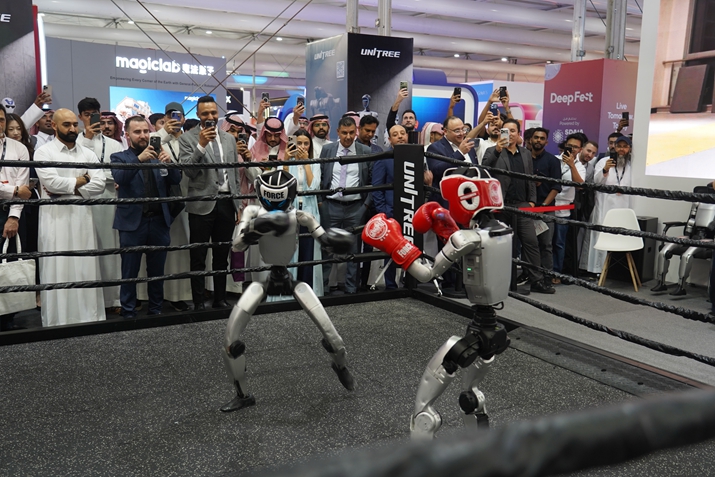
Visitors watch two humanoid robots built by Unitree Robotics boxing at the LEAP 2026 Tech Conference in Riyadh, Saudi Arabia, on September 2 (XINHUA) An alternative By contrast, China has genuinely laid the foundations for an alternative global system. It has spent the fruits of its participation in the U.S.-led global system on the building of internal capacity, a complex internal system of scientific, technological and industrial development. The surpluses yielded from this system have created an alternative foundation for the issuance of developmental loans and credit for countries in dire need for it. This has created a genuine alternative to the International Monetary Fund and other debt-traps, which empower Western creditors with vast political leverage over the developing world. China-proposed Belt and Road Initiative (BRI) also represents a severe threat to the foundations of U.S.-led hegemony, simply on account of the fact that it empowers the majority of the world's population with an alternative path to economic development, a path that enables them to politically dis-align from the control of Washington. This leads us to the present juncture in world history. China's accelerated capacity-building has led it to catch up, and in some areas, even outpace the U.S. in R&D, and implementation of key strategic technologies such as AI, renewable energy, chip, electric vehicles and robotics, exerting immense pressure on U.S. domestic industry. The presidency of Donald Trump is arguably a symptom of this pressure having reached a decisive point: Washington’s acknowledgement that the hitherto course of things are for it unsustainable. Trade wars, tariffs and other forms of protectionism represent a desperation without precedent in the history of U.S. foreign trade policy. Already, as a consequence of the talks surrounding the state visit, Washington has announced a two month extension of the existing trade truce. The significance of Xi's visit for the people of both the U.S. and China cannot be understated. As Americans reel from the consequences of the conflicts with Iran, with energy costs going beyond anything tolerable in the long term, and increased economic hardship, strengthening bilateral economic cooperation with China could not be more timely. Likewise, the Chinese people have experienced the profound unpredictability of U.S. foreign policy and Washington's attitude toward China. Xi's state visit helps to at least clarify where matters stand between the two countries. Of course, amid Trump's ongoing disastrous war with Iran, China has proven to be a key global actor that has been the primary counterweight to outright, unilateral U.S. dominance of the Middle East. This is, once again, not on account of any embittered ideological opposition to the U.S., but on account of the fact that Chinese-led economic development empowers many countries to possess a degree of sovereignty and independence that would otherwise be impossible to maintain. From Xi's visit, Trump will undoubtedly attempt to exact some kind of commitment to help "clean up" the disastrous consequences of his foreign adventure. Already, Xi has called for a return to the June Islamabad Memorandum of Understanding, a return to negotiations pursuant to a comprehensive agreement. Additionally, he has proposed stronger mechanisms to prevent military conflict. Facing a changing world Long gone is the interventionist imperial hubris of the Barack Obama era, during which the last official state visit of Xi to the U.S. took place. Less than a week ago, on September 18, Trump was quoted as responding with "I don't know about that. I think--I think we're repressive also," when pressed on the alleged "repression" of the Chinese Government. What has replaced this is a combination of cynical realism, desperation and genuine confusion on Washington's part. In contrast to the foreign policy resolve of the U.S. Government during its Cold War with the Soviet Union, American elites and top experts genuinely struggle to understand China. The great historical irony of how the U.S.-led unipolar system itself materially and organically facilitated the ascendency and great rejuvenation of China has had an immensely confounding effect on senior U.S. ideologists and policymakers. Hence Washington's newfound internal contradictions: Trump appears to genuinely admire China, even seeking to emulate it in many respects. Simultaneously, Trump aggressively, desperately attempts to maintain the very unilateral hegemony that corresponded to the de-industrialization and liberal economic policy he so apparently resents. Washington seeks unilateral hegemony, while claiming to be victimized and “ripped off” by its own various global allies and proxies, who are, in actuality, chief instruments of this hegemony. During the Cold War, Washington could point to the Soviet Union and its allies as a foreign threat that may very well have come from another planet. But China's rise has occurred from within, rather than from without, the U.S.-led global economic system. After decades of imperial political and soft power hubris, including attempting to lecture the various nations of the world on "human rights" and correct, "democratic" governance, the Trump administration is characterized by a desperately introspective orientation that has not yet found genuine resolution. Washington's contradictions may very well thus be genuine. On the occasion of Xi's visit to the U.S., Trump may very well sincerely pursue an unprecedented thaw of bilateral relations. Yet simultaneously, the visit may be used as a pretext to pursue an aggressively hostile strategy toward China. The author is executive chairman of the American Communist Party Copyedited by G.P. Wilson Comments to dingying@cicgamericas.com |
|
||||||||||||||||||||||||||||
|