
|
| World |
| Rethinking political parties | |
| The true measure of a political party lies in its ability to govern, serve the people and contribute to a fairer international order | |
|
|
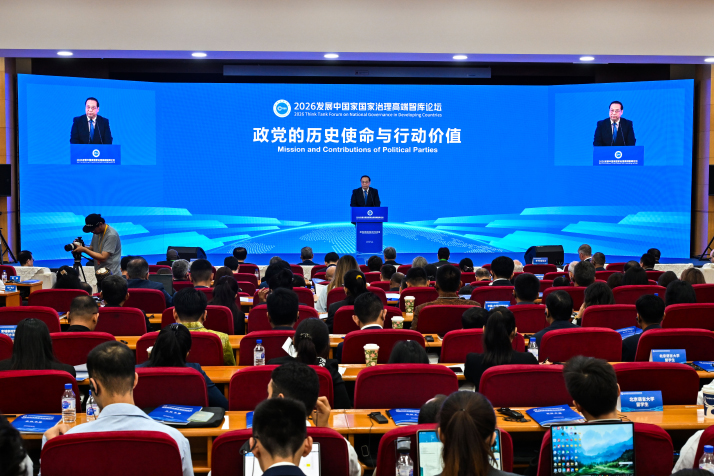 Chang Bo, President of China International Communications Group, speaks at the 2026 Think Tank Forum on National Governance in Developing Countries in Beijing on June 26 (WEI YAO)
At a time when developing countries are seeking new paths toward modernization, the role of political parties is again being discussed not merely as an electoral question, but as a question of governance, development and global representation. Speaking at the 2026 Think Tank Forum on National Governance in Developing Countries in Beijing on June 26, Chang Bo, President of China International Communications Group, said the values, leadership, governance capacity, sense of mission and commitment of political parties are directly related to the future of a country's modernization. The forum, themed The Mission and Contributions of Political Parties, brought together participants from more than 20 countries and international organizations to discuss political parties' role in shared development, social governance and global governance. Beyond elections Political parties should not be seen merely as election participants, Tamara Duisenova, President of Kazakhstan's Academy of Public Administration and the country's former Deputy Prime Minister, said at the opening ceremony. "Political parties have always been institutional vehicles through which societies respond to the challenges of their time," she said. In her view, if the 20th century was the era of mobilization parties, the 21st century is becoming the era of participatory parties. The historical mission of political parties is therefore shifting from simply representing interests of their constituents to creating mechanisms that enable citizens to participate in national governance. Clifford Oparaodu, Secretary of Nigeria's Independent Corrupt Practices and Other Related Offences Commission, emphasized that political parties are "the cornerstone of modern democratic governance." For multiethnic countries such as Nigeria, he said, they are also a vital force for national integration and sustainable development. Beyond competing in elections, political parties recruit leaders, formulate public policy, educate citizens and connect government with society, making them indispensable to effective governance. He also cited the Communist Party of China (CPC) as an example of how a political party can guide national transformation over the long term. From a European perspective, one of the most important aspects of the history and practice of the CPC is its ability to transform a vast country with a rich civilization into a modern socialist nation, according to José Luis Centella, President of the Communist Party of Spain. He said China has succeeded in "putting the economy at the service of the people" and integrating Marxism with China's own philosophical traditions. "The most important reason for the CPC's resilience is that, since its founding in 1921, it has always remained closely connected with the Chinese people," Centella told Beijing Review. "It is a party of the people, one that serves the people and grows together with the people." Héctor Villagrán-Cepeda, former Minister of Transportation and Public Works of Ecuador and a professor at Beijing Language and Culture University, said many countries in Latin America still face a gap between aspiration and reality. "Our dream is to have a united Latin America, a strong Latin America, a Latin America that is respected worldwide," he said. "What we have today is a divided Latin America, grappling with invasions, sanctions and economic problems." China has built a united society that overcame foreign aggression and a century of humiliation, according to Villagrán-Cepeda. For Latin America, that experience has practical value because it demonstrates the importance of political cohesion, long-term goals and organizational discipline, he added. Villagrán-Cepeda highlighted several lessons worth studying: building a strong party, setting long-term goals, strengthening internal supervision, understanding international relations, establishing party schools and upholding a clear doctrine. But he said the most important principle is much simpler: serve the people. "The most important thing is to serve the people," he told Beijing Review. "If you serve the people, they will support you." "The state exists for people, not people for the state," Duisenova said, adding that parliament, government, political parties and civil society should all serve the rights, dignity and interests of citizens. Chang said the people-centered approach represents the core value of party governance and offers a practical path for developing countries to address contemporary challenges. As peace and development have become the shared global aspirations, he emphasized that political parties must translate people's demands for security, stability, sustainable development and environmental protection into tangible action. 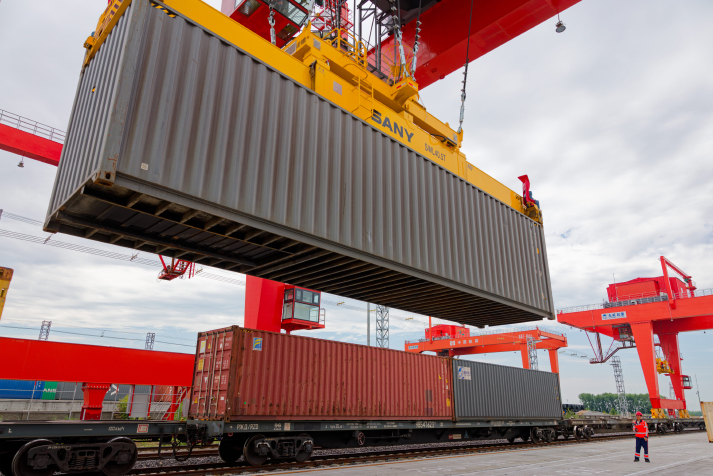 A crane lifts a container at a transshipment yard at a railway station in Tongjiang, Heilongjiang Province, on June 24 (XINHUA)
Toward a fairer global order The discussions at the forum extended beyond the realm of domestic affairs. For developing countries, political parties are not only actors in national politics; they also help shape how their countries participate in global governance. Pompeo Della Posta, an Italian economist and professor of political economy at Beijing Normal University, approached the issue in terms of global economic rules. Developing countries, he said, face a structural challenge: It is difficult to "find a place" when others are already sitting there. Developed countries have long-established interests, institutions, networks and rules. Countries that "come from outside" or "from below" must create room for themselves. The current international order, Della Posta said, still reflects the balance of power after World War II, when institutions such as the World Bank, the International Monetary Fund and later the World Trade Organization were shaped largely by developed countries. Eight decades later, the global economic landscape has changed, and emerging markets and developing countries are demanding a greater role in setting rules. Della Posta emphasized that rules matter because they determine what countries can or cannot do. China, he said, is not only seeking a greater role for itself, but is also speaking for many Global South countries that want a fairer say in the international system. He added that he believes this is where China's proposals on global governance, including the Global Governance Initiative and the Belt and Road Initiative (BRI), become relevant. The BRI aims to boost connectivity along and beyond the ancient Silk Road routes. Roads, railways, ports and logistics networks are not an end in themselves. They create the conditions for trade, industrialization and economic integration. Without infrastructure, many developing countries simply cannot participate fully in globalization, he said. Rather than asking developing countries to adapt to an existing system designed largely by developed economies, initiatives such as the BRI offer new opportunities for countries of the Global South to shape development according to their own priorities. On June 17, China released the white paper More Just and Equitable Global Governance: China's Principles, Proposals and Actions, which calls for a more representative and effective global governance system and greater participation by developing countries. Reuters also reported that, when introducing the white paper, China calls for more Global South voices to be heard at the United Nations. Yu Yunquan, Vice President of China International Communications Group, made this point at the forum's parallel session on political parties and global governance. He said political parties should serve as guides for modernization for humanity. For centuries, he noted, modernization was often treated as equivalent to Westernization, but the world today is different. From the Bandung Conference of Asian and African states in 1955 and the Non-Aligned Movement to the BRI, BRICS cooperation and the four China-proposed global initiatives on development, security, civilizations and governance, developing countries have become builders of a new international order, according to Yu. As Global South countries rise collectively, he said, they are making their voices heard with greater clarity in multilateral platforms such as the United Nations. "China's white paper on global governance responds to the Global South's widespread calls for a fairer and more effective global governance system," Yu concluded. BR Copyedited by G.P. Wilson Comments to liwenhan@cicgamericas.com |
|
||||||||||||||||||||||||||||||
|