
|
| Xinjiang Today |
| Boertala: beyond pristine | |
|
|
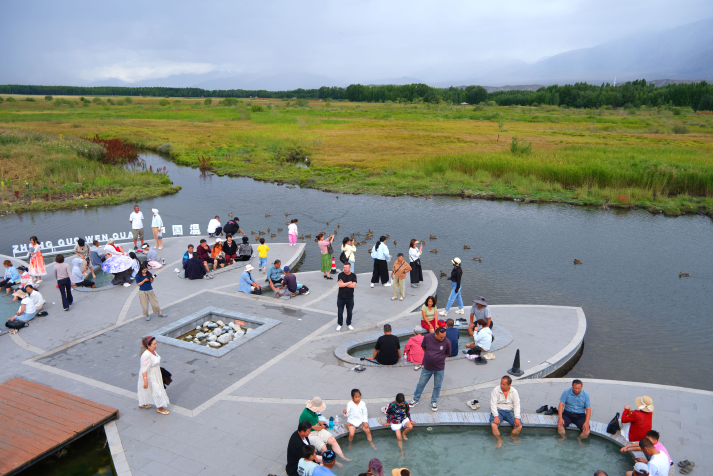 Tourists unwind by hot spring pools at a wetland park in Wenquan County on August 15, 2025 (VCG)
In literature, purity is often equated with cleanliness and untouched isolation—crystalline seas, untouched snow… Boertala (Bortala) Mongolian Autonomous Prefecture, in the far northwest of China, certainly claims that traditional kind of purity in the secret wilds of the Xiaerxili (Sharhili) Nature Reserve and the sapphire depths of Sayram Lake. Yet Boertala, which means "emerald grassland" in Mongolian, is home to nearly half a million people from 35 ethnic groups, including Mongolian, Han, Uygur, Kazak and Hui. Here, purity is a living inheritance, an open embrace of development and a wise coexistence.
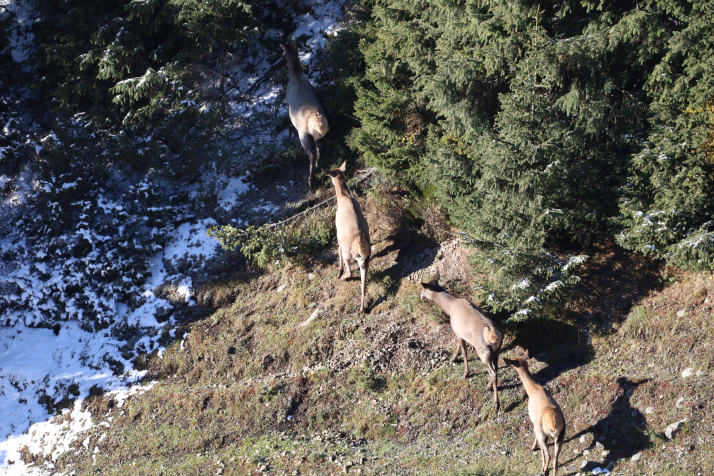 A herd of Tianshan red deer, a nationally protected species, moves through the forests of the Xiaerxili Nature Reserve (VCG)
Preserved land Nestled quietly in the northern mountains of Boertala is an ecological treasure—the Xiaerxili Nature Reserve. This territory was returned to China only after a 1998 border negotiation between China and Kazakhstan. Long serving as a restricted military border zone, the area remained almost entirely free of human interference, preserving a near-pristine ecological state. Spanning the northern foothills of the Alatao (Alataw) Mountains at elevations from 1,210 to 3,670 meters, Xiaerxili encompasses dramatic diversity: snowy peaks, alpine meadows, montane forests and Gobi deserts. Rich water resources and exuberant vegetation provide an excellent habitat and feeding ground for wildlife. To protect this purity, Boertala chose the most restrained path. There is no commercial development, no permanent population in the reserve—just fewer than 100 rangers guarding this land, with strict approval required for any visitor entry. Here, purity is to be revered and safeguarded. 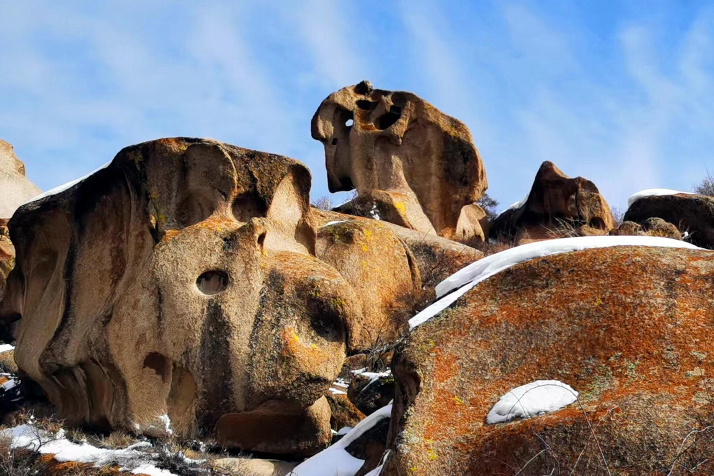 Grotesque and captivating rocks at Guaishiyu (VCG)
If purity in Xiaerxili is a profound stillness, then the purity of Guaishiyu (Strange Stone Valley) is an epic grandeur carved by the ages. The Guaishiyu Scenic Area is one of the world's largest landscapes of pictographic granite porphyry monoliths, arguably the greatest assemblage of grotesque rocks in northwestern China. Geologists say its formation results from vast geological change over eons. Through prolonged weathering, erosion, glaciation and wind-scouring, the hard rock was sculpted into a gallery of fantastical forms: some resembling elephants drinking, others like celestial hounds moon-gazing, or an eagle with outstretched wings. With every step, the view shifts, each stone whispering the story of Earth evolution. For this natural stone museum, Boertala again has chosen preservation over excessive manicuring. The scenic area retains the rocks in their most authentic form, every boulder still bearing the marks of millions of years of wind and rain. 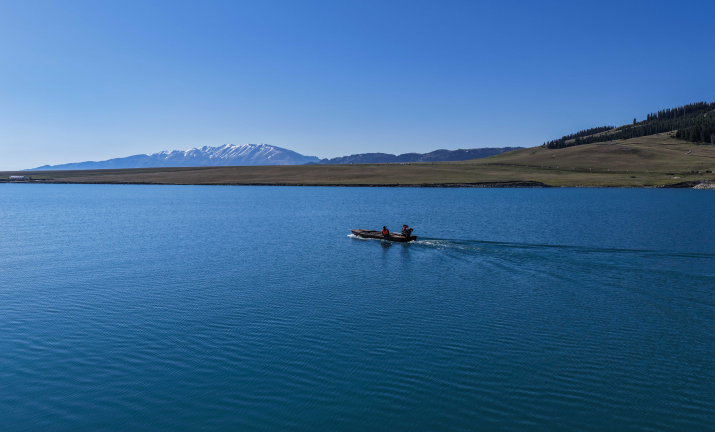 Sayram Lake sees snow-capped mountains, blue water and grasslands converge into a breathtaking panorama on May 17 (VCG)
Clear water Known as "the last teardrop of the Atlantic," Sayram Lake is the highest-altitude and largest alpine lake in Xinjiang. This sapphire set into the Tianshan Mountains boasts water transparency of 16 meters deep, with some areas reaching 20 meters. Its nickname stems from its formation through glacial movements and its connection to ancient tectonic shifts that link it, in legend, to faraway oceans. Over the past three years, its water quality has consistently remained Grade II, the second highest level in China's five-tier system—an exemplary standard among China's plateau lakes. Behind this purity lies Boertala's effective and systematic ecological stewardship. As a closed plateau lake, Sayram has a fragile capacity for ecological self-recovery. Years ago, issues like shoreline collapse and soil erosion threatened the lake's environment. To guard this patch of pure blue, local authorities launched a series of targeted restoration projects. In 2013, a riprap shoreline stabilization initiative began, using meticulously arranged granite blocks to form a protective belt. A cumulative 35 km of ecological revetment has been completed, effectively preventing 90 percent of shoreline collapse and soil loss. Rows of granite boulders now form a unique ecological defense line, blocking sediment from flowing into the water and laying the foundation for the lake's sustained clarity. Since 2012, Boertala has significantly strengthened ecological protections for Sayram Lake. In August 2014, the local government issued a comprehensive plan for environmental protection pilot projects, imposing grazing bans around the lake while launching major environmental initiatives. Today, Sayram Lake holds a total water volume of 21 billion cubic meters, with an average annual net inflow stabilizing at 16 million cubic meters, thanks to years of remediation and improvement. Now, water in Sayram Lake is so transparent you can see the bottom, luminous with layered blues under the shifting sun. Tianshan spruce stand erect on the banks; wild plants like snow lotus and angelica carpet the mountains; rare animals such as ibex and argali roam freely, forming a complete montane ecosystem. Visitors from across the country come in admiration, marveling at the lake's purity and the surrounding landscape's majesty. Here, purity is a vivid practice of the belief that "green is gold"—an ecological blessing to be enjoyed for generations. 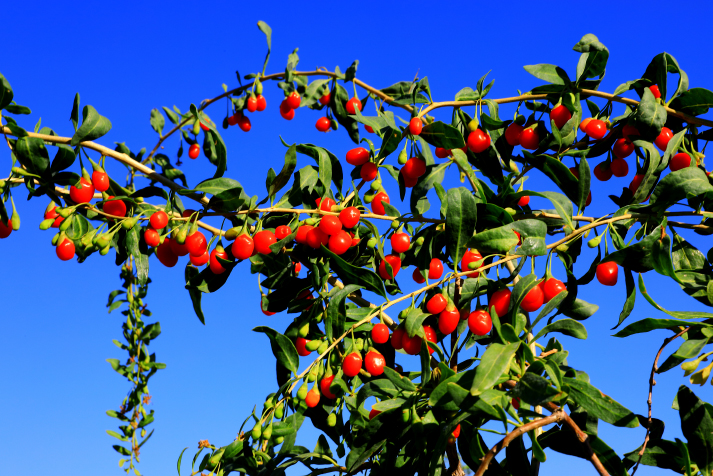 Ripe goji berries in Jinghe County (VCG)
Green focus This philosophy of green development is equally evident in Boertala's industries. The Jinghe goji berry—a tiny, ruby-red fruit—is being carefully cultivated into a "golden fruit of prosperity" that drives an entire economic sector. Jinghe County has a long history of goji cultivation. Situated north of the Tianshan Mountain Range, with long sunshine hours, sharp day-night temperature swings, alkaline sandy soils, and irrigation from melting snow, the county produces berries of brilliant red color, plump fruit, and rich nutritional content celebrated in both domestic and international markets. Over decades of development, the Jinghe goji berry has grown from scattered cultivation into a nationally renowned signature industry. Today, Jinghe's goji planting area covers more than 6,600 hectares, yielding 60,000 tons of fresh fruit annually and forming a complete industrial chain of cultivation, processing, sales and agro-tourism. Local people were not content to simply sell their berries by the pound as a raw commodity. They vigorously optimized goji varieties, breeding new cultivars that combine high yield, premium quality, and strong disease resistance. They brought in advanced processing enterprises to develop over 40 derivative products—from goji berry puree to fresh-locked preservation techniques—ensuring the fruit is "priced by quality and wins by excellence." In 2025, Jinghe Goji Berry was officially recognized as a product of geographical indication by the China National Intellectual Property Administration and included in the EU-China Geographical Indications Agreement for mutual recognition and protection. Relying on the G30 Lianyungang-Huoerguosi (Khorgas or Horgos) Expressway and the Jinghe International Rail-Highway Intermodal Logistics Hub, the fruit is reaching ever wider markets. Collaboration with airlines, cold-chain warehouses and logistics companies makes it possible to set up processing plants right at the field's edge to deliver fresh goji berries across the country in the shortest possible time, or into Central Asian and European markets. Each harvest season, thousands of villagers work busily in the fields, earning 200 to 300 yuan ($29-44) a day. Processing factories have absorbed many local residents "at their doorstep" in stable employment. This little red berry carries Boertala's hopes for a better life and defines another kind of purity—commitment to quality, persistence in innovation and aspiration for shared prosperity. Boertala's understanding of "purity" transcends conventional definition. Purity can be a living inheritance, an open path to development, a wise coexistence and a diverse integration. This pristine purity is Boertala's most treasured quality, and the most compelling tone of its emerald grasslands. Comments to shangzhouhao@cicgamericas.com |
|
||||||||||||||||||||||||||||
|