
|
| Xinjiang Today |
| From salt flats to rice fields | |
|
|
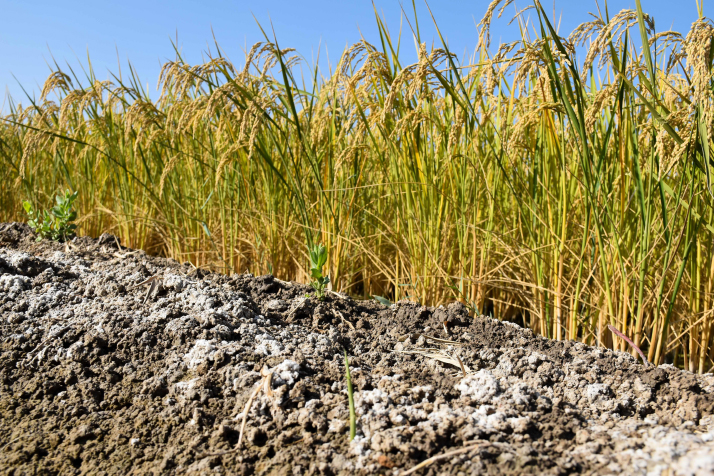 Taken on September 25, 2020, this photo shows a salt-tolerant rice demonstration field bordering the desert in Yuepuhu (Yopurga) County, Kashi (Kashgar) Prefecture, where white salt deposits remain visible along the field ridges (GAO HAN)
For many people outside China, Xinjiang is best known for its snow-capped mountains, sweeping grasslands, fertile oases and the vast Taklimakan Desert. Less familiar are the expanses of saline-alkali land scattered across some of its arid farming areas, where generations of farmers struggled against a single, stubborn obstacle: salt. In these fields, crops often failed long before harvest. Irrigation brought water, but it also drew salt to the surface, leaving behind a white crust that compacted the soil and stunted seedlings. For years, much of the land produced little and, in some places, was simply abandoned. Today, those same fields are green with rice. 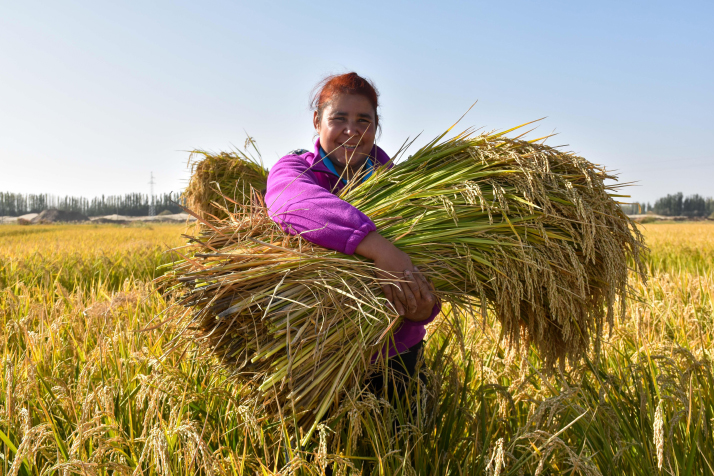 A farmer transports harvested salt-tolerant rice at a demonstration field in Yuepuhu on September 25, 2020 (GAO HAN)
Guardians of the fields One example lies at the 223rd Regiment of the Second Division of the Xinjiang Production and Construction Corps (XPCC), near Tiemenguan in south Xinjiang, a city that houses the headquarters of the XPCC Second Division. The XPCC, headquartered in Urumqi, operates under the dual leadership of the Central Government and Xinjiang Uygur Autonomous Region. It was founded in 1954, following the demobilization of several military units stationed in Xinjiang. The XPCC's mission is to cultivate and guard the border areas. This involves engaging in economic activities, such as developing agriculture and industry, while also helping maintain border security. Liu Jianguo, a local farmer, remembers what the fields looked like before the project began. "Every time we irrigated, a white crust of salt surfaced almost instantly," he said. "The soil had become so hard that it felt like stone." Cotton came first. Then corn. Neither produced much of a harvest. "Even when the seeds sprouted, the plants never really grew," Liu recalled. "After a few years, many people simply stopped farming the land." The turning point came in 2018, when a research team led by renowned agronomist Yuan Longping, famously known as the "father of hybrid rice," launched Xinjiang's first trial of salt-tolerant rice in Yuepuhu (Yopurga) County, Kashi (Kashgar) Prefecture. The idea was simple enough: cultivate rice varieties capable of thriving in saline soils. Although Yuan passed away in 2021, the thriving project stands as a profound and lasting legacy for Xinjiang. Science behind the success The researchers' work began with addressing the salt accumulation. Drainage channels were built to flush highly concentrated salts out of the soil, lowering salinity enough for young rice plants to establish roots instead of dying shortly after germination. Even then, conventional rice varieties still struggled to survive. Reduced salinity alone was insufficient, prompting the team to introduce a salt-tolerant variety nicknamed "seawater rice" in China. Developed by combining desirable traits from indica and japonica rice, this crop tolerates salinity levels exceeding eight parts per thousand while maintaining stable growth. Compared with conventional rice, it develops more robust root systems and gradually remediates the soil by reducing salt accumulation over consecutive growing seasons. But breeding a hardier rice variety solved only part of the problem. The soil itself remained too poor to support healthy crops. Much of the sandy land in south Xinjiang is deficient in organic matter, suffering from exceptionally poor water and nutrient retention. To rehabilitate the soil, they applied sheep manure, oilseed residue and microbial biofertilizers year after year, gradually turning the nutrient-poor sand into productive farmland. Water posed the final challenge. Rather than flooding the fields, researchers adopted dry direct seeding, reducing the amount of water required during germination. Once the seedlings emerged, drip irrigation beneath plastic mulch delivered water directly to the root zones while minimizing evaporation. The system reduces irrigation water use by more than 60 percent compared with conventional paddy cultivation. 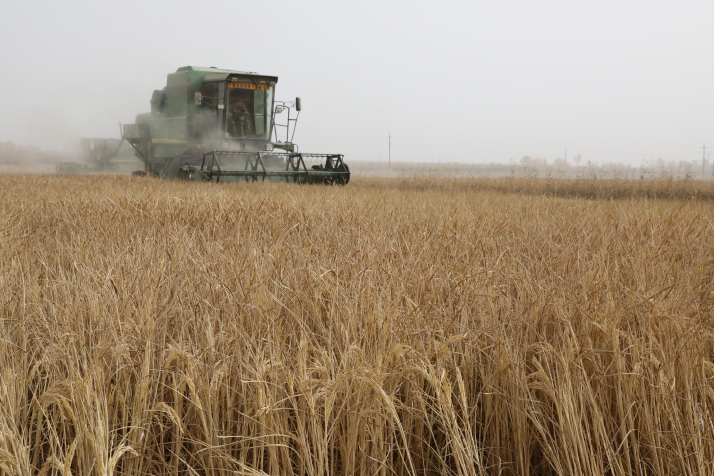 Harvesting salt-tolerant rice at a pilot field managed by the Second Regiment of the First Division of the Xinjiang Production and Construction Corps in Aksu Prefecture on November 6, 2021 (VCG)
Winning back the land What began as a small experiment has gradually expanded across Xinjiang. The first successful harvest in Yuepuhu in 2018 proved that salt-tolerant rice could survive in the region's saline-alkali soils. Since then, pilot projects have spread to several areas as researchers continued refining cultivation techniques for different soil conditions. The results have become increasingly consistent. In 2024, mechanized demonstration fields covering more than 20 hectares recorded average yields of 8.2 tons per hectare, while monitoring showed soil salinity continuing to decline. A year later, demonstration fields at the XPCC's 223rd Regiment achieved an average yield of 7.5 tons per hectare. After several consecutive growing seasons, land once classified as severely saline-alkali has been upgraded to mildly saline conditions. The figures tell only part of the story. Farmers who watched the project unfold say the biggest change was visible much earlier. "The first year surprised everyone," Liu said. "The seedlings survived and they kept getting stronger." Last year, he planted 1.3 hectares of salt-tolerant rice. With average yields exceeding 7.5 tons per hectare, the crop generated a higher income than cotton ever had. More importantly, the land itself has changed. "The soil is much softer now and the salt has noticeably receded. After harvesting the rice, we can now plant wheat and achieve stable yields," Liu said. Today, about 2,000 hectares of salt-tolerant rice is grown across Xinjiang. The improvements have created opportunities beyond rice production. On many reclaimed fields, farmers now plant wheat after the rice harvest, establishing a rice-wheat crop rotation that was unimaginable just a few years ago. Average wheat yields have exceeded 3 tons per hectare, allowing a single plot of land to support two annual harvests instead of one. 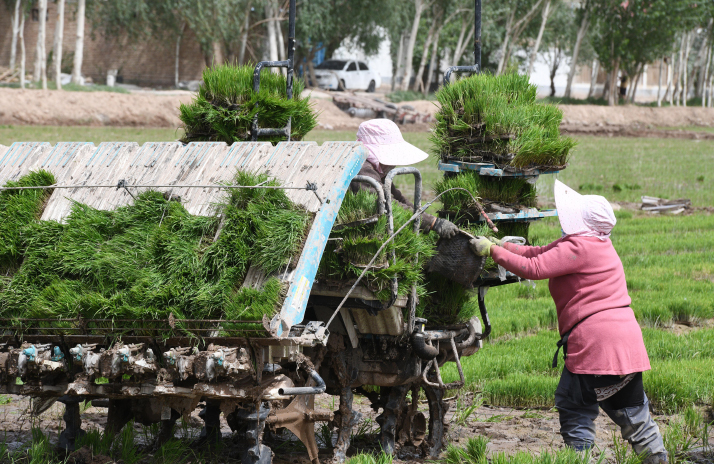 Farmers load salt-tolerant rice seedlings onto a transplanter at a demonstration field in Pahataikeli Township, Kashi Prefecture, on May 13, 2024 (VCG)
Lessons from the land Xinjiang's experience reflects a critical challenge that extends far beyond its own borders. Globally, vast expanses of arable land are plagued by salinization, suppressing crop yields and bottlenecking agricultural productivity. As food security concerns grow increasingly urgent, restoring degraded land is becoming just as vital as bringing new acreage under cultivation. There is undoubtedly no one-size-fits-all solution; every region possesses its own unique climate, soil, and water conditions. However, Xinjiang's achievement underscores a broader lesson: Reclaiming saline-affected land is rarely the result of a single technological breakthrough. Instead, it demands well-conceived, long-term initiatives that simultaneously restore soil health, breed site-adapted crops and maximize water-use efficiency. Eight years ago, few people believed rice could grow in these salt-scarred fields. Today, the rice itself is perhaps the least surprising part of the story. The greater transformation lies beneath the soil, where land once dismissed as barren is slowly returning to life—one harvest at a time. Comments to kangcaiqi@cicgamericas.com |
|
||||||||||||||||||||||||||||
|