
|
| Xinjiang Today |
| Where sand turns to harvest | |
|
|
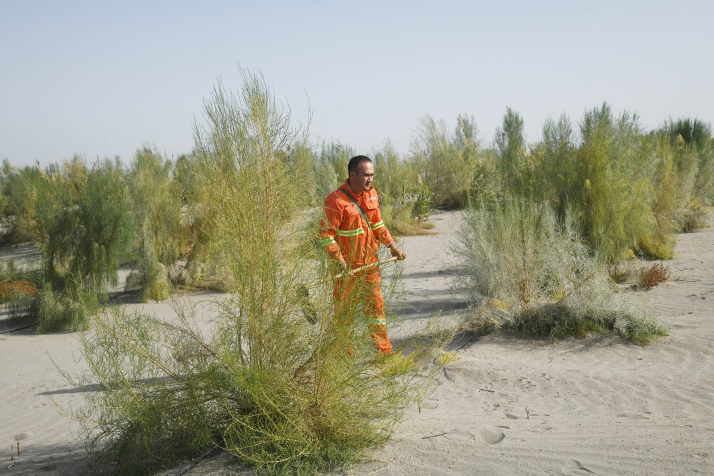 A forest ranger works among saxaul trees in Aksu in September 2023 (VCG)
More than 100 days of sandstorms each year. Thick clouds of dust carried by wind often darkened the sky, necessitating lights even during the day. The world's second largest shifting-sand desert, sitting just 6 km from the city of Aksu, advanced by nearly 5 meters annually.
Faced with such conditions, the choice might seem obvious: move somewhere more livable or stay and try to change the land itself. The harsh environment described above was the reality confronting Aksu in the 1980s. Located on the northwestern edge of the Taklimakan Desert in Xinjiang, the prefecture faced a growing struggle for survival as desertification advanced. For many people elsewhere, relocation appeared to be the more practical option. But for generations of Aksu residents, leaving was never an easy answer. Like many Chinese communities with deep ties to the land, they viewed the place where their families had lived, farmed and raised children not simply as a place of residence, but as home. They were also guided by a belief that the sacrifices of today could create a better future for generations to come. Equally important was a spirit of perseverance deeply embedded in Chinese culture, often illustrated through the ancient tale of Yu Gong, the old man who moved the mountains. In the well-known legendary story, the elderly man resolves to remove two mountains blocking his path. Though mocked for attempting the impossible, he persists, believing that while he may not finish the task himself, future generations will continue the work until it is done. Faced with advancing desertification, the people of Aksu chose a similar path. Rather than retreat before the wind and sand, they committed themselves to a long-term effort of restoring and greening the land. What followed was not a project measured in years, but a struggle that would span generations—an ecological campaign driven as much by survival as by the determination to leave behind a more secure homeland for those who came after them.  The Kekeya Memorial Hall showcases Aksu's efforts to combat desertification (VCG)
Surviving the desert In 1986, Aksu Prefecture launched a battle against desertification in Kekeya, then one of the region's primary sources of sandstorms. In April of that year, a team of around 250 people arrived in Kekeya, a barren stretch of saline-alkali land that served as one of the region's main sources of sandstorms. The challenges were daunting. Funding was scarce and large-scale machinery was virtually nonexistent. Reclaiming the land depended almost entirely on manual labor. Workers dug into the saline-alkali wasteland by hand, while irrigation channels had to be carved manually to bring glacier meltwater from the Tianshan Mountains to Kekeya. Even after saplings were successfully transplanted, keeping them alive remained an enormous challenge. Strong winds could uproot young trees, while saline soil and harsh growing conditions could further reduce survival rates. Many failed to survive. Yet despite the obstacles, local officials and residents pressed on. Armed with little more than traditional kantuman hoes and iron picks, they worked across a landscape where locals often said that "keeping a tree alive was harder than raising a child." One sapling at a time, they tried to create patches of green where there had been only gravel and sand. Among those early pioneers was Imamu Memeti, the first director of the Kekeya Forest Management Station. His son, Eskar, still remembers those years vividly. During the spring planting season, his father often disappeared for a week or two at a time, sleeping in the fields rather than returning home. When he came back, his hair and beard had grown so long that, as Eskar recalls "he looked like a beggar." Now 80, Imamu has witnessed nearly four decades of ecological restoration in Aksu. Over that time, the people carrying out afforestation work in Aksu have changed from one generation to the next. Tools have improved, technologies have advanced, and large-scale ecological projects have expanded from Kekeya to the Aksu River Basin, the Weigan River Basin, and beyond. What has remained unchanged is the conviction that some work is worth doing even when its full rewards may only be enjoyed by future generations. According to Adili Eli, Commissioner of the Aksu Administrative Office, Aksu has restored about 369,000 hectares of desertified land and planted 320,000 hectares of forest. Forest coverage has increased from 6.8 percent in 2012 to 9.1 percent today. The transformation is visible across much of the region. Where sandstorms once dominated the horizon, belts of trees now stretch across the northwestern edge of the Taklimakan Desert, forming what many locals describe as a "green Great Wall." Looking ahead, Aksu has set new ecological targets for the coming years. Forest coverage is expected to exceed 9.2 percent, forest stock volume is projected to surpass 16 million cubic meters, and overall grassland vegetation coverage is targeted to reach 38 percent. Protected natural areas centered on national parks are expected to remain above 6.1 percent of the region's total area. For local residents, however, the significance of these figures extends beyond statistics. They represent an ongoing effort to safeguard the gains of the past four decades and build a greener foundation for future development. From survival to development Securing survival was only the beginning. As sandstorms became less frequent and the immediate threat of desertification gradually eased, the residents of Aksu faced a different question: How could it protect the hard-won oasis while creating lasting opportunities for the people who lived there? The answer did not emerge overnight. In fact, local planners had considered it from the earliest days of afforestation. Over decades of experimentation, Aksu gradually developed a model that sought to balance ecological restoration with economic growth. The idea was simple: Ecological forests would protect economic forests, while economic forests would help sustain ecological forests. Nature offered a solid foundation for that vision. Located along the 41st parallel north and referred to as one of the world's prime fruit-growing belts, Aksu enjoys a combination of favorable conditions, with loose alluvial soils rich in selenium, glacier-fed meltwater from the Tianshan Mountains, nearly 3,000 hours of sunshine annually and day-night temperature differences that often exceed 15 degrees Celsius. Together, these conditions create an ideal environment for fruit cultivation. As shelterbelts mainly formed with poplar, desert poplar and Russian olive trees expanded across the region, orchards began to grow alongside them. Apples, walnuts, jujubes and apricots gradually became an important part of the local economy. Today, Aksu has 300,000 hectares of specialty fruit plantations, ranking second in Xinjiang. The annual production of high-quality fruit exceeds 3 million tons, the highest in the region. Signature products such as Aksu's sugar-core apples and thin-shelled walnuts are sold throughout China and increasingly in overseas markets. Yet growing fruit was only one step. To capture more value locally, Aksu invested in processing industries that could extend the agricultural value chain. The prefecture has established 12 agricultural processing parks and attracted 233 processing enterprises, including Zhejiang-Xinjiang Fruit Industry Co. Ltd. Factories now produce a wide range of products, from pure fruit juice and freeze-dried fruit snacks to seabuckthorn concentrates and other processed goods. What once left the region largely as fresh produce increasingly returns to market as higher-value products. Forestry and fruit production have become key drivers of Aksu's green development. But the region's ambitions extend beyond agriculture. The landscapes created through decades of ecological restoration have also opened new opportunities for tourism. Visitors who come to Aksu today can travel from the snow-capped peaks of the Tianshan Mountains to desert-edge forests that did not exist a generation ago. Along the way, they encounter traces of the region's rich history, from the ancient Qiuci civilization in Kuche (Kuqa or Kucha) to the cultural heritage preserved in the Kizil Caves, which are among the earliest Buddhist cave complexes in China, dating from around the year 300 to the eighth century. Local authorities have sought to connect these resources through themed tourism routes focused on ecological restoration, World Heritage exploration and rural leisure experiences. Sites such as the Tianshan Tomur National 5A Scenic Area, the Kizil Caves, the ancient city of Kuche and the Kekeya Spirit Memorial Hall have become important stops for visitors. For many travelers, these destinations tell more than a tourism story. They offer a glimpse into how environmental restoration, cultural heritage and economic development have gradually become intertwined. The forests that once served primarily as a defense against advancing sand have, over time, become part of a broader effort to create new sources of growth. And in Aksu, that growth increasingly begins with the land itself. From green land to better lives Over the past four decades, Aksu has transformed vast stretches of desert into forests and built new industries on land once threatened by advancing sand. But does the story end there? Not quite. As the history of ecological restoration in Aksu shows, the goal was never simply to plant trees. Nor was it only about increasing fruit production or expanding tourism. At its heart, the effort began with a desire to protect a homeland and create better living conditions for future generations. In that sense, the success of ecological restoration is measured not only by the number of trees planted or hectares restored, but by how people's lives have changed alongside the landscape. Adili said the next phase of development will focus on ensuring that the benefits of environmental protection continue to reach local communities. One priority is employment. The region plans to further improve public welfare forestry programs and expand opportunities for low-income households to participate in ecological protection work. For many rural families, forestry jobs provide both income and a direct connection to the land they help restore. Agriculture remains another key focus. Building on the existing model that combines ecological forests with commercial orchards, local authorities hope to improve fruit cultivation standards and strengthen links between farmers, cooperatives and companies. The goal is not only to grow quality produce, but also to help more residents benefit from processing, marketing and other parts of the value chain. At the same time, Aksu is exploring new forms of green development. Eco-tourism continues to expand, creating employment opportunities in hospitality, transportation and cultural services. Meanwhile, photovoltaic projects are being introduced in some desert areas, combining solar power generation with vegetation restoration and agricultural production. The approach reflects a broader effort to make use of land that was once considered unsuitable for development. Changes are visible in daily life. In cities, new waterfront greenways, parks and neighborhood gardens are reshaping public spaces. Local authorities aim to increase per-capita park green space to more than 24 square meters, allowing residents easier access to greenery close to home. In rural areas, improvements to waste treatment systems, sewage management and public services are gradually changing village environments. Taken individually, these changes may seem modest—a new park, a cleaner village road, a steady job tending trees, an orchard producing higher-value fruit... But together they represent something larger: the gradual transformation of ecological gains into everyday improvements that people can see and feel. For Aksu, ecological restoration has never been a destination reached once and for all. The desert remains nearby. The work continues. Yet the experience of the past four decades has demonstrated that environmental protection, economic development and improvements in living standards do not have to exist in opposition to one another. Under the right conditions, they can advance together. As Aksu looks toward the future, local officials said they will continue expanding ecological restoration efforts, promoting low-carbon development and carrying forward the spirit that first brought people into the sands of Kekeya nearly 40 years ago. The trees planted by one generation have already changed the landscape. The challenge now is ensuring that the opportunities created by those trees continue to grow for generations to come. Comments to xiangyuting@cicgamericas.com |
|
||||||||||||||||||||||||||||
|