
|
| Xinjiang Today |
| Xinjiang through global eyes | |
|
|
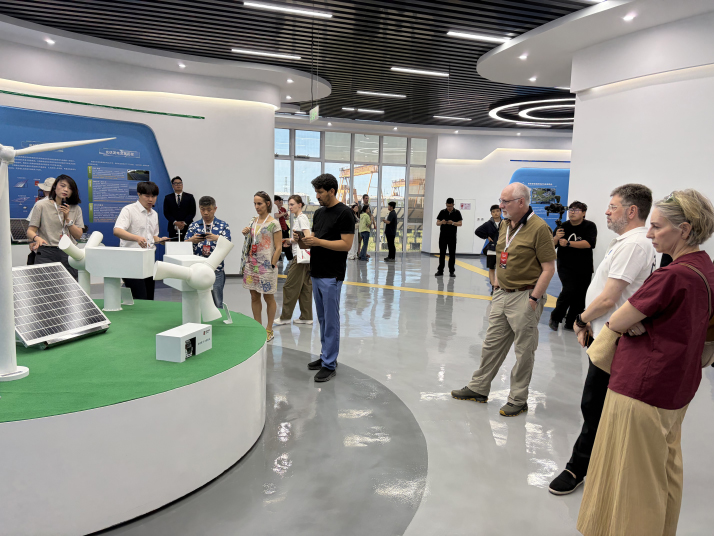 Members of an international delegation tour the State Power Investment Corp.'s Tacheng New Energy Innovation Industrial Park in Tacheng Prefecture on June 15 (ZHANG YAGE)
In June, an international delegation embarked on a week-long journey across Xinjiang, one of China's most culturally rich and geographically diverse regions.
The delegation brought together 16 experts from 12 countries—including the United States, France, Greece, Egypt, Russia, Malaysia, Belgium and Ireland—whose backgrounds spanned academia, journalism, public policy, the arts and the sciences. Over the course of a week, they visited Urumqi, Tulufan (Turpan) and Tacheng, touring heritage sites, community centers, agricultural projects, energy facilities and border ports. These visits were part of a trip organized by the China International Communications Group. What they discovered along the way is a region with a rich tapestry of traditions, where ancient wisdom meets modern innovation, and where ethnic integration is not merely a policy but a lived reality. 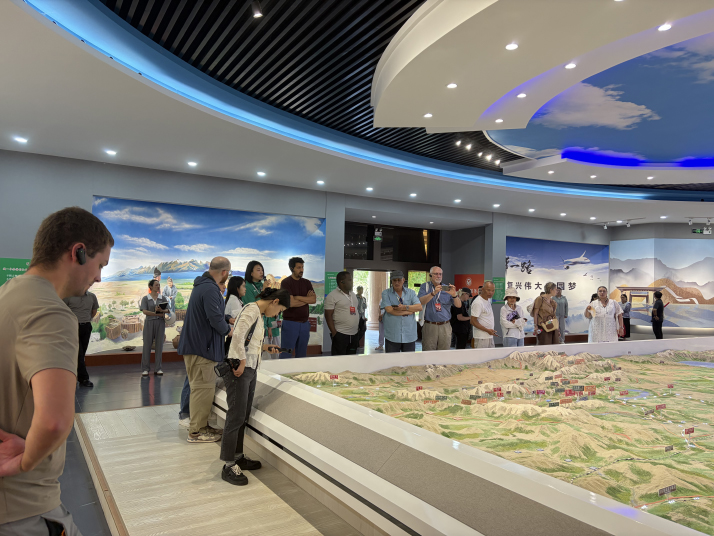 An exhibition hall at the Baketu (Baktu) Port in Tacheng Prefecture, a key gateway on the China-Kazakhstan border, on June 14 (ZHANG YAGE)
Ethnic integration The delegation visited Tacheng Prefecture, which sits in the northwest of Xinjiang, near the border with Kazakhstan. Historically, it was an important stop on the ancient Silk Road, where merchants and travelers from different lands would pause, trade and leave traces of their cultures behind. There, they met Zaitunna Kalimuva, a resident of Tacheng, and learned that the history of the region and of her ethnic group is reflected in the walls of her home, the recipes she prepares and the stories she tells. The delegation arrived at Yimanshu Manor, Zaitunna's family mansion, named after the century-old oak trees that shade its courtyard. The property was built in 1915 and has seen five generations of a Tatar family grow within its walls. In 2012, Zaitunna, a national-level inheritor of Tatar intangible cultural heritage, and her husband Refat Kalimuv began collecting and organizing more than 500 historical objects that had been used by their family for generations—tools, household items, photographs and documents that tell the story of daily life in this corner of Xinjiang. They converted the manor into a Tatar-style cultural center that combines a folk museum, a specialty restaurant and a workshop for traditional Tatar pastries. The Tatars are the smallest ethnic group in China, with a population of around 3,500 people. After visiting the manor, Joshua Dominick, an editor at the Center for China and Globalization, told Xinjiang Today, "It felt like coming home. My grandmother used to make pastries like these. This is a wonderful form of inheritance, whether at the family level or the ethnic level." In 2014, the manor was designated as a base for the promotion of cultural heritage in Xinjiang. In 2021, Tatar Traditional Pastry Making Techniques were added to the national-level representative list of intangible cultural heritage. The pastries have become a signature gift of Xinjiang, and the manor has become a must-visit destination for travelers to Tacheng who want to experience Tatar culture firsthand. "First, we received strong support from the government. They gave us tremendous support in protecting and passing on our culture," Zaitunna told Xinjiang Today. "Government departments always open publicity channels for us to promote our cultural heritage. At first, we thought it might cause inconvenience to our lives. But later, when we turned inheritance into an industry, we realized that publicity is indispensable. Our local government has worked hard to support us, helping more people find employment and allowing our products to reach farther. Now people across the country can purchase our pastries online, and our lives have become sweeter." Zaitunna said Tatar culture has drawn on influences of other ethnic groups in Xinjiang. "Tatar pastries and cuisine have incorporated elements from other Chinese ethnic cultures. We've also borrowed cultural elements from other countries and ethnic groups to make our flavors richer and more acceptable to modern tastes," she said. "Tatar costumes are also special. For example, our aprons and clothing are decorated with natural motifs—trees, vines, flowers and birds. Our ethnic group has loved pastoral culture since ancient times. That's why we focus on courtyard culture—we don't just do it, we bring it to life so people can experience it," Zaitunna added. "Despite our small population, our culture has been preserved intact. The state has documented and preserved our cultural heritage and supports us in celebrating our own festivals every year." From Yimanshu Manor, the delegation made their way to another Tacheng landmark: the Rose Manor, a family-run restaurant that embodies the spirit of ethnic integration around the family table. In Tacheng, many families have members from different ethnic groups. Halidan, the owner of the Rose Manor, is Uygur. Her eldest sister married a Tatar man, her another brother-in-law is Kazak, and she has a Han Chinese brother, Du Ronglu. Du came to Xinjiang from Shandong Province years ago looking for work. When he fell on hard times, Halidan's father took him in, and he has been part of the family ever since. "In Xinjiang, we have always lived in a pluralistic cultural setting," Halidan told Xinjiang Today. "My brother Du Ronglu came here alone. When he faced difficulties, my father brought him home. That is almost normal here. My neighbors come from multiple ethnic backgrounds too. When any of us celebrate our traditional festivals, we celebrate together." The family observes the traditions of all their members' cultures, celebrating the Spring Festival, Eid al-Fitr, and Mid-Autumn Festival together. When Halidan opened her restaurant, she filled the menu with the dishes she had learned from her multi-ethnic family gatherings. Her two daughters now study violin at the China Conservatory of Music in Beijing. "They will carry on all of our music too," she said. This spirit of ethnic integration extends beyond families and into community life—a reality the delegation witnessed when they visited Urumqi's Guyuanxiang Community. Established in July 2001 near the Erdaoqiao International Grand Bazaar, the community is home to people of multiple ethnic groups living and working together, and has become known for its service model focused on caring for the elderly and children. The community has established a senior care center, a children's activity center, senior musical groups, dance troupes and an intangible cultural heritage center. It has brought in partner organizations such as the Kunlun Academy, the Zhisource Social Service Center and an opera studio to offer classes in Chinese classics, calligraphy, painting, opera, dance, handicrafts and chess. Chris Oniya, a lecturer at the University of International Business and Economics in Beijing, told Xinjiang Today, "I think the community management model like that in Guyuanxiang is very effective. We see dedicated activity spaces for seniors and children, and all of these are free. It promotes friendship and harmony among neighbors." Mira Ahmed, a member of the World Sinologists Council and a Chinese-Arab literary translator, said after visiting the community, "I spoke with the children here—they are very lovely. They sang for us in Uygur and standard Chinese. They are very interested in passing on China's excellent traditional culture, such as the 24 solar terms. I think life here is very happy." Gulina Jumahan, a professor at Xinjiang University of Political Science and Management, offered a broader perspective on how community governance has supported ethnic unity and development. "The life of ethnic minorities in Xinjiang has changed so much over the past few decades, and they are able to live in peace largely because the government follows a people-centered approach," she told Xinjiang Today. "For example, I am Kazak. Locals in my father's generation were herders who had to move with the seasons—a very tough way of life. But local governments have gone to great lengths. Village and township governments assign people to accompany herders throughout their seasonal migration. Along the difficult routes, they've set up many service stations for supplies and medical care. My relatives live in remote mountains, some in places so isolated you can hardly imagine. Yet even on those mountaintops, there are service stations with electricity and water. This was unthinkable in my grandparents' time, or even my father's generation. In the Altai Mountains, there are service stations especially for herders. That shows how meticulous the public services are. So, to answer the question of why we live in such a good era—good governance is the reason. And the guiding principle of that governance is people-centered, detailed and deep. As a descendant, I feel very fortunate and grateful." Music, too, has become a language of unity. Tacheng's accordion museum, the largest of its kind in China, houses 1,151 instruments from around the world. The collection traces the evolution of the accordion from early hand-cranked organs to modern electronic models, displayed alongside immersive audio-visual exhibits and interactive installations. In 2016, Tacheng set a Guinness record for the world's largest accordion ensemble with 1,517 musicians playing simultaneously; in August 2025, the city broke its own record with 5,282 performers. The museum was certified by Guinness World Records as the world's largest accordion museum in 2023 and joined the International Accordion Museum Alliance the same year. Alexandros Modiano, former Vice Mayor of Athens, reflected on the museum's deeper meaning after his visit. "An instrument is more than a thing. It is a social relationship crystallized into wood, metal and air. And what has been crystallized in the accordion is one of communities gathered together, of music made for and by everyone, and of culture as a common inheritance rather than a private luxury," he told Xinjiang Today. Modiano drew a parallel between the accordion and what he saw elsewhere in Tacheng, including the Tacheng Red Mansion Museum, a rust-red, Russian-style building constructed in 1910 by a Tatar merchant from Russia. "What I really like in Tacheng is that under one roof you can have a little bit of everything—a panorama, an idea, the taste of the various traditions, and the various cultures that do not only coexist but also build on one another. The very fact that this building is used to shelter all those cultures is a sign by itself. We learned about the history of this building, which encompasses more than a century of local history. And then we see how the various ethnic groups contribute to something that's more than the total of the various elements," Modiano added. Regional specialties During the journey, delegation members discovered how Xinjiang's location and climate have shaped unique strengths across the region. In Tulufan, the desert heat that greeted them has given rise to both ingenious water systems and thriving agriculture. The Karez irrigation system, a network of underground channels that brings glacier meltwater from the Tianshan Mountains to the Tulufan Basin, is a testament to the region's long history of human ingenuity. The Tulufan Karez Paradise, established in March 1992 by the Xinjiang Karez Research Association, has become a major tourist destination. It was designated a national water scenic area by the Ministry of Water Resources in 2006, a national 4A-level (the second highest level) tourist site in 2010, and a national water education base in 2019. Since its establishment, it has received over 12 million visits. The main attractions include three Karez wells, with over 100 meters of underground tunnels and five vertical shafts open for public viewing. The site also features a museum with dynamic Karez well models, cultural relics, photographs, and a visitor center designed to educate the public about this ancient form of water management. Marie Luce Chevalier, a researcher at the Chinese Academy of Geological Sciences, told Xinjiang Today, "It's all underground, with water coming from the Tianshan Mountains, about 60 km away. I can understand how difficult it is because the glaciers coming down the Tianshan carry a lot of rocks. They had to dig through those rocks, which is not easy. Some parts are 70 meters deep, and for 60 km, it is quite an achievement. But then they can prosper here in the basin. What impressed me most is how spontaneously the local people developed this, and how they've passed down this wisdom to modern times." The same desert climate that made the Karez system necessary also made Tulufan ideal for grape cultivation. In Xincheng Ximen Village, located on the western outskirts of Gaochang District, 153 of the village's 180 hectares of farmland are planted with grapes. The village has transformed its grape industry through improved cultivation techniques, efficient water-saving facilities and new grape varieties. Fresh grape sales increased from 420 tons in 2022 to 3,200 tons in 2024. Village enterprise output increased from 160 million yuan ($25 million) in 2022 to 224 million yuan ($32 million) in 2024, creating 123 jobs. Major projects include the Red Pomegranate E-commerce Incubation Base and an agricultural product processing workshop, with total investment of 21.9 million yuan ($3 million) supported by both Central Government departments and Hunan Province through paired assistance programs. Tudor Finneran, a columnist for news portal China.org.cn, told Xinjiang Today after trying the village's raisin products, "I've just tried five or six kinds of raisins. They're very delicious. The village has processing workshops and dedicated e-commerce livestreaming rooms for sales. I think this really makes good use of local advantages." Xinjiang's climate has also made it a natural laboratory for renewable energy. The State Power Investment Corp.'s Tacheng New Energy Innovation Industrial Park, built in partnership with Xi'an Jiaotong University, includes a 7,500-square-meter New Energy Innovation Research Institute, an indoor exhibition hall, and an outdoor exhibition area, featuring small-scale wind power demonstration zones and a photothermal-coupled catalytic hydrogen production experimental facility. Dermot Macgrath, an Irish entrepreneur and frontier technology investor, told Xinjiang Today, "There's lots of renewable potential [in Xinjiang] because of the topography—the mountains, the wind—that's the first thing. The second is large, wide-open areas and very hot sun." He said, "The most interesting thing is that China has single-handedly done one of the most important things for renewable energy: It has completely collapsed the price of solar panels, in a good way. Solar adoption globally has accelerated a lot faster because of these lower prices." Upon learning that the solar and wind farms he saw there can operate without being connected to the grid, he added, "Right now, particularly in the AI industry, there's a huge data center build-out. The main problem is electricity and connecting to the grid. So, when you have self-contained solar and wind farms paired with energy storage, you can essentially run and build data centers a lot faster without waiting for grid connections." Cementing the ties The delegation also visited the Baketu (Baktu) Port in Tacheng—a fitting stop for a tour that had traced Xinjiang's past, present and future. The Baketu Port, with over 260 years of trading history, was an important hub on the northern route of the ancient Silk Road. Today, it is being transformed through major infrastructure investment into a modern gateway for trade with Central Asia and beyond. The Baketu Port Clearance Capacity Enhancement Project (Phase I), located in the Pilot Development Zone, has a planned total investment of 180 million yuan ($27 million). Construction began in April 2023 and includes 12 buildings such as a service center and a border trade service center. Upon completion, inspection lanes will increase from three to 10, H986 advanced container scanning systems from one to three, and exit lanes from four to eight. The staging area will grow from 10,000 to 40,000 square meters, and annual cargo clearance capacity is expected to rise from 500,000 tons to 1 million tons. Phase II, with a total investment of 240 million yuan ($35 million), will further increase capacity from 1 million tons to 3 million tons per year, including new quarantine processing facilities, road construction and supporting infrastructure. The port operates on a "7×12" hour clearance schedule, with dedicated "green channels" for perishable goods. In the first half of 2025 alone, import and export cargo volume reached 354,000 tons, a 6.3-percent year-on-year increase, hitting a record high. Abdel Aziz Hamdi, a founding member of the Egyptian Sinologists Council, told Xinjiang Today, "I think the Baketu Port, and Xinjiang more broadly, plays a very important role in China's opening up, especially to Central Asia and Europe. We saw the history of the Baketu Port in the exhibition hall—it was an important part of the ancient Silk Road. Now, with modern smart logistics technologies and the support of the China-proposed Belt and Road Initiative, it can continue its historical mission. Egypt was once part of the Maritime Silk Road and is now also a Belt and Road partner. We very much hope to maintain this spirit of cooperation and mutual benefit between our two countries." From the oak-shaded courtyard of a Tatar manor in Tacheng to the bustling community centers of Urumqi, from the ancient underground irrigation channels in Tulufan to the modern wind and solar farms powering a new economy, delegation members have learned that Xinjiang's diversity is not just a matter of demographics—it is a living, breathing reality. It is reflected in the pastries passed down through generations, the children learning to sing in multiple languages, the herders receiving support in remote mountain pastures, and the traders moving goods across borders that have connected continents for centuries. They have gained a deeper understanding of a region where tradition and innovation, culture and commerce, and peoples of many backgrounds continue to weave a tapestry of shared life and shared future. (Print Edition Title: A Tapestry of Cultures) Comments to zhangyage@cicgamericas.com |
|
||||||||||||||||||||||||||||
|








